Tired of your mask fogging up your glasses? Consider LASIK

Face mask-related eyeglass fog: an annoying COVID-19 consequence
If you wear glasses and a face mask, you already know the frustration. You exhale, warm air escapes upward through the gap at the nose, hits your cold lenses, and within seconds your vision disappears behind a wall of fog. It happens at the worst possible moments – mid-conversation, while driving, or right when you need to focus on something important. The good news is there are practical ways to stop mask fogging glasses, and we will walk you through the best ones.
Before we get into solutions, it helps to understand why it happens. The warm, moist air from your breath needs somewhere to go. When your mask does not seal tightly around your nose bridge, that air travels upward and condenses on the cooler surface of your lenses. Fix the seal, and you fix most of the problem.
We have seen a large uptick in eyeglass wearers asking about LASIK for exactly this reason. They tell us that mask-related fogging has seriously impacted their ability to perform effectively and safely at work and in sports. For first responders, assembly line workers, and food service professionals, foggy lenses are not just annoying – they are a genuine safety concern.
Several workarounds can genuinely help. But for people tired of managing the problem every day, there is also a permanent solution. We will cover both – starting with the practical tips you can use right now, and finishing with why so many of our patients ultimately decided that temporary fixes were not enough.
COVID-19 also presents health challenges for contact lens wearers
The American Academy of Ophthalmology has long recommended that contact lens wearers take extra precautions during periods of heightened illness risk, advising many patients to switch to eyeglasses as a safer alternative. That guidance highlights something eye care professionals have known for years: contacts require frequent hand-to-eye contact, making them inherently riskier than glasses during any cold and flu season, not just a pandemic.
But here is the part no competitor seems to mention: glasses are not actually the safe, convenient endpoint that guidance implies. If you have been following the tips above, you already know glasses come with their own daily frustrations, and fogging is just one of them. Repositioning your frames, applying soapy water, adjusting your mask fit, and wiping lenses mid-task are all workarounds, not solutions. For first responders, assembly line workers, food service professionals, and anyone else who cannot simply pause to de-mist their lenses, these workarounds are more than inconvenient. They are a genuine safety concern.
That’s where LASIK comes in as the only permanent answer. Rather than choosing between the hand-to-eye risks of contacts and the fogging frustrations of glasses, patients who are good candidates for laser vision correction can eliminate the problem entirely. AAO guidance isn’t just a reason to put your contacts away temporarily. For many people, it is the nudge that makes them realize neither contacts nor glasses are the ideal long-term solution.
At Assil Gaur Eye Institute, our surgeons have performed over 100,000 vision correction procedures and offer a complimentary LASIK evaluation so you can find out whether you are a candidate. Freedom from glasses and contacts is not a workaround. It is an enviable outcome, and it is available to you.
What causes eyeglasses to fog up?
The quick answer is moist, warm air (same as when your car windshield fogs up). When you exhale, your breath is warm and filled with tiny droplets of water vapor. This moist, warm air rises toward the bridge of your nose and escapes from the top of the mask, landing on your cooler eyeglass lenses. Surface tension lets the droplets accumulate and spread into a thin film across your lenses, fogging them until the water eventually evaporates. Whether you use paper or cloth masks doesn’t seem to matter.
The physics behind the fog comes down to one key factor: temperature differential. Your exhaled breath sits at roughly 98°F, while your lenses – especially in air-conditioned rooms or cooler outdoor environments – are significantly colder. When that warm, humid air hits a cooler surface, it condenses almost instantly, just like a cold glass of water sweating on a warm day. The bigger the gap between your breath temperature and your lens temperature, the faster and thicker the fog forms.
Mask fit plays a major role here too. A well-fitted mask channels most of your exhaled air downward and outward through the fabric. A loose mask – particularly one that gaps at the nose bridge – acts almost like a funnel, directing a concentrated stream of warm, moist air straight up toward your lenses. This is why fogging tends to get worse as the day goes on: the mask loosens, the seal breaks down, and more air escapes upward. Understanding this mechanism is the first step toward actually solving the problem, whether through a better mask fit, a quick anti-fog trick, or a permanent solution like precision laser vision correction that eliminates the need for glasses entirely.
How to stop glasses fogging up with a face mask: 8 practical tips
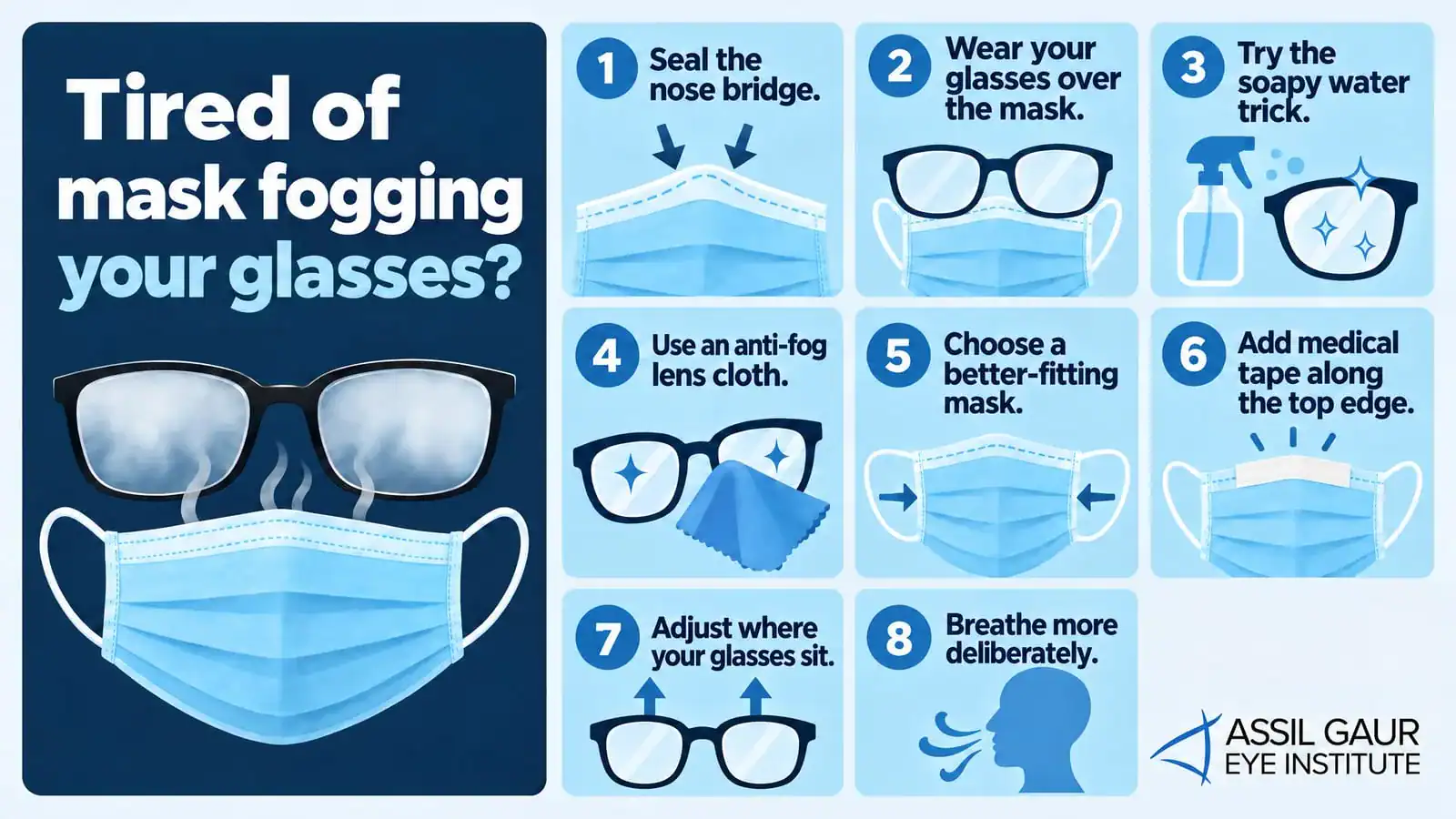
Now that you understand why fogging happens, let’s fix it. Warm, moist air escaping upward through gaps in your mask is the culprit, so every tip below targets that root cause in a slightly different way. Try a few in combination for the best results.
Seal the nose bridge. Most masks include a bendable wire along the top edge. Press it firmly against the bridge of your nose so air has nowhere to escape upward toward your lenses. This single step makes the biggest difference.
Wear your glasses over the mask. Pull the top edge of your mask up and rest your frames on top of it to create a physical seal. It looks a little unconventional, but it works surprisingly well.
Try the soapy water trick. Wash your lenses with a drop of dish soap, then let them air dry or gently buff them with a soft cloth. The thin soap film disrupts surface tension and prevents condensation from fogging up.
Use an anti-fog lens cloth. Pre-treated anti-fog cloths are widely available and easy to carry. A quick wipe before you head out can keep lenses clear for several hours.
Choose a better-fitting mask. Loose masks leak far more warm air than snug ones. A contoured shape or adjustable nose wire gives you much more control over airflow direction.
Add medical tape along the top edge. A small strip of skin-safe tape across the upper edge of your mask creates an airtight seal against your cheeks and nose, redirecting breath downward and away from your lenses.
Adjust where your glasses sit. Sliding your frames slightly forward on your nose creates a small gap that allows air to circulate and dissipate before it can condense on the lens surface.
Breathe more deliberately. Exhale slowly and direct your breath downward to reduce the volume of warm air rushing upward. It takes a little practice, but it genuinely helps during high-activity moments.
These tips can reduce fogging significantly, but they all require ongoing effort every single time you put on a mask. If you are tired of managing workarounds, laser vision correction eliminates the problem at its source by removing your dependence on glasses entirely. Contact us to schedule a complimentary LASIK consultation.
Eyeglass fogging can have serious consequences
Imagine you’re a first responder and have to jump out of your air-conditioned vehicle to address an urgent call. When you emerge from your cool rig, you get hit with the warm summer air and bang – your glasses fog up, hampering your ability to leap into action.
Or say you work on an assembly line doing precision work and your prescription glasses fog up, temporarily blocking your near vision. The same can apply to the barista preparing your coffee order, the line cook making your lunch, or the technician repairing your laptop. Anyone who does near work has had their productivity, not to mention their patience, affected by eyeglass fog.
Not all precision work is high-stakes, but eyeglass fogging can have serious consequences in jobs where you can get injured by machinery, get burned while preparing food, or injure others while performing personal health or beauty services.
Eye injuries are increasing in association with Face masks and Coronavirus
The American Academy of Ophthalmology reports an increase in eye injuries among construction workers and even people doing work around the house who forgo safety glasses because they fog up too much.
And then there’s the increased risk of contamination with Covid-19 from transferring coronavirus droplets onto your face when putting on glasses, adjusting the top of your mask, or repeatedly removing your glasses to clean them. While we don’t believe that such activity poses a real increased risk, it does seem to add to people’s anxiety during these strange times.
How much does face mask-related eyeglass fogging affect you?
At the end of the day, every eyeglass wearer has to decide how much of an impediment eyeglass fogging poses to their day-to-day functioning. If you don’t do near-vision tasks or participate in activities that require immediate, precise vision, and you’re willing to put up with constant fogging, you can rely on compensatory measures.
Fog-fighting efforts like wiping your glasses, taping the top of your mask to your face for a better seal, applying a film of soapy water or shaving cream to your glasses, or repeatedly applying anti-fog sprays to the lenses can be time-consuming and offer only short-lived results. Not to mention the hassle and risk involved in repeatedly touching your face.
If eyeglass fogging is more than a mild inconvenience and the resulting vision problems seriously affect your productivity or safety, or if you’re unwilling to live with the increased risk of COVID contamination that repeated face touching poses, you might want to consider a more permanent solution to reduce your dependence on eyeglasses.
Eliminate face mask eyeglass fog forever with LASIK
If you have worked through every tip on this page and are still pulling your glasses off to wipe them down mid-shift, you already know the truth: workarounds aren’t a solution. They are a tax you pay every single day for depending on glasses. For first responders, assembly line workers, food service professionals, and anyone else who cannot afford a foggy lens at the wrong moment, that tax is simply too high. The only way to stop mask fogging glasses for good is to stop wearing glasses altogether.
That is exactly what Eagle Vision LASIK at Assil Gaur Eye Institute was built to deliver. Our proprietary procedure, developed by world-renowned refractive surgeon Dr. Kerry Assil, uses state-of-the-art vision measurement technology to achieve a level of precision that frequently gives patients sharper, crisper sight than they ever experienced through their best pair of glasses or contacts. No lenses. No fog. No workarounds.
Elite athletes trust Eagle Vision LASIK for the same reason you should. LeBron James chose AGEI when he needed vision correction he could count on under pressure, and he is one of many NBA All-Stars who have experienced the freedom from glasses that our exclusive approach delivers. If world-class precision matters at that level of performance, imagine what it can do for your daily life.
Dr. Assil is regarded as one of the world’s foremost experts in refractive surgery, having trained over 14,000 eye surgeons worldwide, including his partner Dr. Avneet K. Sodhi Gaur. Together, their team has performed over 100,000 vision correction procedures, earning AGEI its reputation as Los Angeles’ premier ophthalmology practice and the destination for patients who want nothing less than the very best.
You have tried the soapy water trick. You have adjusted your mask a dozen times. You have repositioned your frames and fogged up anyway. There is a better answer, and it starts with a complimentary evaluation. Call 866-945-2745 or schedule your complimentary LASIK consultation online to find out whether Eagle Vision LASIK can give you the freedom from glasses you deserve, permanently.

Written by The AGEI Educational Team

Medically Reviewed by Dr. Kerry Assil