LASIK
What is Monovision LASIK?
Monovision LASIK targets presbyopia: age-related difficulty with your near vision. It can also address conditions like myopia or astigmatism, as well as the age-related stiffening of the eye’s natural lens that causes eye strain and leads most people to reach for readers in their 40s.
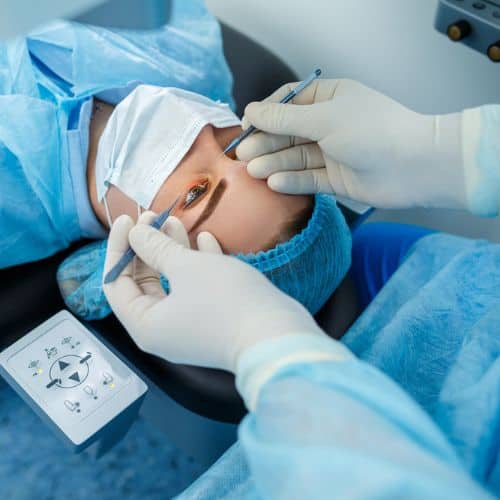
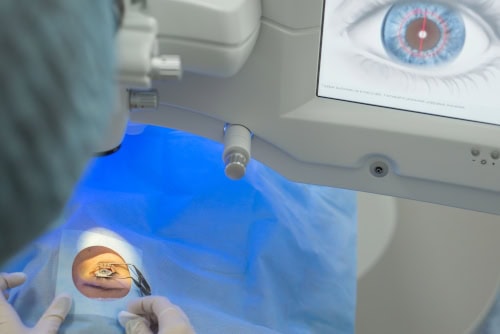
Monovision LASIK is a laser vision correction procedure that adjusts your two eyes differently: one eye is corrected for distance vision, while the other is set to address near-vision needs, such as reading.
Normally, your brain pays more attention to one eye at distance (the dominant eye) and the other at near (the non-dominant eye). After the Monovision procedure, your brain learns to favor your dominant eye even more for distance and your non-dominant eye for close-up. This gives your retina a clearer image for whatever you are looking at. The result? You can read a menu and then read a road sign without switching glasses!
Who is monovision a good option for?
Monovision tends to work well if you:
- Are in your 40s or beyond and are reaching for readers several times a day.
- Have healthy eyes but progressively worsening near vision.
- Want to reduce your dependence on glasses without a lens implant.
- Adapted well to monovision contact lenses in the past.
- Have realistic expectations—meaning you want excellent function rather than perfection at every distance.
It is a weaker fit if your work demands maximum depth perception at speed, such as certain flying and driving roles, or if fine detail at a fixed distance is central to your job. Our ophthalmologists will tell you plainly if that is the case.
Benefits and honest trade-offs of Monovision LASIK
One eye for distance and the other for closer vision may sound strange, but once you have the procedure, your brain does the rest, blending the image by selecting what it needs. This is much the way your brain makes sense of sound arriving at two ears. The result is functional vision across the range you actually use, with far less dependence on bifocals, reading glasses, contacts, or other corrective lenses.
Most monovision patients read comfortably, drive comfortably, and stop thinking about their eyes. The trade-off is real and worth stating; depth perception and night vision can feel slightly different because the two eyes do different jobs, and some patients still prefer glasses for long night drives or extended fine-detail work.
As with any LASIK surgery or laser procedure, temporary side effects can include dry eyes, light sensitivity, glare or halos, and fluctuating vision while the eyes heal. More serious complications are uncommon, and careful screening helps prevent them. Our surgeons will review the benefits, limitations, and alternatives with you before you decide anything.
At Assil Gaur Eye Institute, you get to try Monovision before you commit
Monovision suits most people who try it, but not everyone. The only honest way to find out is to experience it, not just read about it.
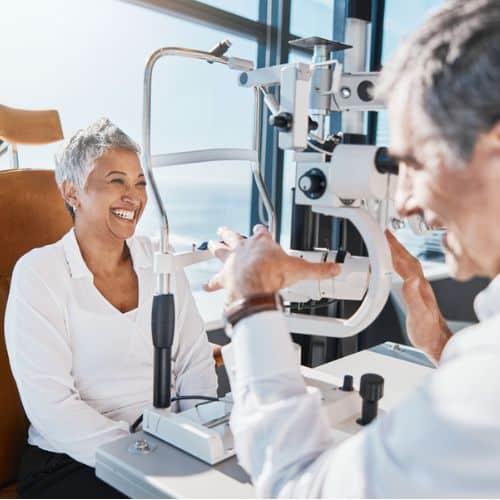
Our doctors simulate monovision in the office with trial lenses, so you can see what the blend feels like before scheduling anything. If you want longer simulation, we can fit you with contact lenses for a few days so you can drive, work, read, and watch television the way you normally would.
Some patients love it immediately. Some find the adjustment distracting and choose a different route. We would much rather learn that during a contact lens trial than after a procedure.
If monovision isn’t for you, that is not the end of the conversation. Refractive lens exchange (RLE), with multifocal or with extended depth of focus lenses, and full distance correction with readers for close work are all options our surgeons will walk you through.
SEE LIFE THROUGH OUR PATIENT'S EYES
REAL LASIK PATIENT STORIES




AGEI: surgical experience that is hard to match
Monovision is not a device you buy. It is a judgment call about how much near vision to trade for distance, in which eye, and by how much. That judgment and the treatment quality are what separate a result you forget about (because it becomes a seamless, natural part of your life) from one you think about all day (because there is continually something ‘off’).
Assil Gaur Eye Institute (AGEI) has been making that call in Los Angeles since 1949, when Dr. Robert M. Sinskey, the father of modern cataract surgery, chartered the institute. Our medical director, Dr. Kerry Assil, has performed more than 70,000 eye surgeries, trained more than 14,000 ophthalmologists and optometrists worldwide, and authored more than 100 scientific publications.
Dr. Assil began his career as an academic ophthalmologist, pioneering techniques and inventions in refractive surgery, and he developed both EAGLE Vision LASIK and EPIC PRK here at AGEI.
That matters for monovision specifically. Our laser planning runs on iDesign, the only wavefront system approved for monovision LASIK in presbyopic patients. Dr. Assil’s proprietary algorithms adjust the plan for your age, pupil behavior in different lighting, corneal shape, and how you actually spend your day. A retired teacher who reads books for hours and a contractor who drives job-to-job should not receive the same monovision target. At AGEI, they do not.
What our patients say
“Every morning, I am thrilled that they are not there.”
Marc, a Los Angeles attorney, spent more than 50 years in glasses before a refractive lens exchange with Dr. Assil. “I was blind. I couldn’t read any letters on the eye chart without my glasses,” he says. He now plays softball and tennis without them.
“Every morning, I still reach for my glasses on the nightstand. And every morning, I am thrilled that they are not there.”
“It was like plastic had been removed from my eyes.”
Larry consulted numerous eye doctors before finding AGEI, looking for what he called a final tune-up of his vision. “His attitude was so different from the other doctors I’d seen,” he says of Dr. Assil. “There’s a problem-solving mentality at AGEI to do something unique.
"I walked out of the surgery, and I could see wonderfully. It was like plastic had been removed from my eyes.”
“I’ve never had vision this crisp in my life.”
Dr. Klaus Ito, an optometrist, chose Eagle Vision LASIK at AGEI and now has 20/10 vision in each eye.
“That’s better than 20/20, I’ve never had vision this crisp in my life.”
Frequently asked questions about Monovision LASIK
Will I notice my eyes doing different things?
For the first days to weeks, possibly. Most patients adapt within a week or two. That is exactly what the in-office simulation and the contact lens trial are for, so you know your own answer before surgery rather than after.
Is monovision available with PRK as well as LASIK?
Yes. Monovision can be performed with EPIC PRK, our all-laser surface procedure, which is often the better choice if you have thinner corneas or have been told elsewhere that you are not a LASIK candidate.
Will monovision stop presbyopia from progressing?
No. Presbyopia continues as the natural lens stiffens with age. Monovision manages it well for years, and if your needs change later, refractive lens exchange remains available.
Can monovision be reversed or adjusted?
The near-vision eye can often receive enhancements later to bring it back toward distance. This is one reason our treatment planning preserves as much corneal tissue as possible.
Am I too young for monovision?
Patients under 40 usually do not need it unless treating other refractive errors like hyperopia (farsightedness) or being nearsighted, since the natural lens still focuses up close on its own. Monovision becomes relevant in the 40s, and more so around 45.
What if I try it and do not like it?
Then we do something else. That is the entire purpose of testing it first. Options include full distance correction with readers for close work, refractive lens exchange, and extended depth-of-focus lenses.
Done with reading glasses? Let’s talk
Monovision has given thousands of patients clear vision across the distances of an ordinary day, without reliance on glasses and contacts. The right way to find out whether it suits you is to try it, and that starts with a comprehensive evaluation.
Schedule your complimentary monovision LASIK consultation with our ophthalmologists. Call 866-945-2745 or request your appointment online.
Sources
-
The American Academy of Ophthalmology, What Is Presbyopia?
https://www.aao.org/eye-health/diseases/what-is-presbyopia -
The FDA’s guidance on LASIK
https://www.fda.gov/medical-devices/surgery-devices/lasik -
The National Eye Institute, Refractive Errors
https://www.nei.nih.gov/learn-about-eye-health/eye-conditions-and-diseases/refractive-errors
Schedule your monovision LASIK consultation now!

Written by The AGEI Educational Team

Medically Reviewed by Dr. Kerry Assil