What is eye astigmatism?
Astigmatism is a common eye condition in which light rays entering the eye cannot focus evenly on the retina, resulting in blurred vision.
Astigmatism is caused by an abnormally shaped cornea; when light rays pass through it, they bend (refract) before striking the retina, causing blurred vision. This phenomenon is known as a “refractive error”.
What causes astigmatism?
Astigmatism occurs when the cornea or lens inside the eye is irregularly shaped. Instead of having a smooth, round curvature like a basketball, the surface is more oval, like a football. This uneven shape prevents light from focusing cleanly onto the retina, scattering it across multiple points and producing the blurred or distorted vision that defines the condition.
Astigmatism is extremely common, affecting roughly 1 in 3 people to some degree. It also frequently coexists with myopia (nearsightedness) or hyperopia (farsightedness), meaning many patients manage more than one refractive error at the same time.
Although the exact cause of an abnormally shaped cornea or lens remains unclear, heredity seems to play a big role. It can be present at birth, but it can also appear later in life or develop after an eye injury or surgery.
Astigmatism: a refractive error

Refraction is the process of light being bent as it passes through an object. When light rays pass through your cornea and lens, they bend (or refract) before reaching the retina. Once the rays strike your retina, they’re converted into signals that travel through the optic nerve to your brain, where they’re decoded into the images you see. If the light rays aren’t evenly focused on the retina, you get blurred or distorted vision.
Astigmatism is one type of refractive error, but others include myopia (nearsightedness), in which distance vision is blurred, and hyperopia (farsightedness), when near vision is blurred. In astigmatism, your vision is blurred or distorted to some degree at all distances.
Astigmatism symptoms
Many people with astigmatism don’t realize that they have it because, often, the symptoms come on gradually. And children born with astigmatism often go undetected until their performance in school or sports reveals a vision problem. At any age, monitor eye health with an annual eye exam and tell your eye doctor about any changes you notice in your vision.
Astigmatism symptoms include:
-
Headaches
-
Eyestrain
-
Squinting in order to see clearly
-
Distorted or blurred vision at all distances
-
Difficulty seeing at night
If you experience any of these symptoms, please contact your eye doctor.
When should you see a doctor about astigmatism?
Now that you know what astigmatism symptoms look like, the natural next question is: when do those symptoms actually warrant a trip to the eye doctor? The honest answer is sooner than most people think. Because astigmatism develops gradually, it is easy to adapt to blurry or distorted vision and assume it is just normal tiredness or screen fatigue. Don’t wait it out.
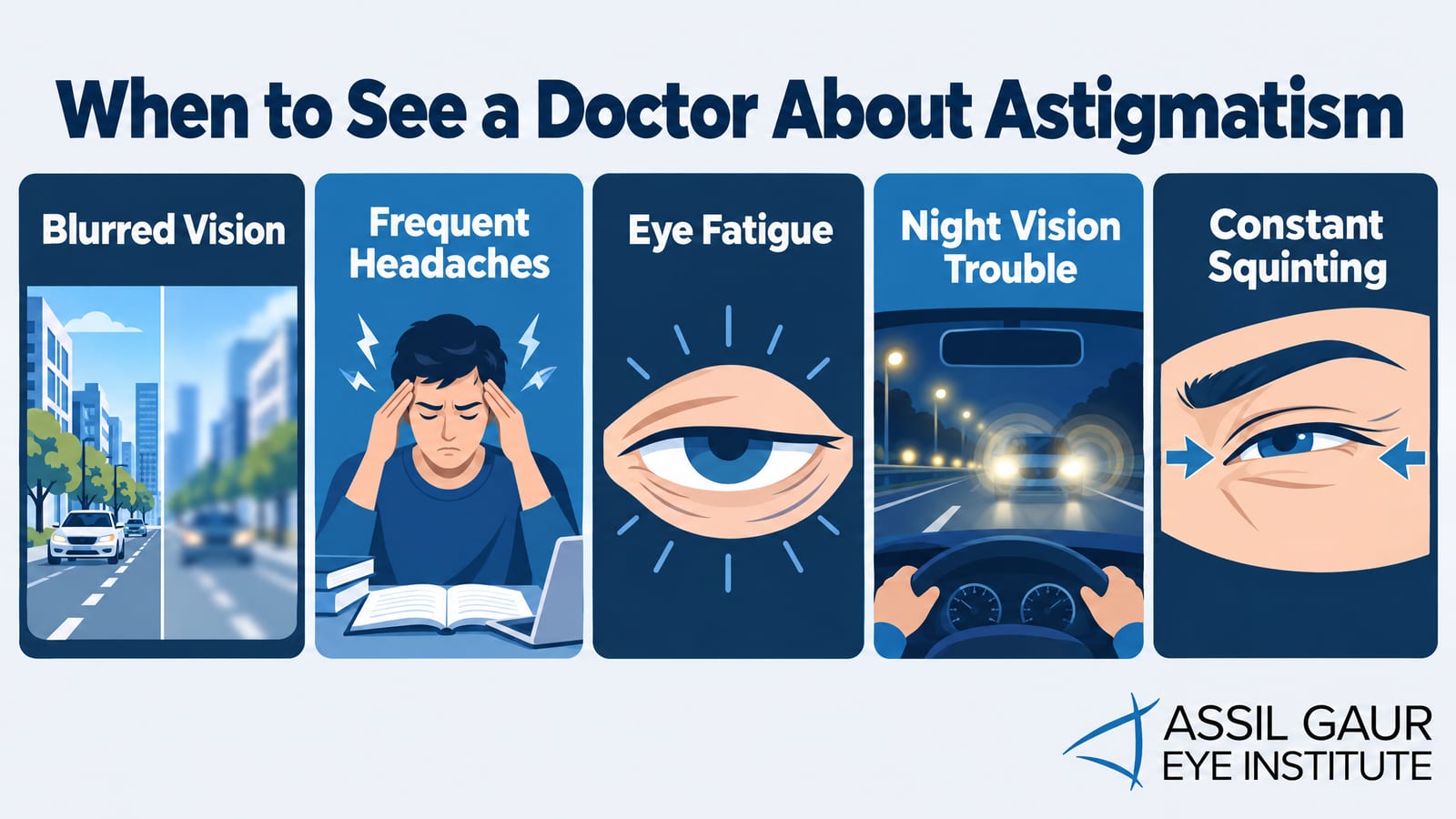
Schedule a comprehensive eye exam if you notice any of the following:
-
Blurred or distorted vision at any distance that does not clear up on its own
-
Frequent headaches, especially after reading or screen time
-
Eyestrain or eye fatigue that feels disproportionate to your activity level
-
Difficulty seeing clearly at night or while driving after dark
-
Squinting to bring objects into focus
For children and adolescents, the stakes are even higher. Kids rarely report vision problems because they assume everyone sees the world the way they do. Undetected astigmatism in children can contribute to academic struggles, difficulty reading, and in some cases amblyopia (lazy eye). Pediatric eye exams are recommended starting at six months, again at age three, and before entering school. After that, annual exams are the gold standard.
Adults should have a comprehensive eye exam at least every two years, or annually if you already wear glasses or contacts. If you are curious about advanced vision correction options beyond corrective lenses, a complimentary evaluation at Assil Gaur Eye Institute is a great place to start the conversation.
Types of astigmatism
Corneal astigmatism
In a normal eye, the cornea is round like a baseball and fairly symmetric, so light rays bend the same way no matter where they enter. With corneal astigmatism, the cornea is football-shaped, so light rays bend in different directions depending on where they enter the cornea, causing images to appear blurry or distorted.
There are two subtypes of corneal astigmatism:
Regular astigmatism
Regular astigmatism is the most common type, where the front surface of the eye has an oval shape
Irregular astigmatism
Irregular astigmatism is caused by corneal scarring from injury or surgery, or from keratoconus – a disease-causing gradual thinning of the cornea
Lenticular astigmatism
Sometimes, astigmatism isn’t caused by a deformed cornea but by a distorted lens shape that bends light rays abnormally and scatters them before they reach the retina. Vision correction for lenticular astigmatism usually involves prescription eyeglasses with corrective lenses that compensate for the degree of astigmatism present.
Schedule your consultation today with our internationally recognized ophthalmologists
Astigmatism risk factors
Your risk of developing astigmatism may be higher if you have:
-
A family history of astigmatism or other eye conditions, like keratoconus
-
Scarring or thinning of your cornea
-
Extreme nearsightedness
-
Extreme farsightedness
-
Prior eye surgery
Can astigmatism be prevented?
Now that you know the risk factors behind astigmatism, a natural follow-up question is whether you can actually do anything to stop it from developing. The honest answer is that most cases of astigmatism cannot be prevented. If the condition is present from birth or tied to your genetics, no lifestyle change or habit will keep it from showing up.
That said, you can do a few things to protect your eye health and potentially reduce the risk of astigmatism worsening over time. Wearing UV-protective sunglasses is a smart habit, since prolonged sun exposure is linked to conditions like pterygium that can distort the cornea and contribute to astigmatism. Avoiding eye rubbing is also worth mentioning, as chronic, vigorous rubbing has been associated with keratoconus, a progressive corneal condition that causes significant irregular astigmatism.
Routine eye exams are your best tool here. Catching astigmatism early, especially in children, means you can manage it before it affects learning, development, or quality of life. The American Optometric Association recommends regular comprehensive eye exams for all ages, and that advice holds especially true if you have a family history of refractive errors.
While prevention may not always be possible, world-class vision correction absolutely is. Whether your astigmatism is mild or significant, advanced treatment options exist to give you clear, comfortable vision and enviable outcomes you can count on.
How is astigmatism diagnosed?
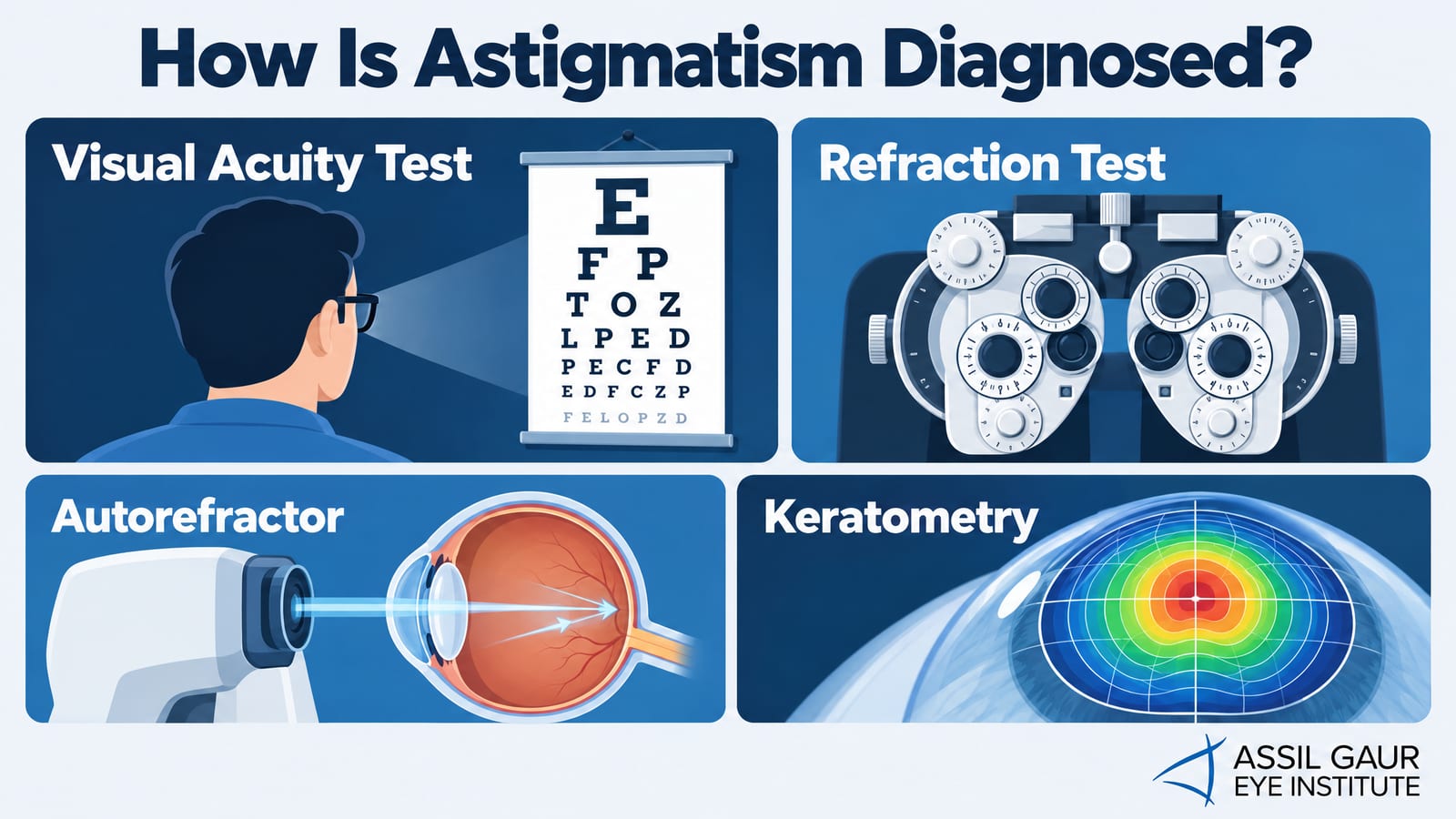
A detailed eye exam diagnoses astigmatism. At AGEI, we use state-of-the-art technology and time-proven traditional tools to assess your vision. Your eye exam can include:
-
Visual acuity test: Your doctor may start by asking you to read letters from a chart at a distance to determine how well you can see with each eye.
-
Refraction test: Your doctor asks you to look through a machine (optical refractor) while inserting different-strength lenses to determine the precise prescription that corrects your vision. This test is usually performed to fit you for glasses.
-
Autorefractor: To determine your prescription by sending a beam of light into your eye and measuring how the light wave changes as it bounces off the back of the eye.
-
Keratometry: Measures the slope and curvature of your cornea, in other words, its topography.
Call now or book your appointment online.
Non-surgical astigmatism treatments
For patients who aren’t ready for surgery, or who prefer to manage their astigmatism without a procedure, several effective non-surgical options are available. The right choice depends on your prescription strength, lifestyle, and how much correction you need day to day.
Eyeglasses
Prescription eyeglasses remain the most straightforward way to correct astigmatism. Lenses are ground with a cylindrical curve that compensates for the uneven shape of your cornea or lens, bending incoming light so it focuses correctly on the retina. For mild to moderate astigmatism, a well-fitted pair of glasses can deliver clear, comfortable vision throughout the day. They are also the easiest option to adjust as your prescription changes over time.
Rigid gas permeable (RGP) contact lenses
Rigid gas permeable lenses are made of a special plastic that does not mold to your eye; instead, they provide a corrective lens that bends light rays correctly as they enter your eye. Because the lens holds its shape over the eye, it effectively replaces the irregular corneal surface with a smooth, uniform refracting surface, which can produce sharper vision than soft lenses for higher degrees of astigmatism. Unfortunately, because they are stiffer and thicker than soft lenses, some people have difficulty getting used to RGP lenses.
Toric soft lenses
Toric soft lenses are by far the most popular contact lens solution for astigmatism. They are designed to match the shape of your eye and provide balanced, clear vision across the different prescription zones. At AGEI, we offer several toric soft lens options.
Orthokeratology (Ortho-K)
Orthokeratology, often called Ortho-K, uses specially designed rigid lenses that you wear overnight while you sleep. The lenses gently reshape the front surface of the cornea so that, when you remove them in the morning, you can see clearly throughout the day without glasses or contacts. The effect is temporary and reversible, meaning the cornea gradually returns to its original shape if you stop wearing the lenses. Ortho-K is a particularly appealing option for active patients, athletes, or those who find daytime contact lens wear uncomfortable. It is also used to help slow the progression of myopia in younger patients who have astigmatism alongside nearsightedness.
Choosing between glasses and contacts
Glasses are generally the simplest, lowest-maintenance choice, especially for patients with higher or irregular astigmatism, where fitting contacts can be more complex. Contact lenses offer a wider, more natural field of view and are preferred by patients with active lifestyles. RGP lenses tend to deliver the sharpest correction for significant astigmatism, while toric soft lenses prioritize comfort and convenience. Ortho-K sits in a category of its own, offering daytime freedom without surgery. During your complimentary evaluation at AGEI, our team will review your prescription, corneal shape, and daily habits to help you choose the option that best fits your life.
Surgical astigmatism treatments
Refractive surgery options for astigmatism
Refractive surgery is any surgery designed to improve your ability to focus light correctly on the retina, decreasing your dependence on glasses or contact lenses. This can take the form of laser procedures or artificial lens implantation. The right approach depends on the severity of your astigmatism, your corneal thickness, and your overall eye health – and our surgeons will walk you through every option at your complimentary evaluation.
PRK / LASIK for astigmatism
Traditionally, refractive laser surgery has used LASIK (laser-assisted in situ keratomileusis) for mild astigmatism or PRK (photorefractive keratectomy) for more severe astigmatism.
At AGEI, we offer Eagle Vision, a step beyond iDesign and Contoura Vision. Using the latest LASIK technology, Eagle Vision creates a detailed map of your entire eye (cornea and additional layers) to customize your laser treatment, often providing better vision than you ever had with glasses or contacts. On average, Eagle Vision surpasses the best eyeglasses prescription.
Elite athletes who depend on precision vision at the highest level trust Eagle Vision. NBA legend LeBron James chose Eagle Vision LASIK for his astigmatism correction – and the results speak for themselves. When you are performing at the top of your game, you need world-class vision correction, and Eagle Vision delivers exactly that. It is the same advanced, exclusive procedure available to every patient who walks through our doors.
Learn more about LASIK surgery and AGEI’s Eagle Vision™
Lens implantation (IOL) for astigmatism
This surgery places a permanent prescription optical lens (IOL) inside your eye, in front of your natural lens, to correct your astigmatism. This is an option for folks with severe astigmatism who wish to be free of glasses or contact lenses and who have been told that they are not good candidates for LASIK surgery.
Toric intraocular lenses (IOLs for short) have different powers in different zones of the lens, allowing them to correct the asymmetric power in an astigmatic eye. If you need cataract surgery and have astigmatism, you can replace your natural lens with a toric IOL that corrects your astigmatism at the same time, giving you premium, full-range vision without the ongoing need for corrective lenses.
Learn more about IOLs
Limbal relaxing incisions (LRI)
Limbal relaxing incisions are partial-thickness incisions made at the outer edge of an astigmatic cornea in order to flatten its steep curvature into a rounder shape. This improves vision and can reduce or eliminate the need for distance glasses.
LRI is sometimes performed during cataract surgery or intraocular lens implantation for people with mild to moderate astigmatism. At AGEI, we perform this procedure using a Femtosecond laser to ensure that the relaxing incisions have the precise depth and length needed to safely correct your astigmatism.
The Femtosecond laser gives our surgeons a level of precision that manual blade techniques simply cannot match. Each incision is planned digitally and executed with sub-micron accuracy, leading to more predictable outcomes and faster recovery for you.
Arcuate keratotomy for astigmatism
Arcuate keratotomy (AK) is closely related to LRI but involves incisions placed slightly closer to the center of the cornea, within the optical zone. Because these incisions sit closer to where light enters the eye, they can produce a stronger corrective effect and are often chosen for patients with moderate to high corneal astigmatism. Like LRI, AK can be performed as a standalone procedure or combined with cataract surgery and IOL implantation to address astigmatism at the same time as the primary procedure. At AGEI, arcuate keratotomy is guided by advanced corneal mapping data, ensuring that every incision is placed with the same world-class precision our patients expect.
What surgical astigmatism correction is best for me?
The best surgical approach depends on several factors, including your eye health, prescription, eye shape, lifestyle, and preferences. All of these procedures are safe and provide clear vision for many of our patients.
AGEI offers no “one-size-fits-all” options. It depends upon your eyes, your lifestyle, and your goals. If we believe surgery isn’t the best approach for you, we will tell you. That’s what we would want a surgeon to tell us before we undergo any procedure. And treating our patients the way we would want to be treated is one of the core tenets of our practice. Period.
The AGEI care difference
Assil Gaur Eye Institute’s dedication to providing the best eye care available is what motivates us to strive for the highest standards of excellence in your eye health.
AGEI utilizes the most advanced surgical techniques and technology available today to offer our patients the best possible vision outcomes in the safest manner.
Call now or book your appointment online.
Frequently asked questions about astigmatism
Can astigmatism get worse over time?
It can, yes. Astigmatism often changes gradually, particularly during childhood and adolescence when the eye is still developing. In adults, it tends to be more stable, though conditions like keratoconus can cause it to progress more rapidly. Regular eye exams are the best way to catch any changes early and adjust your correction accordingly.
Is astigmatism hereditary?
Genetics do play a role. If one or both of your parents have astigmatism, you have a higher chance of developing it yourself. That said, it can also appear with no family history, so it is worth having your children’s eyes checked even if no one else in the family wears glasses.
Can LASIK fix astigmatism?
In most cases, yes. Advanced laser vision correction like Eagle Vision LASIK is highly effective at correcting astigmatism by precisely reshaping the cornea. Many patients achieve vision that actually surpasses what their best glasses prescription could deliver. Patients who are not ideal LASIK candidates may be better suited to PRK, LASEK, or implantable contact lenses instead.
Can you have astigmatism and nearsightedness at the same time?
Absolutely. Astigmatism very commonly occurs alongside nearsightedness or farsightedness. The good news is that most surgical and non-surgical treatments address all of these refractive errors together in a single correction. A complimentary evaluation at Assil Gaur Eye Institute will give you a precise picture of your full prescription and the best path forward.

Written by The AGEI Educational Team

Medically Reviewed by Dr. Kerry Assil