Brow lift, browpexy, or blepharoplasty, which do you need?
If you have been told you need eyelid surgery, there is a real chance that what you actually need is a brow lift – or a procedure most people have never heard of called a browpexy. That confusion is not your fault. The anatomy of the upper face is interconnected in ways that make self-diagnosis genuinely difficult, and most online resources treat these three procedures as simple alternatives when the clinical reality is far more nuanced.
If you are researching upper-face rejuvenation and feeling overwhelmed by overlapping procedure names, this guide will cut through the noise. You will learn exactly what each procedure does, who it is right for, and how a specialist decides whether you need one, two, or all three. Specifically, you will leave understanding why brow position changes everything about an eyelid surgery outcome, what browpexy is and when it replaces or accompanies blepharoplasty, and what the clinical decision process actually looks like in a specialist’s hands.
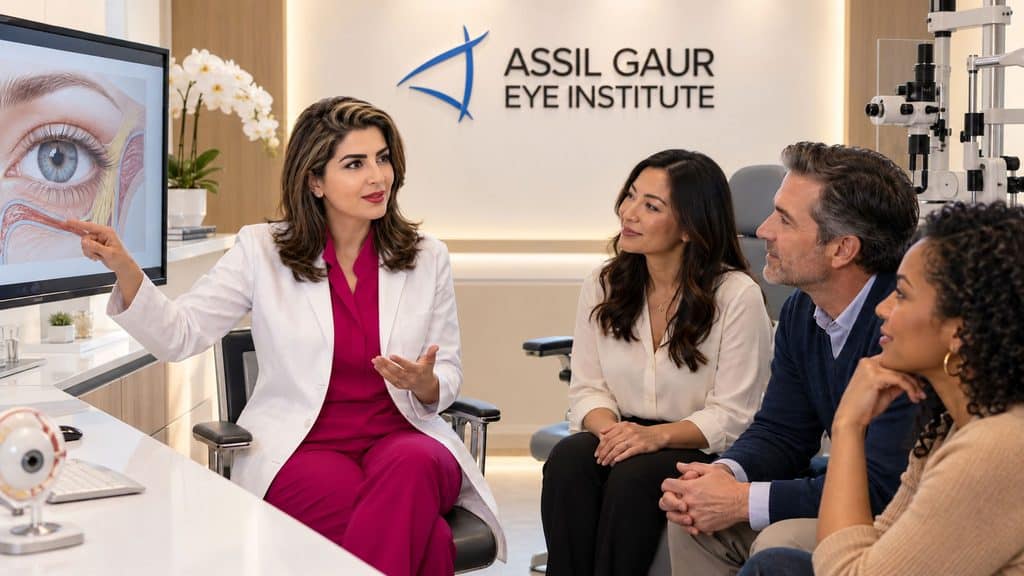
If you are already considering a consultation, our oculoplastics and aesthetic eye procedures program at Assil Gaur Eye Institute is led by a fellowship-trained specialist who performs this exact evaluation every day.
Why so many patients research the wrong procedure first
Most patients arrive at a consultation having already decided they need eyelid surgery. They notice heaviness over their eyes, a tired appearance, or excess skin folding over the upper lid – and they search for “eyelid lift.” That search leads them to blepharoplasty, and they stop there.
The problem is that drooping skin on the upper eyelid is not always caused by the eyelid itself. When the brow descends below its natural position – a condition called brow ptosis – it pushes soft tissue downward onto the lid, creating the appearance of excess eyelid skin. Removing that skin through blepharoplasty without addressing the brow is like mopping the floor while the tap is still running. The result looks better temporarily, but the underlying cause remains.
This is the most consequential diagnostic error in periorbital rejuvenation. An experienced oculoplastic surgeon evaluates brow position before recommending any eyelid procedure, because the brow is the structural foundation everything else rests on.
What happens if you get blepharoplasty when you actually need a brow lift?
If a surgeon performs blepharoplasty on a patient whose primary problem is brow ptosis, they may have to remove more skin than is anatomically ideal to create visible improvement. This can pull the brow down further over time, accelerate the appearance of aging, and in some cases compromise the patient’s ability to fully close the eye. The outcome may look acceptable at first but tends to deteriorate faster than a correctly planned procedure. In our experience at Assil Gaur Eye Institute, patients who come to us after an unsatisfying result elsewhere frequently have this exact mismatch between diagnosis and treatment.
What browpexy actually does – and how it is different from a brow lift
Browpexy is a surgical technique that stabilizes the brow by anchoring the soft tissue of the brow to the periosteum – the fibrous layer covering the bone of the orbital rim – using sutures placed through a small incision. It does not reposition the brow dramatically upward. Instead, it prevents further descent and provides a modest lift, typically 2 to 4 millimeters, which is enough to restore a natural resting position in patients with mild to moderate brow ptosis.
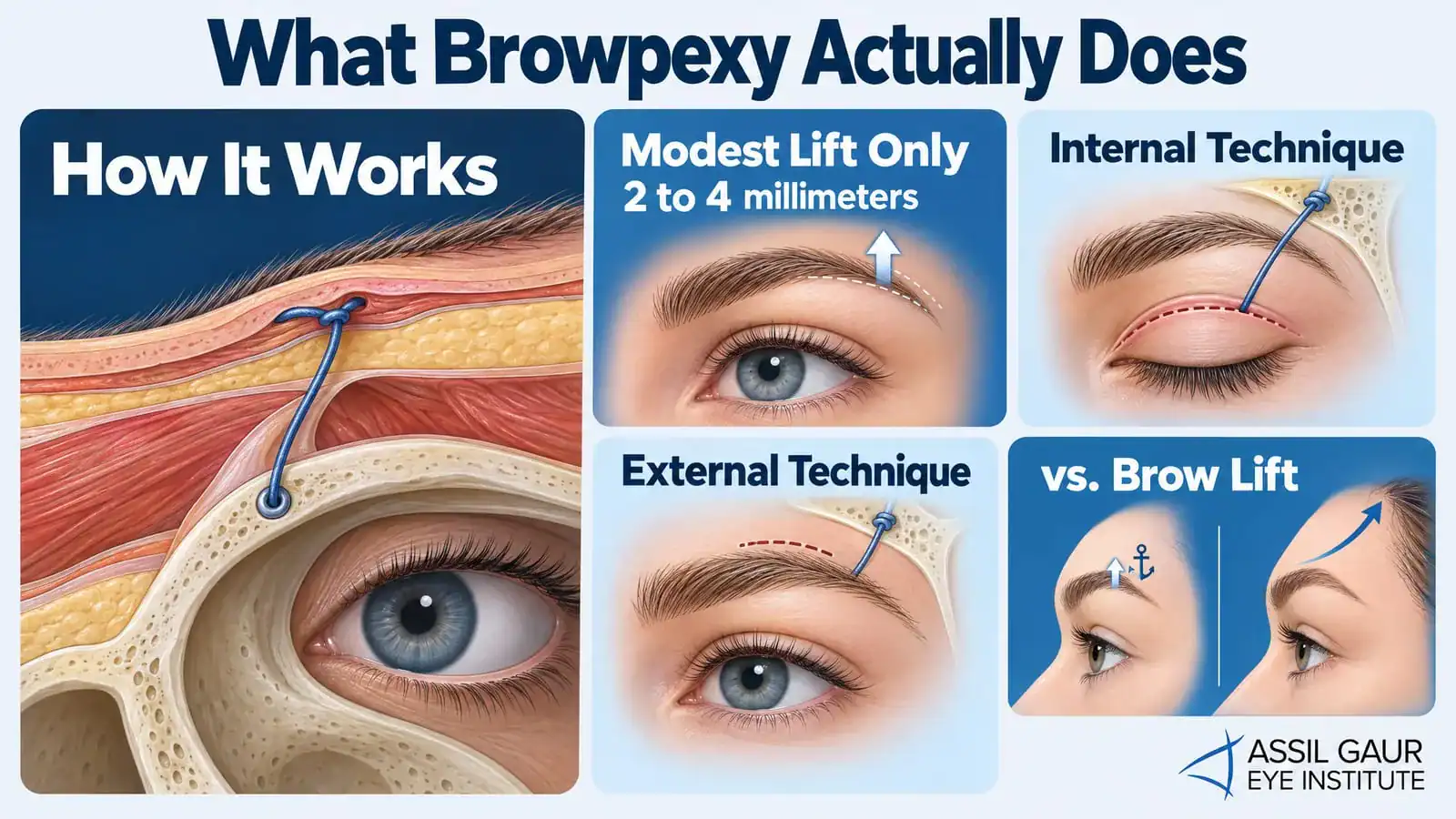
There are two main techniques: internal browpexy and external browpexy. Internal browpexy is performed through the same upper eyelid crease incision used for blepharoplasty, making it invisible and adding minimal additional recovery. External browpexy uses a small, separate incision just above the brow, allowing slightly more precise suture placement and potentially a marginally greater lift, but leaving a small scar that must be concealed within the brow hairs. A published comparison in PubMed-indexed research has confirmed that both techniques produce durable results, with the choice depending on the degree of ptosis and the surgeon’s assessment of what the anatomy will support.
The key distinction from a brow lift is scope. Browpexy is a stabilization and minor repositioning procedure. A brow lift is a repositioning and tissue elevation procedure that addresses the entire forehead and brow complex.
Is browpexy less invasive than a brow lift?
Yes, significantly. Browpexy involves suture fixation through a small incision, with no tissue removal or forehead dissection. A brow lift – whether performed endoscopically, through a coronal incision, or via a direct approach above the brow – requires elevation of the forehead tissues, release of the muscles that pull the brow down, and fixation at a higher position.
Brow lifts involve greater surgical complexity, longer recovery time, and a higher risk of visible scarring. Browpexy is the right choice when brow descent is mild, and the patient’s primary concern is eyelid skin excess that coexists with early brow laxity.
Brow lift vs blepharoplasty: understanding what is drooping and where
Blepharoplasty addresses dermatochalasis – the medical term for excess, redundant skin of the upper or lower eyelid. It removes or redistributes skin, muscle, and sometimes fat from the eyelid itself. The incision is placed in the natural upper eyelid crease, making the scar essentially invisible once healed. Blepharoplasty does not lift the brow. It does not address forehead laxity. It works only on the eyelid tissue below the brow.
A brow lift – also called a forehead lift – addresses descent of the brow and forehead complex. The endoscopic brow lift, the most commonly performed modern technique, uses several small scalp incisions and a camera to release and reposition the forehead tissues without a long scar. A direct brow lift places the incision immediately above the brow and is typically reserved for patients with very heavy brows or those who are not candidates for endoscopic surgery. A brow lift results in an elevated, more open brow position that changes the entire upper-face frame.
The American Society of Ophthalmic Plastic and Reconstructive Surgery (ASOPRS) recognizes oculoplastic surgery as the subspecialty specifically trained to evaluate and treat conditions of the eyelids, brow, and orbit – a distinction that matters when the diagnosis requires understanding how these structures interact rather than treating each in isolation.
How do I know if I need a brow lift or eyelid surgery?
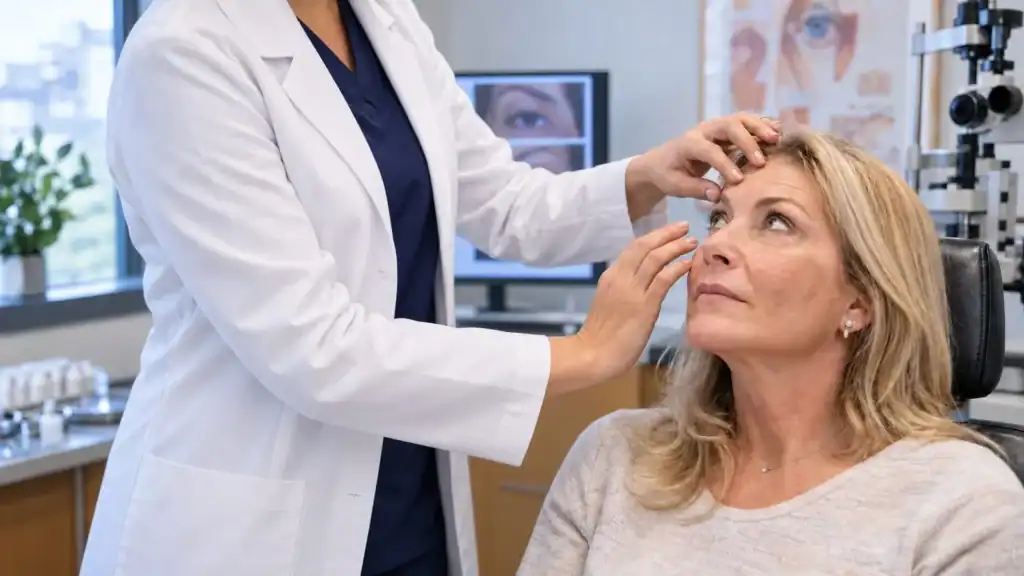
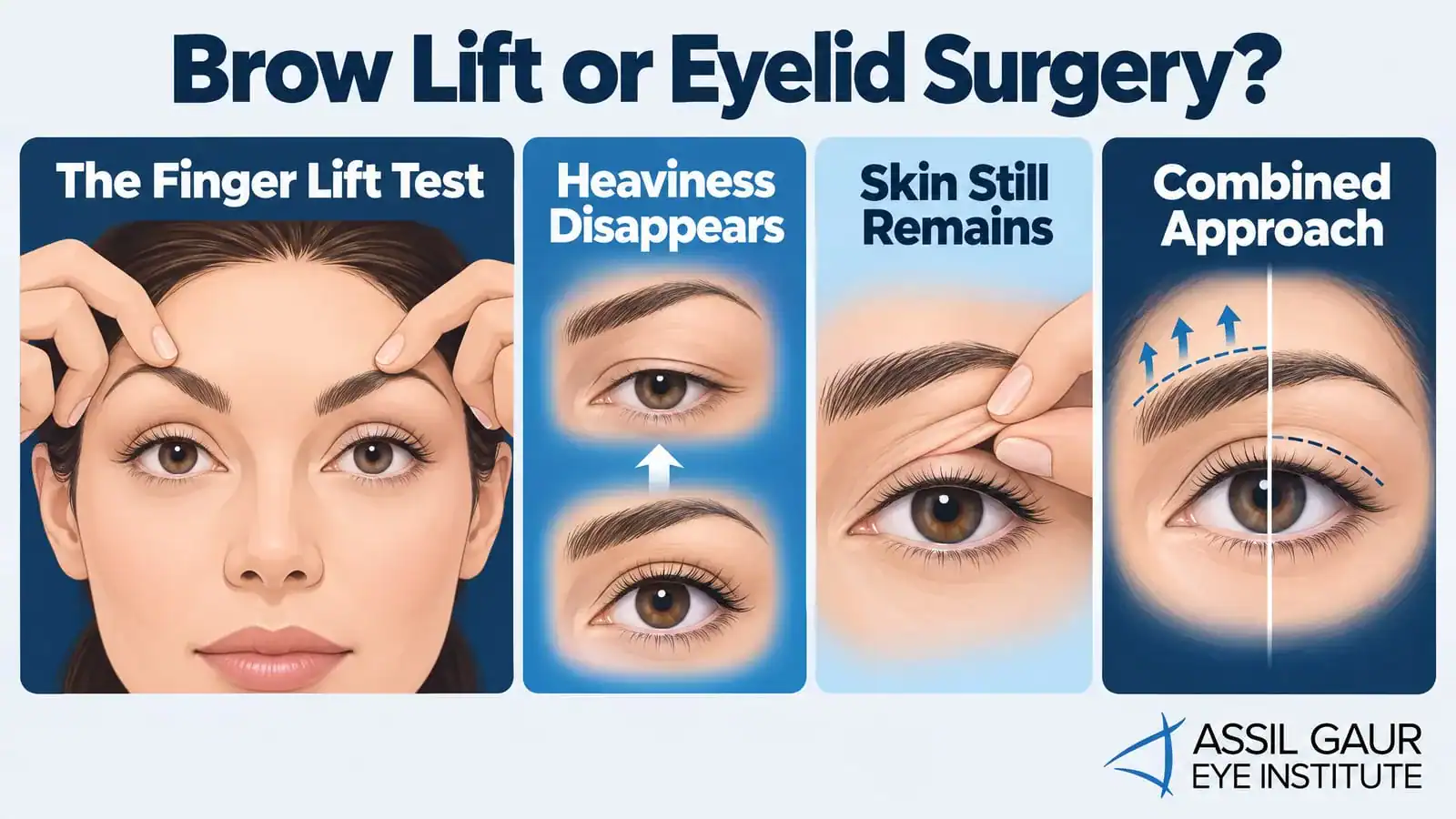
A simple clinical test helps clarify this: place your fingertips gently on your brow and lift it to where it sat when you were younger. If the heaviness over your eyes largely disappears when you do this, brow position is the primary driver of your concern, and a brow lift or browpexy is likely the more appropriate first intervention. If significant excess skin remains on the eyelid even with the brow held up, blepharoplasty is indicated – either alone or in combination. This test is not a substitute for a specialist evaluation, but it gives you a useful starting point before your consultation.
The clinical decision tree: how an oculoplastic surgeon chooses between all three
When a patient presents for periorbital rejuvenation, a trained oculoplastic surgeon works through a structured assessment before recommending any procedure. The evaluation begins with brow position: is the brow sitting at, above, or below the orbital rim? In women, the ideal brow position typically arches slightly above the rim; in men, it sits at or just above it. Any descent below these landmarks signals brow ptosis that must be factored into the treatment plan.
Next, the surgeon assesses the eyelid on its own. With the brow manually held in its correct position, how much excess skin remains on the upper lid? Is there fat prolapse contributing to fullness? Is there true ptosis of the eyelid itself – a separate condition involving the levator muscle that raises the lid – distinct from brow ptosis? These are different diagnoses requiring different interventions.
The decision tree then branches into four common clinical scenarios:
Brow ptosis only, minimal eyelid skin excess: Brow lift or browpexy alone, depending on the degree of descent.
Eyelid skin excess only, brow in normal position: Upper blepharoplasty alone.
Mild brow ptosis with concurrent eyelid skin excess: Browpexy performed through the blepharoplasty incision at the same operative session – the most efficient and recovery-friendly combination.
Significant brow ptosis with eyelid skin excess: Brow lift first or simultaneously with blepharoplasty, depending on the degree of each and the patient’s overall goals.
This framework is what separates an oculoplastic specialist’s consultation from a general aesthetic assessment. The American Academy of Ophthalmology notes that oculoplastic surgeons complete additional fellowship training specifically in the anatomy and surgery of the periorbital region – training that directly informs this kind of layered diagnostic thinking.
When combination treatment makes more sense than a single procedure
Combination procedures are more common in oculoplastic practice than most patients realize. Browpexy performed concurrently with upper blepharoplasty is one of the most frequently performed combinations because it adds minimal time to the surgery, uses the same incision, and produces a more complete result than either procedure alone in patients with mild brow laxity.
Consider a patient in their mid-50s who presents with heavy upper lids and a brow that has descended 3 millimeters below its ideal position. Performing blepharoplasty alone would require removing more skin than is safe to compensate for the brow’s contribution to the heaviness – and would still leave the brow in a suboptimal position. Adding an internal browpexy through the same incision stabilizes the brow, allows the surgeon to remove a more conservative and anatomically appropriate amount of eyelid skin, and produces a result that looks natural rather than operated-on.
When brow descent is more significant – 5 millimeters or more- or when the patient also has deep forehead lines they want addressed, a full endoscopic brow lift may be staged before or combined with blepharoplasty. Staging lets each tissue layer settle before addressing the next, which can improve precision. Combining them in a single session reduces total recovery time. The right approach depends on the individual anatomy and the surgeon’s judgment.
Can browpexy and blepharoplasty be done at the same time?
Yes, and this is actually the most common way browpexy is performed. Internal browpexy uses the same upper eyelid crease incision as blepharoplasty, so both procedures are completed in a single operative session with no additional visible scarring. The combined approach suits patients with mild to moderate brow ptosis alongside upper eyelid skin excess. It is more efficient than staging the procedures separately and typically adds only 15 to 20 minutes to the total operative time.
Recovery and downtime compared: browpexy, brow lift, and blepharoplasty side by side
Recovery varies meaningfully across these three procedures, and understanding the differences helps patients plan realistically.
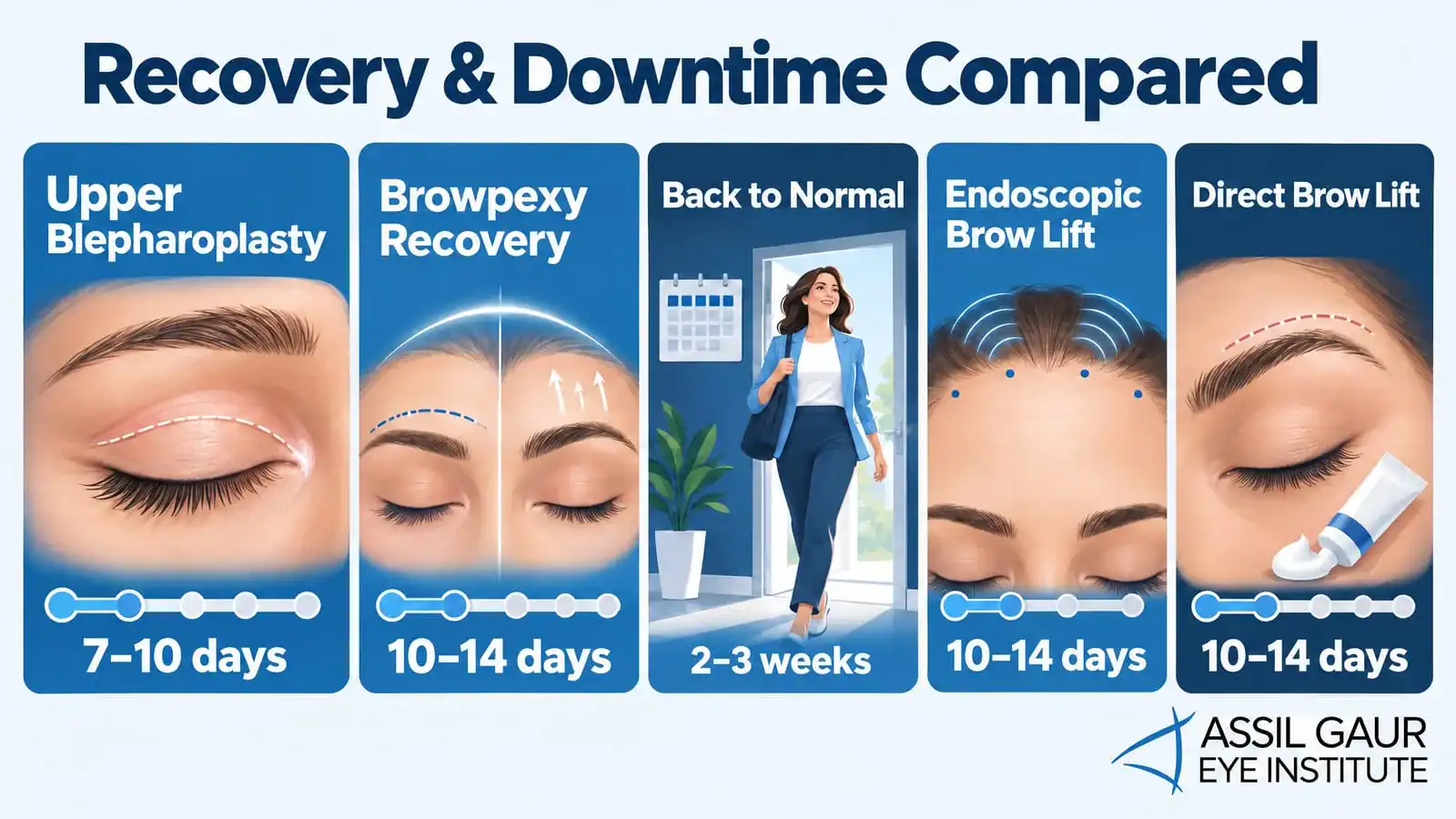
Upper blepharoplasty alone typically involves 7 to 10 days of visible bruising and swelling, with most patients comfortable returning to work and social activities within 10 to 14 days. The incision heals within the eyelid crease and is rarely visible after 4 to 6 weeks.
When performed alongside blepharoplasty, browpexy adds minimal recovery beyond what blepharoplasty alone requires. Patients should expect the same 7 to 14-day window. Performed as a standalone procedure, browpexy recovery is similarly brief.
An endoscopic brow lift involves a longer recovery: most patients experience swelling and tightness for 2 to 3 weeks, with some scalp numbness that can persist for several months as sensation returns. Returning to strenuous activity typically takes 3 to 4 weeks. A direct brow lift has a similar timeline but requires careful scar management above the brow during healing.
Why the surgeon’s subspecialty matters as much as the procedure itself

The procedures described in this article sit at the intersection of ophthalmology and plastic surgery – and that intersection is exactly where oculoplastic surgeons are trained. A general plastic surgeon may perform brow lifts and blepharoplasty with excellent results, but the periorbital anatomy – the relationship between the eyelid, the orbit, the levator muscle, and the brow – is the specific domain of oculoplastic fellowship training.
This matters most when the diagnosis is complex. Distinguishing true eyelid ptosis from brow ptosis and dermatochalasis, or identifying a combination of all three, requires the anatomical fluency that comes from years of focused subspecialty practice. Getting the diagnosis wrong does not just produce a suboptimal aesthetic result – it can affect visual function.
At Assil Gaur Eye Institute, Dr. Adeleh Yarmohammadi, a fellowship-trained oculoplastic surgeon, directs our oculoplastics program, and patients consistently describe results that exceed their expectations. One patient, Fay V., described her outcome this way: “The result is everything I dared to hope for. I am very happy and full of appreciation.” Another, Annie Y., noted that Dr. Adele “reconstructed my eyes to help me see better, but also created more symmetry on my face.” These outcomes reflect the precision that subspecialty training makes possible.
What to expect at your oculoplastics consultation in Los Angeles
A thorough oculoplastics consultation is not a sales conversation – it is a clinical evaluation. At AGEI, patients can expect the surgeon to assess brow position with the face at rest and with animation, evaluate the upper and lower eyelids independently, test for any functional component such as visual field obstruction from a drooping lid, and review photographs to understand how the face has changed over time.
You will leave the consultation with a clear understanding of which structures are contributing to your concern, which procedures address each one, and what a realistic outcome looks like. If you are a candidate for a combination approach, that will be explained in detail – including the sequencing, the recovery, and what each element of the plan is designed to achieve.
The goal is not to perform the most procedures. It is to perform the right ones.
Frequently asked questions
What is the difference between a browpexy and a brow lift?
Browpexy is a suture-based stabilization procedure that anchors brow tissue to the orbital rim bone, providing a modest lift of 2 to 4 millimeters and preventing further descent. It is typically performed through the same incision as upper blepharoplasty and involves no forehead dissection. A brow lift is a more extensive procedure that repositions the entire brow and forehead complex upward, releases the muscles that pull the brow down, and is appropriate when brow descent is significant – generally 5 millimeters or more below the ideal position. The two procedures address the same anatomical problem at different severities.
What is the recovery time for browpexy compared to a brow lift?
Browpexy recovery, particularly when performed alongside blepharoplasty, typically follows the same 7 to 14-day timeline as eyelid surgery alone. Bruising and swelling resolve within two weeks for most patients, with no scalp numbness or prolonged tightness. An endoscopic brow lift involves 2 to 3 weeks of visible swelling and tightness, with scalp numbness that can persist for several months as the sensory nerves recover. Patients undergoing a brow lift should plan for a longer period away from strenuous activity – typically 3 to 4 weeks – compared to the 1 to 2 weeks recommended after browpexy or blepharoplasty.
Does blepharoplasty lift the brows at all?
No. Blepharoplasty removes or redistributes eyelid tissue and has no direct effect on brow position. In fact, removing too much upper eyelid skin during blepharoplasty can create a mechanical pull that draws the brow downward over time, worsening brow ptosis. This is one of the reasons a thorough preoperative assessment of brow position is essential before any upper eyelid surgery – the two structures are anatomically linked, and treating one without evaluating the other can produce an outcome that looks unnatural or ages poorly.
Take the next step toward a refreshed, natural upper face at Assil Gaur Eye Institute
Whether you are noticing heaviness over your eyes for the first time or you have been researching these procedures for months, the clearest path forward starts with an evaluation by our oculoplastic surgeon, Dr. Adeleh Yarmohammadi (“Dr. Adele”), a specialist who understands the full picture. At Assil Gaur Eye Institute, our oculoplastics program is built around exactly this kind of precision diagnosis – identifying not just what you see in the mirror, but what is anatomically driving it and what will genuinely correct it. Schedule your consultation by calling 866-945-2745 or requesting an appointment online.
Assil Gaur Eye Institute combines fellowship-trained surgical expertise, advanced periorbital anatomy assessment, and a patient-first approach to deliver enviable outcomes for patients across Los Angeles and Southern California. Our clinics are accessible to patients throughout the region, including Beverly Hills, Santa Monica, West Los Angeles, West Hollywood, Culver City, Hollywood, Venice, Marina del Rey, Malibu, Manhattan Beach, and Downtown Los Angeles. Trust us to help you understand your options and choose the procedure – or combination of procedures – that is genuinely right for your face.
Call now or book your appointment online.

Written by The AGEI Educational Team

Medically Reviewed by Dr. Adeleh Yarmohammadi