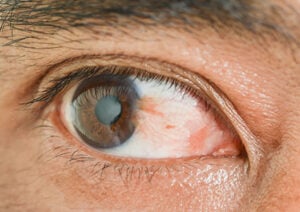
What is a pterygium?
The conjunctiva is the clear membrane covering the white of your eye. A pterygium (pronounced teh-RIJ-ee-um) is a benign (non-cancerous, non-life-threatening), fleshy wedge of conjunctival tissue filled with blood vessels. It usually starts in the inner corner of your eye and creeps toward the cornea, the clear dome at the front of the eye.
Pterygia are most common between the ages of 30 and 50, though they can appear at any age. The condition is strongly linked to ultraviolet light from sunlight or tanning beds, and to wind and dust exposure. This is why surfers, outdoor workers, and athletes see it so often.
Early on, many pterygia cause nothing worse than redness and a gritty feeling. Our ophthalmologists can monitor the growth during routine exams and prescribe medicated drops to manage irritation. When it becomes painful, starts affecting vision, or bothers you cosmetically, surgical removal is the only definitive treatment. The American Academy of Ophthalmology is clear on this point: lubricating eye drops and lubricants manage symptoms, but they do not eliminate the growth.
When is it time to operate?
Our eye surgeons generally recommend watching a pterygium rather than removing it right away. Having said that, there is a reason not to wait too long. The further a pterygium advances across the cornea, the more tissue has to be removed and the more complex the reconstruction becomes. Removing a small pterygium is a cleaner operation with a better cosmetic and visual result than removing an advanced one.
Patients typically choose removal when they experience:
• Persistent irritation, the chronic feeling of something stuck in the eye.
• Burning or itching that drops no longer relieve.
• Cosmetic concerns, because the growth is visible and affects confidence.
• Vision changes, as the pterygium distorts the cornea and induces astigmatism.
• Corneal threat, where the growth is advancing toward the center of your vision.
Until removal is medically necessary, this surgery is considered elective, and that classification is what influences your insurance coverage.
What does pterygium surgery cost?
Pterygium surgery is not a fixed-price procedure. Several factors move the number:
- Severity of the growth. Larger, more advanced pterygia require more dissection and a larger graft.
- Geographic location. Costs in major metropolitan areas like Los Angeles reflect both operating costs and the caliber of specialists available.
- Surgeon expertise. A fellowship-trained corneal specialist commands a premium. On a procedure involving your vision, and one with a meaningful chance of needing to be redone, that premium is the part of the bill most worth paying.
- Surgical technique. Whether a graft is used, what kind, and whether it is secured with sutures or fibrin glue all affect the price.
- Anesthesia and facility fees, which are usually billed separately.
- Post-operative care, including follow-up visits, medicated drops, and an eye patch during healing.
A 2023 blog on the American Academy of Ophthalmology website talks about evolving approaches for pterygia. This blog discusses how surgical technique, particularly the use of grafting rather than leaving bare sclera, significantly influences both outcomes and recurrence. Recurrence is the hidden cost line in every pterygium quote.
To give you a concrete pricing idea, the cost of pterygium surgery, often called surfer’s eye removal, averages about $3,825 nationally, with most patients quoted somewhere between $2,600 and $5,000.
Call now or book your appointment online.
Your pterygium surgical options explained
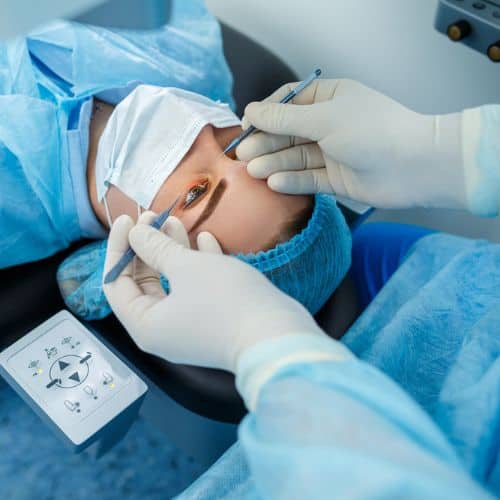
There is no laser option for pterygium removal. This is a precision surgical procedure requiring careful excision and, in most cases, a graft to cover the area where the growth was.
Sutures versus fibrin glue
Once the pterygium is excised and the graft is positioned, it has to be secured.
- Sutures are tiny stitches, usually removed one to two weeks later. Dissolving sutures are generally avoided here, since they tend to cause prolonged discomfort and slow healing.
- Fibrin glue is a biocompatible surgical adhesive that dissolves naturally as the eye heals. It reduces inflammation, shortens recovery, and carries a very small infection risk. It costs more than sutures.
What kind of pterygium surgery graft is best?
- Conjunctival autograft takes healthy tissue from elsewhere on your own eye and places it over the surgical site. It is the long-standing gold standard and substantially outperforms bare sclera.
- Amniotic membrane graft is what our surgeons favor (and the emerging new gold standard) because amniotic tissue actively suppresses post-operative inflammation, scarring, and new blood vessel growth, the three processes that drive regrowth.
- Bare sclera leaves the area uncovered. It is the cheapest approach and carries by far the highest regrowth risk. Leading ophthalmologists no longer recommend it.
Call now or book your appointment online.
How does AGEI keep pterygium recurrence below 1 percent?
It’s reported that the recurrence rate for pterygium (surfer’s eye) surgery ranges from 11.4% to 60.0% depending on technique, the surgeon’s experience, and patient factors. A second surgery to treat a recurrent pterygium on scarred tissue is harder, costlier, and less predictable than the first. The cheapest quote is rarely the cheapest outcome.
At Assil Gaur Eye Institute (AGEI) in Los Angeles, our surgeons’ recurrence rate now sits around 1%. Here’s why; over the past 12 years, our surgeons have adopted a series of refinements that include:
- Removing the pterygium along with the underlying scar tissue to achieve clean borders.
- Minimizing surgical manipulation of the tissue surrounding the gap.
- Using an amniotic membrane graft to suppress post-operative inflammation, scarring, and new blood vessel formation.
- Bathing the surgical gap with two medications that limit the inflammation and scarring that drive regrowth.
- Securing the graft with fibrin glue, which reduces the irritation sutures cause and forms a physical barrier around the graft perimeter against regrowth.
- Following a meticulous post-operative medication regimen to suppress swelling and infection.
None of these steps is exotic on its own. Performing all six consistently, on every case, is what separates a result that holds from a result that reoccurs.
Does insurance cover pterygium surgery?
Coverage depends on the pterygium’s classification. If your ophthalmologist documents that the pterygium is threatening your vision or causing medically significant symptoms, it may qualify as medically necessary and be eligible for at least partial coverage under private insurance or Medicare. If the procedure is primarily cosmetic, most vision plans will not cover it. We recommend three things:
- Work with your AGEI surgeons’ team to document the medical necessity of your procedure thoroughly.
- Contact your insurance provider directly about your benefits and any pre-authorization requirements. We will also contact them.
- Ask our team about financing options, including CareCredit.
Our team handles insurance documentation for these procedures routinely and will support you through the process.
Pterygium surgery recovery and aftercare
Assil Gaur Eye Institute’s pterygium surgery has a high success rate, and most patients are comfortable quickly.
After surgery, our doctors prescribe steroid and antibiotic drops to prevent infection and reduce the chance of recurrence. Following the dosing schedule exactly is one of the more important things you can do to protect your result.
You will be seen the day after surgery, then at one week, one month, three months, six months, and one year. After that, annual checks monitor for any regrowth. Expect some irritation and a foreign-body sensation once the anesthesia wears off. Thistypically resolves within a week. Redness at the surgical site can last up to six weeks. Most patients heal fully in six to eight weeks, with smaller pterygia healing faster.
How to protect your positive results after pterygium surgery?
Even after an excellent surgical outcome, the UV exposure that caused the pterygium is still there. Our team recommends:
- Wear sunglasses that block 100% of UV rays whenever you are outdoors.
- Choose wraparound frames for protection against wind and dust.
- Wear protective eyewear if you work in dusty, windy, or high-UV conditions.
- Use artificial tears to keep the eye surface from drying out.
- Avoid rubbing your eyes, which irritates the surface.
- Keep up with regular eye exams, so any early regrowth is caught quickly.
Why patients choose AGEI for pterygium removal
Assil Gaur Eye Institute has cared for patients in Los Angeles since 1949, when the institute was chartered by Dr. Robert M. Sinskey, the father of modern cataract surgery. AGEI is trusted by more than 100,000 patients. Our medical director, Dr. Kerry Assil, has performed more than 70,000 eye surgeries and trained more than 14,000 ophthalmologists and optometrists worldwide.
Ocular surface work is a particular strength here. Alongside pterygium removal, our surgeons perform conjunctival nevus (eye freckle) removal for patients who travel from across the country and overseas for it.
One of those patients, Lucy, flew from Australia to AGEI after a procedure elsewhere left her worse off.
Dr. Assil took the time to explain everything to me and what was going to be involved with the procedure. I told him I was nervous, and he then assured me everything would be okay. The procedure was really quick, there was never any eye pain, and I had no side effects at all.
What you get here is a treatment plan built around your eyes and your goals, advanced technique including amniotic membrane grafting with fibrin glue, comprehensive care before and after surgery, and straightforward guidance on insurance, financing, and flexible payment options.
Schedule your pterygium evaluation
You do not need to guess whether your pterygium needs treatment, what it would cost, or whether your insurance would cover it. A consultation answers all three.
Our ophthalmologists will examine the growth, measure whether it is affecting your cornea, walk you through your options, and give you a clear picture of cost and coverage before you commit to anything. Call Assil Gaur Eye Institute at 866-945-2745 or click here to schedule your evaluation. We see patients throughout Los Angeles, Beverly Hills, Santa Monica, West Los Angeles, Culver City, Marina del Rey, Malibu, and the surrounding communities.
Pterygium Surgery FAQs
How long does pterygium surgery take?
Pterygium excision is an outpatient procedure that typically takes well under an hour, and you go home the same day.
Will a pterygium come back?
Reported recurrence rates span a wide range because technique drives almost everything. Older bare-sclera surgery recurs in a large share of cases, while modern conjunctival and amniotic membrane grafting lowers that risk substantially. In our practice, clean excision with amniotic membrane grafting, fibrin glue, and a strict post-operative regimen has brought recurrence below 1%.
How soon should I be seen for pterygium?
Sooner is better. Smaller pterygia are simpler to remove, heal faster, and give better cosmetic and visual results than advanced ones.
-
American Academy of Ophthalmology, Pterygium
https://www.aao.org/eye-health/diseases/pterygium-surfers-eye -
Eye and Vision
https://eandv.biomedcentral.com/

Written by The AGEI Educational Team

Medically Reviewed by Dr. Kerry Assil