Minimally Invasive Glaucoma Surgery (MIGS): Benefits & Procedures
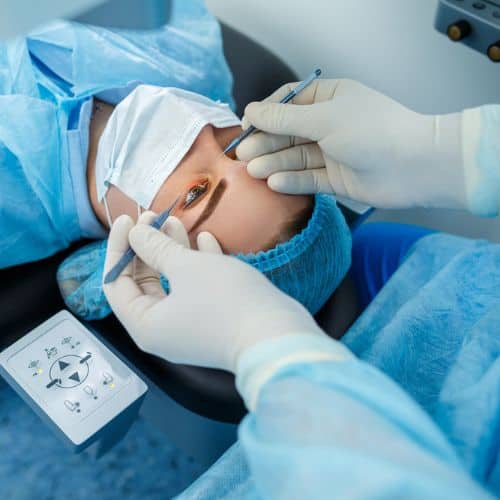
MIGS incorporates state-of-the-art minimally invasive glaucoma surgeries that use microscopic instruments to facilitate small incision surgery. It provides a safer option to reduce intraocular pressure (IOP) than traditional glaucoma surgery, with the added benefits of a higher success rate and faster recovery time. MIGS present a significantly reduced risk of complications like hypotony, infection, and scarring.
The goal of MIGS procedures is to improve fluid drainage in patients with mild to moderate glaucoma, reducing eye pressure that damages the optic nerve. Clinical trials have shown that MIGS procedures achieve a significant decrease in eye pressure over periods of up to 24 months, along with a decrease in prescription eye drop usage.
What is MIGS surgery and who is a candidate?
MIGS surgery – short for minimally invasive glaucoma surgery – is a category of advanced procedures designed to lower the elevated eye pressure that drives glaucoma-related vision loss. Unlike traditional glaucoma surgeries such as trabeculectomy or tube shunts, which involve significant tissue removal and lengthy recovery periods, MIGS procedures use microscopic incisions, precision instrumentation, and the eye’s own anatomy to restore healthier fluid drainage with far less disruption to surrounding tissue.
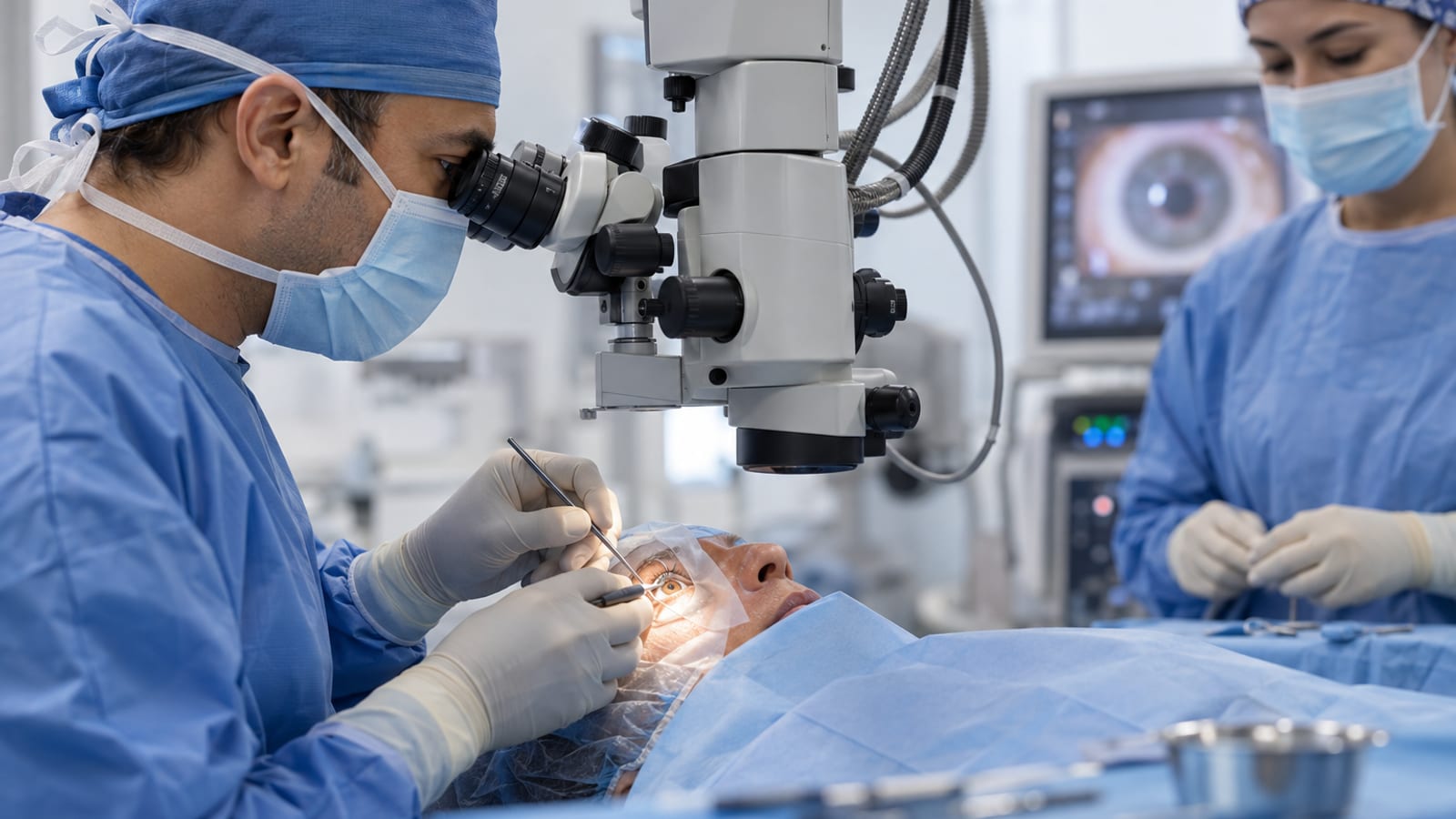
The result is a shorter procedure time, a faster recovery, and a meaningfully lower risk of serious complications – making MIGS an appealing option for patients who want world-class glaucoma care without the downtime associated with conventional surgery. Many MIGS procedures are also performed at the same time as cataract surgery, allowing patients to address two conditions in a single visit.
So who is the right candidate? MIGS is generally best suited for patients with mild to moderate open-angle glaucoma whose eye pressure is not adequately controlled by drops alone, or for those who struggle with the daily demands of a complex medication routine. It is also a strong option for patients who want to reduce their long-term dependence on glaucoma eye drops. If you have been told you are at risk for glaucoma, genetic testing and early intervention may help determine whether a procedure like MIGS belongs in your care plan.
Patients with advanced glaucoma or certain anatomical considerations may be better served by other treatments, which is why a thorough evaluation with a trusted specialist is always the essential first step.
What are the three types of MIGS surgery?
MIGS procedures fall into three different categories according to how they achieve decreased intraocular pressure:
-
Improving your eye’s natural drainage system, known as the trabecular meshwork (iStent, Trabectome, and OMNI360). Similar to a traditional tube shunt.
-
Redirecting excess ocular fluid outside of your eye (XEN Gel Stent).
-
Decreasing ocular fluid production within your eye (Endocyclophotocoagulation).
What are the risks and safety profile of MIGS surgery?
Now that you have a clearer picture of who makes a good candidate for MIGS surgery, it is only fair to talk honestly about the risks involved. The good news is that MIGS procedures carry a significantly lower complication rate than traditional glaucoma surgeries like trabeculectomy or tube shunt implantation, which is a big part of why they have become so popular among both patients and surgeons.
That said, no surgical procedure is completely without risk. The most commonly reported side effects after MIGS surgery include temporary eye pressure spikes, mild inflammation, and some blurring of vision in the days immediately following the procedure. Most patients find these resolve on their own within a short recovery window.
Less common but possible complications include bleeding inside the eye (hyphema), device repositioning in implant-based procedures, and in rare cases, inadequate pressure reduction that may require additional treatment. Because MIGS is frequently performed alongside cataract surgery, your surgeon will review how combining procedures may affect your individual risk profile.
Contraindications are also worth understanding. Patients with advanced glaucoma, certain types of angle abnormalities, or significant scarring from prior eye surgery may not be ideal candidates for every MIGS approach. That’s why a thorough evaluation by a world-class glaucoma specialist matters before making any treatment decision.
At Assil Gaur Eye Institute, Dr. Avneet K. Sodhi Gaur takes a precision-driven approach to patient selection, ensuring that the procedure recommended for you is the one most likely to deliver safe, lasting results. Learn more about advanced eye care options available to Southern California patients.
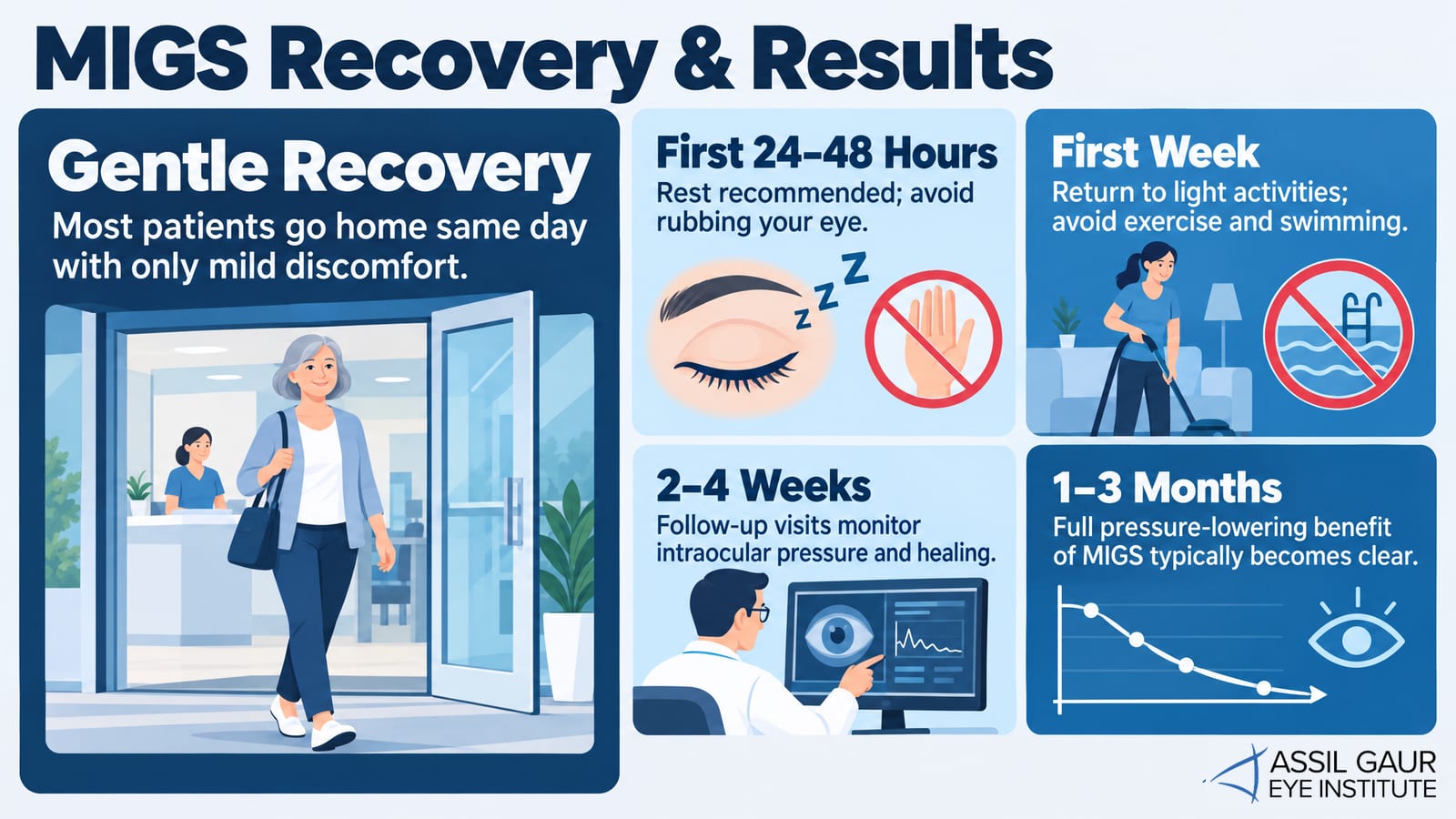
What to expect: MIGS recovery and results
One of the biggest advantages of MIGS surgery over traditional glaucoma procedures is how gentle the recovery tends to be. Most patients go home the same day and notice only mild discomfort, some redness, or temporary blurry vision in the first day or two. These effects typically settle quickly, and many people feel back to their normal routine within a week.
Here is a general sense of what the recovery timeline looks like for most patients:
-
First 24 to 48 hours: Rest is recommended. You may experience mild irritation or light sensitivity. Avoid rubbing your eye.
-
First week: Most patients return to light daily activities. Avoid strenuous exercise, swimming, and heavy lifting.
-
Two to four weeks: Follow-up appointments allow your surgeon to monitor intraocular pressure (IOP) and healing progress.
-
One to three months: The full pressure-lowering benefit of MIGS typically becomes clear during this window.
In terms of results, clinical data are genuinely encouraging. Studies on devices like the iStent Inject show sustained IOP reduction and meaningful decreases in glaucoma medication use over 23 months of follow-up. Many patients can reduce or even eliminate daily eye drops, which is a significant quality-of-life improvement. For a closer look at the risks associated with long-term eye drop use, that context makes medication reduction an especially meaningful outcome.
Results do vary depending on glaucoma severity, the specific procedure performed, and whether MIGS is combined with cataract surgery. Your surgeon at Assil Gaur Eye Institute will set realistic, personalized expectations during your consultation so you know exactly what to anticipate.
What interventions decrease ocular fluid production for glaucoma?
Another way to prevent vision loss from glaucoma and reduce IOP is to decrease ocular fluid production. One way to do that is via Endocyclophotocoagulation.
What is Endocyclophotocoagulation?
Endocyclophotocoagulation, also known as ECP, decreases eye pressure by decreasing overall fluid production. ECP utilizes a miniature camera placed inside the eye to view the ciliary body cells that produce ocular fluid.
The laser then targets these cells with a precise beam to reduce fluid production and lower intraocular pressure. ECP can be used for both open-angle and angle-closure glaucoma patients and takes about five minutes per eye.
ECP is most often recommended for patients with mild to moderate glaucoma who have not achieved adequate pressure control through eye drops alone, or for those who struggle with medication adherence. It is also an excellent option for patients already undergoing cataract surgery, since the two procedures can be performed in the same operative session with no meaningful increase in recovery time.
Clinically, ECP has been shown to reduce intraocular pressure by approximately 20 to 30 percent, and many patients can reduce their dependence on glaucoma medications after the procedure. Because ECP targets the source of fluid production rather than creating a new drainage pathway, it has a favorable safety profile compared with more invasive surgical alternatives.
Recovery after ECP is typically straightforward. Most patients experience mild inflammation in the days following the procedure, managed comfortably with prescription eye drops. The majority return to normal daily activities within a week. At Assil Gaur Eye Institute, Dr. Avneet K. Sodhi Gaur will guide you through a personalized post-operative plan to protect your results and monitor your intraocular pressure over time.
Call now or book your appointment online.
Which glaucoma surgery is right for me?
During your examination, our eye doctor will review the options available from our large toolkit of procedures. The doctor will review your type and stage of glaucoma, eye anatomy, and any other medical conditions you may have. Taking all of these factors into account – along with the safety profile of the procedures – our glaucoma expert will choose the best option for you.
Glaucoma staging plays a central role in that decision. Patients with mild to moderate glaucoma are typically the strongest candidates for MIGS surgery, where the goal is meaningful pressure reduction with a faster recovery and a lower risk profile than traditional filtering surgery. Those with more advanced or severe glaucoma may require procedures that achieve a greater drop in intraocular pressure, such as the XEN Gel Stent, which creates a more aggressive drainage pathway while still being far less invasive than a trabeculectomy.
We often perform MIGS procedures in combination with cataract surgery for appropriate patients. This combination is one of the most powerful tools in our arsenal. When a patient already needs cataract removal, adding a MIGS procedure during the same surgical session adds minimal extra time while delivering real, lasting pressure control. It is an efficient, precision-driven approach that our team uses to help qualifying patients reduce or eliminate their dependence on daily glaucoma eye drops. MIGS performed at the Assil Gaur Eye Institute include iStent, OMNI 360, XEN gel stent, and ECP.
Eye anatomy also shapes the recommendation. Open-angle glaucoma, the most common form, responds well to trabecular procedures like the iStent or OMNI 360 because the drainage angle is accessible. Patients with narrow angles or anatomy that limits trabecular access may be better suited to a ciliary body procedure like Endocyclophotocoagulation. Dr. Avneet K. Sodhi Gaur evaluates each of these variables with world-class precision so that every patient receives a truly personalized treatment plan before their first procedure. A complimentary evaluation is the best first step toward understanding which path is right for you.
Why trust Assil Gaur Eye Institute’s glaucoma specialists?
Assil Gaur Eye Institute adheres to the highest standards of ophthalmology and patient care in the country. They have assembled a team of top ophthalmologists from across the country who continue AGEI’s tradition of providing patients with the highest-quality specialist eye care and postoperative support.
Our Director of Glaucoma Services, Dr. Avneet K. Sodhi Gaur, is a board-certified, fellowship-trained cataract and glaucoma specialist and a member of the American Academy of Ophthalmology.
She has extensive experience in conventional glaucoma laser treatments and surgical procedures, such as trabeculectomy and glaucoma drainage implants. Dr. Gaur also performs state-of-the-art minimally invasive glaucoma procedures, including iStent, iStent Inject, Hydrus, ECP, OMNI 360, and Xen gel stent.
Call now or book your appointment online.
We are conveniently located for patients throughout Southern California and the Los Angeles area, including Beverly Hills, Santa Monica, West Los Angeles, West Hollywood, Culver City, Hollywood, Venice, Marina del Rey, Malibu, Manhattan Beach, and downtown Los Angeles.
-
Davids A-M, Pahlitzsch M, Boeker A, Winterhalter S, Maier-Wenzel A-K, Klamann M. Ab interno canaloplasty (ABiC)—12-month results of a new minimally invasive glaucoma surgery (MIGS). Graefe’s Archive for Clinical and Experimental Ophthalmology. 2019;257:1947-1953.
-
Grover D.S., Fellman R.L. Gonioscopy-assisted transluminal trabeculotomy (GATT): Thermal suture modification with a dye-stained rounded tip. J. Glaucoma. 2016;25:501–504. doi: 10.1097/IJG.0000000000000325.
-
Lass J.H., Benetz B.A., He J., Hamilton C., Von Tress M., Dickerson J., Lane S. Corneal endothelial cell loss and morphometric changes 5 years after phacoemulsification with or without CyPass Micro-Stent. Am. J. Ophthalmol. 2019;208:211–218. doi: 10.1016/j.ajo.2019.07.016.
-
Saheb H, Ahmed I. Micro-Invasive glaucoma surgery: current perspectives and future directions.Curr Opin Ophthalmol. 2012;23:96-104.
-
SooHoo J.R., Seibold L.K., Radcliffe N.M., Kahook M.Y. Minimally invasive glaucoma surgery: Current implants and future innovations. Can. J. Ophthalmol. 2014;49:528–533. doi: 10.1016/j.jcjo.2014.09.002.

Written by The AGEI Educational Team

Medically Reviewed by Dr. Avneet Sodhi Gaur