Durysta, an exciting new glaucoma treatment
Glaucoma is the leading cause of blindness and visual impairment in the United States. Unfortunately, because many patients with open-angle glaucoma don’t experience symptoms, they may not be aware that they have the disease.
A big challenge in managing open-angle glaucoma (OAG) and ocular hypertension (OHT) has been getting patients to comply with taking medicated eye drops essential for managing intraocular pressure (IOP).
In fact, 80% of glaucoma patients do not use their prescribed topical drops as instructed, either due to side effects or forgetfulness. That is why the Durysta™️ implant was invented.
Why Glaucoma Implants Matter
Glaucoma is a progressive optic nerve disease driven by elevated intraocular pressure. When eye drops fail to control that pressure adequately, or when patients cannot tolerate them or use them reliably, implant-based solutions become the next line of defense. These devices and drug-delivery systems work by either creating a new drainage pathway for aqueous humor, mechanically bypassing the trabecular meshwork, or delivering pressure-lowering medication continuously inside the eye. Understanding the full spectrum of glaucoma treatment options is the first step toward protecting your vision.

Why Eye Drop Non-Compliance Drives Patients Toward Implants
Many glaucoma patients struggle to maintain a consistent drop schedule. Common barriers include difficulty instilling drops correctly, forgetting doses, traveling without medication, and experiencing side effects such as dry eye, redness, or allergic reactions to preservatives. For these patients, an implant that eliminates the daily drop burden is not just convenient but clinically meaningful, since uncontrolled intraocular pressure accelerates optic nerve damage.
Types of Glaucoma Implants and Surgical Options
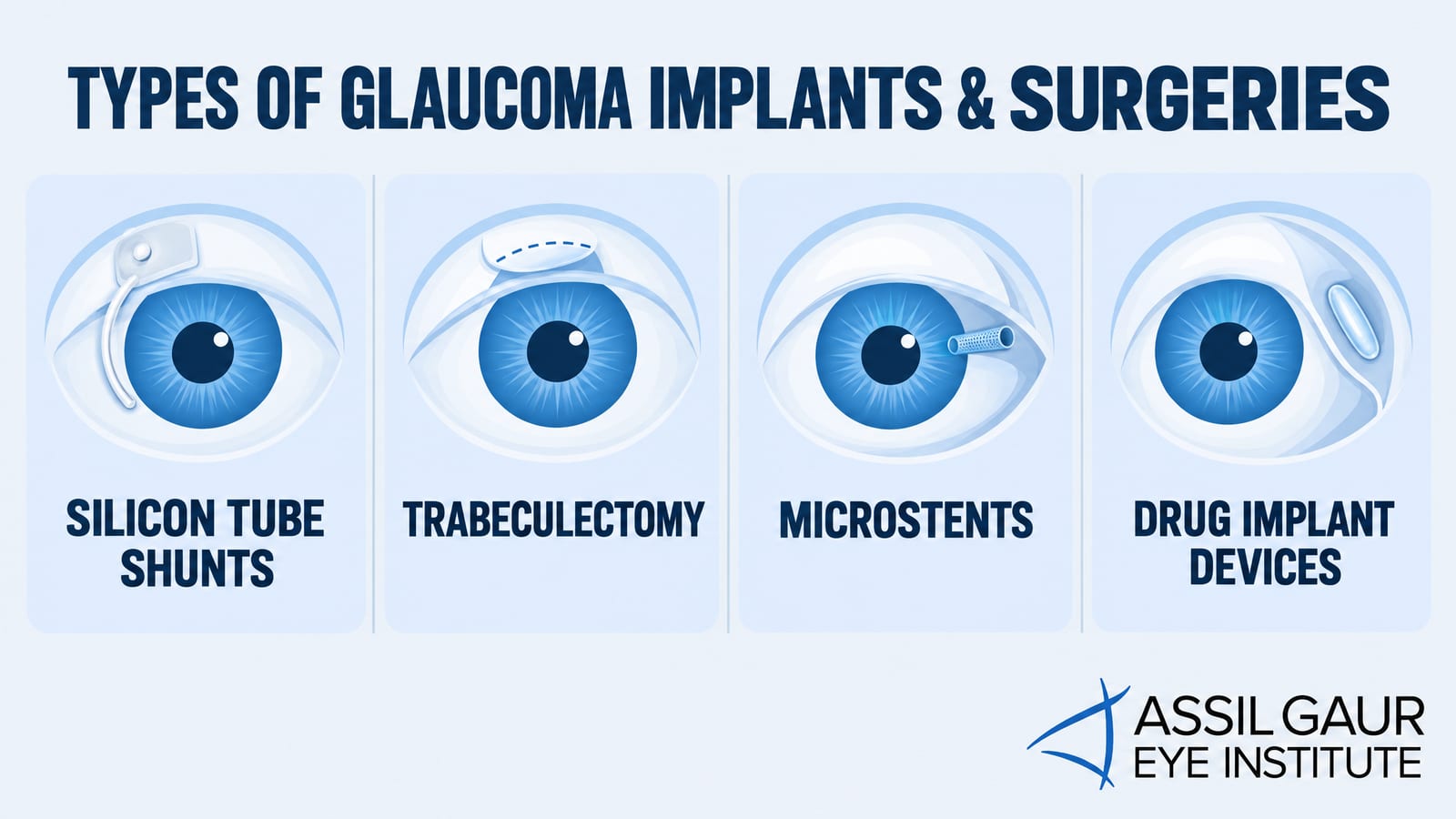
Surgeons and patients have more implant choices than ever. The main categories are:
Tube Shunts and Glaucoma Drainage Devices
Tube shunts such as the Ahmed shunt and the Baerveldt implant redirect aqueous humor through a silicone tube to a plate positioned under the conjunctiva, where a filtering bleb forms and fluid is absorbed. These glaucoma drainage devices are typically reserved for eyes that have failed trabeculectomy or have complex anatomy. They are highly effective for advanced open-angle glaucoma and certain angle-closure glaucoma cases, though conjunctival bleb management and the risk of corneal endothelial cell loss require careful long-term follow-up.
Trabeculectomy
Trabeculectomy remains the gold-standard filtering surgery for many patients. The surgeon creates a guarded opening in the sclera that allows aqueous humor to drain beneath the conjunctiva, forming a bleb. It delivers robust intraocular pressure reduction but requires longer recovery and carries a higher risk profile than newer approaches.
Minimally Invasive Glaucoma Surgery (MIGS) Implants
MIGS devices such as the iStent and the Hydrus microstent are placed through a tiny corneal incision, often during cataract surgery, to improve aqueous outflow through the eye’s natural drainage pathway. Selective laser trabeculoplasty (SLT) is a related non-incisional option. MIGS procedures offer a favorable safety profile and rapid recovery, making them well suited for mild-to-moderate open-angle glaucoma treatment in patients who want to reduce their dependence on drops.
Sustained-Release Drug Implants
The newest category replaces the daily drop routine with a biodegradable implant that delivers medication continuously inside the anterior chamber. Durysta, developed by Allergan, is the leading FDA-approved option in this class and is the focus of the section below.
Call now or book your appointment online.
Durysta: a Biodegradable Implant for Glaucoma
Durysta is the first biodegradable, sustained-release implant approved by the FDA for open-angle glaucoma and ocular hypertension. Unlike tube shunts or MIGS devices that create or widen a drainage pathway, Durysta works pharmacologically: it delivers bimatoprost, a prostaglandin analog, continuously within the anterior chamber to reduce aqueous humor production and increase outflow. This makes it the right choice for patients whose anatomy or disease stage does not yet require surgical drainage intervention but who cannot reliably manage topical therapy.
Where tube shunts and drainage devices are reserved for moderate-to-advanced glaucoma that has not responded to medication or laser treatment, Durysta occupies a distinct and valuable middle ground. As a precision pharmacological implant rather than a structural drainage device, it does not alter the eye’s anatomy. For patients with early-to-moderate open-angle glaucoma who struggle with the daily routine of eye drops, whether due to side effects, forgetfulness, or physical difficulty applying them, Durysta offers a compelling alternative that delivers consistent, controlled medication without any of those barriers.
How Durysta Works
The implant is pre-loaded with 10 mcg of bimatoprost in a single-use sterile applicator. During a safe, 5-minute in-office procedure, the ophthalmologist injects the tiny rod-shaped cartridge into the front nasal side of the anterior chamber. No incision or suture is required. Because Durysta is biodegradable, it dissolves naturally over up to six months, is eliminated by the body without removal, and most patients maintain controlled intraocular pressure even after the implant has fully broken down.
Clinical trial data add another compelling reason to consider Durysta over standard topical therapy. Patients who received the implant reported fewer ocular side effects than those using bimatoprost eye drops daily, a meaningful finding for anyone who has experienced redness, irritation, or eyelash changes from long-term drop use. That tolerability advantage, combined with the convenience of a single in-office procedure, is what sets Durysta apart from both traditional drops and more invasive surgical implants.
Who Is a Candidate for Durysta?
Durysta is indicated for open-angle glaucoma and ocular hypertension. It is contraindicated if you have an active eye infection, have undergone a corneal transplant, have corneal endothelial cell dystrophy, have a ruptured or absent posterior lens capsule, or are allergic to bimatoprost or any component of the implant. Dr. Sodhi Gaur reviews each patient’s full ocular history before recommending Durysta over surgical drainage.
In practical terms, Durysta is often the preferred implant option for patients who are not yet candidates for a tube shunt or MIGS procedure but need more reliable pressure control than drops alone can provide. If your glaucoma is more advanced and requires a structural solution, Dr. Sodhi Gaur will discuss whether a drainage device or a minimally invasive surgical implant is the more appropriate path. The goal is always to match the right implant to the right patient at the right stage of disease, and that evaluation is where world-class glaucoma care truly begins.
What Are the Side Effects of Durysta?
Clinical trials produced a striking finding: patients randomized to Durysta experienced fewer side effects than the control group using standard glaucoma eye drops. The most clinically significant adverse events include eye redness, eye pain, iritis, and conjunctival hemorrhage. Light sensitivity, blurred vision, and a foreign body sensation are also reported but typically resolve early.
“It’s highly unusual for a new medication to exhibit fewer side effects than the standard it’s being compared to, but that’s exactly what happened with Durysta. Fewer side effects and better pressure control make for a compelling argument to consider switching,” says AGEI’s glaucoma specialist, Dr. Avneet Sodhi Gaur. The safety of Durysta during pregnancy has not been established, so patients who are pregnant or planning to become pregnant should discuss their options with Dr. Sodhi Gaur before proceeding.
Minimally Invasive Glaucoma Surgery (MIGS): What to Expect
If your doctor has mentioned MIGS, you are probably wondering how it differs from traditional glaucoma surgery. The short answer is that minimally invasive glaucoma surgery uses tiny implants and micro-scale instruments to lower eye pressure with far less disruption than older procedures like trabeculectomy. Recovery is typically faster, the risk profile is lower, and the procedures are often performed at the same time as cataract surgery, making them a genuinely appealing option for many patients.
The most well-known MIGS implants improve the eye’s natural drainage system. Tiny stents are placed at the eye’s drainage angle, creating a more open pathway for fluid to flow out and pressure to drop. The procedure itself usually takes only a few minutes and is performed through a small incision. Most patients go home the same day and notice minimal disruption to their daily routine during recovery.
MIGS is generally best suited for patients with mild to moderate glaucoma who need additional pressure control beyond what eye drops alone can provide. It is not typically recommended for advanced glaucoma, where more aggressive surgical options may be necessary. Your surgeon will evaluate your optic nerve health, drainage-angle anatomy, and overall eye pressure targets before recommending a specific approach.
Call now or book your appointment online.
Choosing the Right Implant: How Dr. Sodhi Gaur Evaluates Patients
Named one of Los Angeles’ Top Doctors, Dr. Avneet K. Sodhi Gaur is a board-certified, fellowship-trained glaucoma specialist with advanced training at Tufts Medical Center/New England Eye Center and Ophthalmic Consultants of Boston-Mass Eye and Ear Infirmary. She performs the full spectrum of glaucoma procedures, including trabeculectomy, Ahmed and Baerveldt drainage implants, MIGS procedures such as iStent placement, and sustained-release drug delivery with Durysta. Her evaluation considers disease severity, optic nerve status, prior surgical history, corneal health, and a patient’s ability to manage topical therapy.
.At Assil Gaur Eye Institute, world-class glaucoma specialist Dr. Avneet K. Sodhi Gaur takes a precision-driven, personalized approach to every patient. Whether MIGS, a sustained-release implant like Durysta, or another advanced treatment is right for you, you can explore your options in depth through our glaucoma care resources or by scheduling a consultation directly with our team.

Written by The AGEI Educational Team

Medically Reviewed by Dr. Avneet Sodhi Gaur