Intraocular Lens (IOLs) Refractive Lens Exchange (RLE)
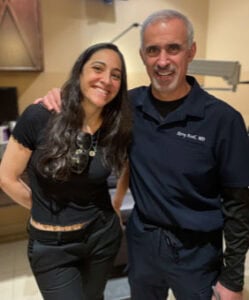
39-Year-Old Couldn’t See DMV Eye Chart—What Doctors Found Will Surprise You
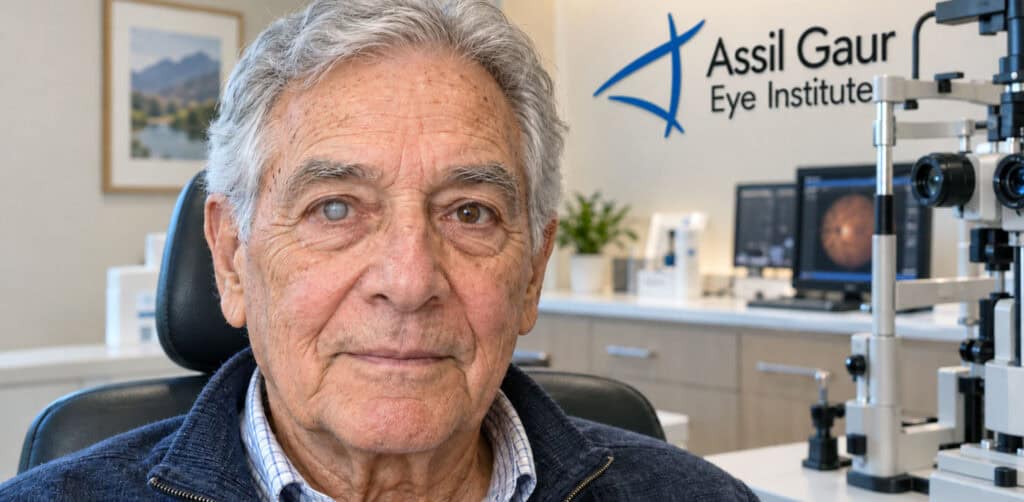
“Looking back at it now,” says Perri, “my vision loss occurred over five years. But it was so subtle I barely noticed it. That was until it was time to renew my driver’s license, and I couldn’t see any letters on the eye chart out of my right eye. How could this be? I was always the one who never needed glasses in my family!
“The DMV examiner told me he had only seen this in older people with cataracts and implored me to see an eye doctor immediately. It was at that moment that I had to admit how much my eyesight issue affected me. But how could I have cataracts at age 39?”
“It didn’t take long before I couldn’t drive at night,” says Perri. “And when I misjudged the depth of a kitchen shelf and dropped several dishes on the floor instead of placing them in the cabinet, I knew I could not put this off any longer.”
Can someone get cataracts at age 39?
Yes, indeed, you can, and that was what happened to Perri. Without even really knowing it, a cataract was impairing vision in her right eye. Since most people don’t develop cataracts until age 55 or older, she thought she was too young to have one.
Generally, younger people only develop cataracts after eye trauma. However, Perri has no recollection of having had any such incident.
The road from Humboldt, CA to Assil Gaur Eye Institute
Perri, a professional food and health coach and a resident of Humboldt County in Northern California, met with some local ophthalmologists near her hometown. Unfortunately, she didn’t feel comfortable with them.
She then consulted with some colleagues and friends, several of whom live in Southern California, and almost all of them pointed her to Assil Gaur Eye Institute in Beverly Hills.
Perri’s path to clear vision begins with three letters: RLE
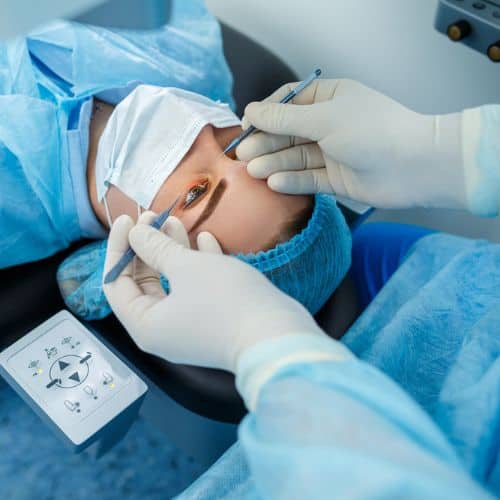
The RLE procedure (also called refractive lens exchange) is a “clear lens exchange” surgical procedure to correct vision for those not eligible for LASIK or other laser vision correction options. It was the perfect option for Perri.
RLE surgery replaces the eye’s natural lens with an artificial lens. This new lens corrects refractive errors and reduces or removes the need for glasses or contact lenses.
Refractive lens replacement is used to correct eye conditions such as presbyopia (age-related nearsightedness), hyperopia (farsightedness), and myopia (nearsightedness). Most intraocular lenses (IOLs) have a toric version that also corrects for astigmatism.
Interestingly, the exact same surgery can be performed in conjunction with cataract surgery, although it is not referred to as RLE. RLE is an elective procedure and is not covered by insurance. However, when performed during cataract removal, some of the procedure is covered by insurance, as it is considered medically necessary when part of cataract surgery.
Confusing? Do not worry; our surgery consultants will explain everything to you and tell you how much of the procedure your insurance will cover.
What are the potential benefits of RLE?
- Prevention of future cataract development.
- Good-to-excellent far vision following Single Vision Lens implantation (near working distance tasks still require eyeglasses).
- Good-to-excellent near, intermediate, and far vision with multi-focus lens implantation.
- Possible reduced likelihood of future need for laser vision correction or reading glasses.
Request Your Consultation
Call now or book your appointment online.
How do AGEI’s surgeons pick the best lens for each patient’s refractive lens exchange procedure?
With over a dozen IOL options, it can be difficult for some ophthalmologists to determine who is a good candidate for each available lens.
To choose the best lens for each patient, Dr. Assil developed a precise algorithm to select the best IOL for each patient’s unique physical realities and lifestyles.
“There is no single intraocular lens that is ideal for all patients,” says Dr. Assil. “A lens that perfectly matches one person may not perform well for another. Our approach to lens selection makes sense and has been validated by the frequency with which multifocal IOL manufacturers have asked us to collaborate closely in designing new refractive lens exchange surgery technologies.”
Dr. Assil fixes Perri’s eye with the Johnson and Johnson Symphony OptiBlue lens
Developed by Johnson & Johnson, the Symfony Optiblue implant was the first FDA-approved IOL with an extended depth of focus. This way, our patients’ range of vision extends from near vision to far, unlike with traditional monofocal IOLs.
The Symfony OptiBlue has been hailed as a significant technological achievement and considered an alternative to monofocal lenses, which have only one point of focus, usually set for distance vision.
The Symfony OptiBlue lenses were designed to help patients see clearly without the need for glasses or contacts after surgery. However, we still recommend wearing strong sunglasses to protect your eyes from harmful UV rays.
“I selected the Symphony Optiblue lens for Perri to help assure her the sharpest possible distance vision while also gaining her excellent computer vision,” says Dr. Assil, who performed the outpatient surgery in under 30 minutes. “This decision was made based on the lens characteristics, coupled with the curvature of Perri’s cornea and the diameter of her pupil. Custom-matching lens exchange characteristics melding to the natural anatomy of the eye is very important to achieving the most favorable results.”
Perri was fine, leaving the entire lens decision to Dr. Assil. “I completely trusted him,” she says.
Perri’s life having crystal clear vision
Perri says she was startled by how straightforward the surgery was.
“Overall, it was a walk in the park process. I thought I would have to rest for a week, but for the most part, I could resume my normal activities,” she says, adding that she did have to use eye drops during recovery.
Several weeks after surgery, Perri still wears her unique sunglasses, which she considers stylish and practical. “I want to make sure I take care of my eyes for the rest of my life,” she says.
Living out in the country, Perri says it gets very dark outside, especially in her area. “But now it does not matter! I can see everything perfectly, and I can drive safely,” she says of life post-surgery. “I’m still in complete awe.”
She credits the entire Assil Gaur Eye Institute team for giving her clear sight with her refractive lens exchange procedure. “The team deserves all the credit,” she says. “My future is so much brighter thanks to them.”
Why trust AGEI with your eye lens replacement surgery?
With 30 years of experience, Dr. Assil is one of the most experienced cataract surgeons in the United States. He has performed over 70,000 eye surgeries and authored over 100 textbook chapters and articles on refractive and cataract surgery. Assil Gaur Eye Institute has assembled a team of top ophthalmologists from around the country who offer their patients the highest quality of specialist eye care in the United States. In keeping with the founding principles of AGEI, eye surgeons maintain their clinics comfortably and familiarly, much like family-run medical practices used to be.
Today, AGEI is nationally recognized for its compassionate, patient-centric care, commitment to pioneering advances in ophthalmology, and dedication to supporting its patients’ and the community’s health and well-being.
In addition to refractive lens exchange and cataract surgery, the ophthalmology experts at AGEI are nationally recognized for their eye care and treatment options for a full range of conditions, including glaucoma, retinal detachment (and other diseases of the retina), cornea conditions, floaters and flashes, dry eye, presbyopia, and other vision correction procedures (refractive surgery) such as LASIK surgery, PRK, and many more laser procedures.
Request Your Consultation
Call now or book your appointment online.
More Stories You might be interested in


Cataract Surgery Intraocular Lens (IOLs)
Sylvia, 75, Goes Glasses-Free for First Time in a Decade After Premium Cataract Surgery with Dr. Assil

Cataract Surgery Intraocular Lens (IOLs)
Light Sensitivity Made Steve’s Life Unbearable—Until Dr. Assil’s State-of-the-Art IOL Surgery
Refractive Lens Exchange (RLE)