Intraocular Lens (IOLs) Refractive Lens Exchange (RLE)

Woman Too Scared to Drive With Cataracts Gets Better-Than-Perfect Vision from Dr. Assil 20 Years After LASIK
Earlier this year, Stacy Small finished an eye surgery that began almost a quarter century ago with innovative eye pioneer Dr. Kerry Assil. It was to be a tentative step into the wide, wide world of excellent vision
At the time of her first eye surgery, Dr. Assil, recently named by Los Angeles Magazine as one of the best eye doctors in the area, was an up-and-comer struggling to make a name for himself in the competitive world of ophthalmology. Stacy, at a friend’s urging, decided to see Dr. Assil for a consultation on the cutting-edge LASIK procedure.
LASIK opened new boundaries for Stacy 20 years ago
LASIK (Laser-Assisted in Situ Keratomileusis) was developed in the early 1990s. The procedure is based on earlier techniques and advancements in both refractive surgery and laser technology.
The first LASIK procedure was performed in 1989 by Greek ophthalmologist Ioannis Pallikaris, often credited with pioneering the technique. LASIK laser vision correction quickly gained popularity throughout the 1990s as technology improved and clinical outcomes were refined.
“I was terrified but excited, after a lifetime of subpar vision that required glasses since age seven to see the blackboard in second grade,” says Stacy, who was in her 20s at the time. “I was one of the youngest kids to wear contact lenses because I was athletic. My dad felt my glasses got in the way of my excelling at sports.”
After LASIK surgery, Stacy could finally see clearly, having gone from 20/400 vision to 20/20 overnight. Seeing 20/400 means you can read a letter chart clearly from 20 feet away, which a person with normal vision could read from 400 feet away. Another way to think of it is that someone with 20/400 vision would have to stand just 5 feet from a TV to see it, as a person with 20/20 vision could be from 20 feet away.
According to the American Optometric Association, 20/400 vision falls in the severe impairment range. While not total blindness, this level of eyesight loss is debilitating without visual aids.
2024: Time for a vision tune-up
Many years after her LASIK correction, Stacy’s life was once again upended by a vision challenge that had become further debilitating. Obstacles included struggling to read signage far away and books up close. She tried multiple prescription glasses to correct the worsened vision, but that wasn’t helping. She also suffered from headaches, had a few stumbles on curbs she didn’t see, and felt fatigued after a few hours at her computer.
After another consultation with Dr. Assil, Stacy, now 54, decided to follow his advice: remove cataracts in both eyes (which impair light on the retina) in one day and receive a refractive lens exchange surgery (RLE). Due to the passage of time, Stacy was no longer a suitable candidate for a LASIK touch-up.
“Stacy had LASIK 20 years earlier, and now the internal lens of her eye had stiffened so that she could not simultaneously see near and far without glasses,” the doctor said. “The RLE procedure could best remedy that.”
What is the difference between RLE and LASIK surgery?
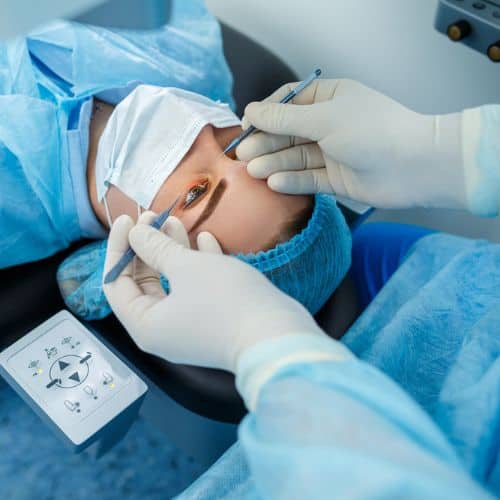
RLE surgery involves removing the eye’s natural lens and replacing it with an artificial lens (IOL). A small incision in the cornea is required to remove the natural lens and insert the IOL.
LASIK reshapes the cornea using an excimer laser to correct refractive errors. A flap is created in the cornea using a microkeratome or femtosecond laser. The underlying corneal tissue is reshaped with the laser, and the flap is repositioned.
Request Your Consultation
Call now or book your appointment online.
Choosing the perfect intraocular lens for Stacy
The Eyhance lens implant is available in a toric version to treat patients with higher levels of astigmatism. The Eyhance and Eyhance toric lenses are inserted into the eye using the Tecnis Simplicity delivery system, one of the easiest and fastest methods for inserting the lens into the eye.
As the founder and CEO of the Elite Travel Club (and a frequent traveler), Stacy had difficulty seeing airport signage, reading menus, and understanding schedules — all the more reasons for her to expedite her lens replacement surgery.
“I’d been afraid to drive for the last six months,” she explains. “I couldn’t see in the dark.”
“I also took Dr. Assil’s advice to get both eyes done on the same day,” Stacy says. “He understood my concerns about downtime and my desire to return to my normal life quickly. All I needed were eye drops after surgery.”
A great patient experience, and her sight is better than ever!
While being driven home by a friend after an uneventful surgical procedure, both of Stacy’s eyes had 20/15 vision. Driving went from a scary experience to an enjoyable one.
“I can read tiny types in a book again and also see the street signs clearly,” she says of her new quality of life. “I feel much happier being able to see the world.”
Why trust AGEI for your refractive lens exchange procedure?
Under Dr. Assil’s leadership, the Assil Gaur Eye Institute has assembled a team of top ophthalmology specialists from around the country, continuing AGEI’s tradition of offering patients the highest quality specialist eye care in the United States. In keeping with AGEI’s founding principles, our doctors have maintained a comfortable and familiar atmosphere in their clinics, much like family-run medical practices used to be.
Today, AGEI is nationally recognized for its compassionate, patient-centric care, commitment to pioneering advances in ophthalmology, and dedication to supporting the health and well-being of its patients and community.
Our lifelong commitment to advancing the field of ophthalmology is evident in our work, which includes developing new surgical techniques and advancing laser surgery at our eye center. We lecture internationally and have taught state-of-the-art surgical skills to over 10,000 ophthalmologists worldwide. In addition, we have participated in dozens of FDA clinical trials, either as the lead investigators or as a member of a multi-center team, testing new ophthalmological devices and surgical techniques.
Los Angeles’s leading LASIK, cataract, glaucoma, and retinal surgeons are available in one practice. State-of-the-art treatments are available for all eye conditions, including glaucoma, eye cancer, vitrectomy, cataract surgery, macular disease, removal of eye nevus birthmarks, floaters, dry eye, diabetic eye conditions, and hyperopia.
We remain committed to our founding mission of delivering exceptional laser eye surgery in a compassionate and caring environment. We continue to be driven to advance the field of ophthalmology (eye disease) and give back to our community.
Request Your Consultation
Call now or book your appointment online.
We are conveniently located for patients throughout Southern California and the Los Angeles area, including Beverly Hills, Santa Monica, West Los Angeles, West Hollywood, Culver City, Hollywood, Venice, Marina del Rey, Malibu, Manhattan Beach, and Downtown Los Angeles.
More Stories You might be interested in


Cataract Surgery Intraocular Lens (IOLs)
Sylvia, 75, Goes Glasses-Free for First Time in a Decade After Premium Cataract Surgery with Dr. Assil
Cataract Surgery Intraocular Lens (IOLs)
Light Sensitivity Made Steve’s Life Unbearable—Until Dr. Assil’s State-of-the-Art IOL Surgery
Refractive Lens Exchange (RLE)