Intraocular Lens (IOLs)

Debilitating floaters threatened Jacqueline’s Hollywood career. Dr. Assil’s revolutionary light-adjustable lens saved her vision, and livelihood
The first time Jacqueline Mayes experienced floaters in her left eye was almost 18 years ago after giving birth to her son, Tate. Eye floaters are spots in your vision that look like black or gray specks, strings, or cobwebs. They move when you move your eyes and move away when you try to look at them directly.
Over the years, the floaters came and went and were more of a nuisance than a medical emergency. But about a year and a half ago, Jacqueline, 57, says, they suddenly got worse. While on a herky-jerky ride at a local amusement park, rough movement caused a floater to appear with a vengeance. “A sheet of grey covered my eye, and I couldn’t make the floater move,” she says. “I couldn’t see as the grey fog blocked or smeared the image.”
Jacqueline works as a script continuity consultant in the film industry, providing detailed records of what has been shot for each scene, as well as information about wardrobe, props, set dressing, and hair. Her position requires ultra-keen eyesight to spot discrepancies on several small computer screens during shooting.
The road to an interocular lens and restored vision
A concerned Jacqueline quickly scheduled an appointment with her long-time optometrist. But after a cursory examination, the doctor told her it was nothing more than an ordinary floater. Nothing to be concerned about.
Convinced that her obscured sight was anything but “ordinary,” Jacqueline sat at her computer digging deeply into the internet, searching for the best doctors to treat floaters. Finally, Dr. Gaur of the Assil Gaur Eye Institute jumped out at her, having been named the best ophthalmologist in Los Angeles.
Using her functional right eye, Jacqueline eagerly read about the expertise of Dr. Pilyugina (or Dr. P, as her patients call her). The doctor received her ophthalmology training at Stanford University and completed a specialized two-year retina-vitreous surgical fellowship with the University of California at San Diego.
A consult visit was scheduled, but Dr. P was reticent to perform a vitrectomy (removal of the eye’s vitreous gel) because Jacqueline still had a natural eye lens. However, Dr. Kerry Assil agreed to perform a lens replacement, which would later be followed by the vitrectomy by Dr. P.
Because Jacqueline had a thin cornea, Dr. Assil recommended using a light-adjustable intraocular lens (IOL) — which is thinner and unlikely to cause damage to the cornea. This technique is commonly used in the treatment of cataracts, but in this instance was a necessary step in preparing Jacqueline’s eye for further treatment.
Types of IOLs
Depending on the patient’s sight in the affected eye, there are several IOLs to choose from. These include:
- Toric. Just like regular contact lenses, toric IOLs are meant to correct astigmatism.
- Silicon. The FDA has approved intraocular lenses made of silicone, which include a 3-piece silicone IOL and a 1-piece silicone IOL.
- Light adjustable lens. The eye doctor optimizes vision after lens implantation during a series of office-based light treatment procedures that take only a few minutes each.
How is IOL surgery performed?
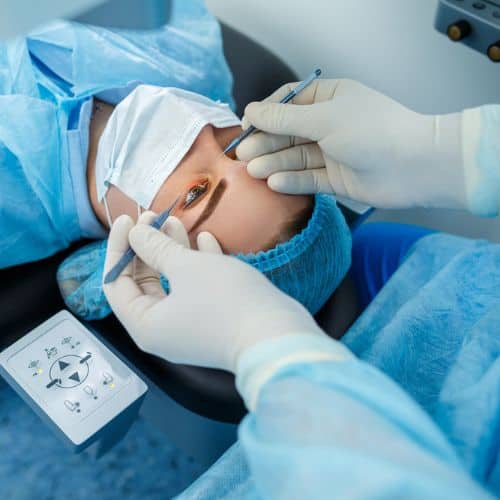
Jacqueline’s outpatient procedure was done under local anesthesia. Dr. Assil created a tiny incision (so small it eliminated the need for stitches) and inserted the light-adjustable lens. The procedure took less than 30 minutes, and the recovery period was about two weeks.
After surgery, Jacqueline was told to avoid strenuous exercise or anything else that significantly increases blood pressure. She also needed to visit the ophthalmologist regularly for several months to monitor the implants.
Request Your Consultation
Call now or book your appointment online.
About the light-adjustable lens
The adjustable light lens is a special IOL that allows the level of correction to be decided after surgery. The light-adjustable lens is fine-tuned using ultraviolet light in a medical office.
When you have cataract surgery, the clouded lens is removed and replaced with a new, artificial lens. While Jacqueline didn’t have cataracts, her light-adjustable IOL procedure followed the same process.
Customizing the lens
After an uneventful surgery, Jacqueline was given two pairs of protective glasses — one with clear lenses, one with brown lenses — to keep out ultraviolet rays. She wore them every minute, unless she was bathing or sleeping. During the recovery process, she also had to apply eye drops daily to aid in healing.
“They aren’t a terrific fashion statement, but they were comfortable,” she says, adding that ultraviolet rays could skew her new lens.
The doctor provided Jacqueline with several visual options to find the best prescription lens for her. After narrowing it down and finding the one that provided the most precise vision, she began her light treatments. The doctor used a Light Delivery Device (LDD) to adjust the lens to fit Jacqueline’s prescription.
Jacqueline underwent three 90-second light treatments. Between the treatments, she continued to wear her protective glasses.
After three light treatments, Jacqueline was ready to see the world. There’s no need for further surgery or any other form of invasive treatment.
End of story, my vision is crystal clear in my left eye. This procedure was a life-changing event for me!
On with the show
Though she still spends plenty of time with her son, who’s going off to college in the fall, Jacqueline is back on the set. Specializing in filming advertisements, you may have seen her work on MTV and ADT commercials.
Though she still wears reading and distance glasses for driving, Jacqueline has 20/20 vision. “I have awesome vision, and the result was worth every second of the work,” says a very happy Jacqueline.
Why trust your eyesight to Assil Gaur Eye Institute?
Under Dr. Assil’s leadership, the Assil Gaur Eye Institute has assembled a team of top ophthalmology specialists from around the country who continue AGEI’s tradition of offering patients the highest quality of specialist eye care in the United States. In keeping with the founding principles of AGEI, our doctors have managed to maintain a comfortable and familiar atmosphere in their clinics, much like family-run medical practices used to be.
Today, the Assil Gaur Eye Institute is nationally recognized for its compassionate patient-centric care, its commitment to pioneering advances in ophthalmology, and its dedication to supporting the health and well-being of its patients and community.
We are conveniently located for patients throughout Southern California and the Los Angeles area at locations in or near Beverly Hills, Santa Monica, West Los Angeles, West Hollywood, Culver City, Hollywood, Venice, Marina del Rey, Malibu, Manhattan Beach, and Downtown Los Angeles.
Request Your Consultation
Call now or book your appointment online.
More Stories You might be interested in


Intraocular Lens (IOLs) Refractive Lens Exchange (RLE)
Mario’s Second Eye Lens Replacement Surgery, This Time With Dr. Assil, was the Charm

Cataract Surgery Intraocular Lens (IOLs)
Sylvia, 75, Goes Glasses-Free for First Time in a Decade After Premium Cataract Surgery with Dr. Assil

Cataract Surgery Intraocular Lens (IOLs)