Iris Conditions in Los Angeles
in Los Angeles
What is an Iris?
The iris is the colored tissue around the pupil in the front part of the eye. It plays a critical role in the overall health and function of the eye by controlling how much light reaches the back of the eye, to the retina.
The iris has two tiny muscles that cause the pupil to contract and dilate. When outdoors, the pupil contracts and the iris expands to protect too much light from entering the eye. In low-light situations, the pupil opens wide, and the iris becomes smaller to let in as much light as possible, making it easier to see in low light.

What are common iris defects?
Iris problems are usually one of two things:
Congenital aniridia
This condition is when a person is born without a complete iris or irises.
Incomplete or torn irises
A penetrating eye injury usually causes this condition. This leaves the eye without a mechanism to regulate how much light enters it. These patients experience nighttime glare, severe light sensitivity, halos, and difficulty seeing objects near and a little farther away clearly at the same time.
Having no iris or a damaged iris can also negatively affect personal appearance and self-esteem.
What are the treatments for iris abnormalities?
It used to be that people born without an iris or with a damaged iris had to live with no functioning way to control the amount of light entering their eyes. People born without an iris often experience severe light sensitivity, glare, and difficulty focusing on objects near and far simultaneously. Also, patients had concerns with the appearance of their eyes.
In May 2018, the Food and Drug Administration (FDA) approved the HumanOptics CustomFlex artificial iris implant that offers persons with absent or damaged irises improved vision by reducing light sensitivity and glare while enhancing the appearance of the iris.
The Customflex artificial iris implant surgery
The Customflex Artificial Iris allows a controlled amount of light to enter the eye while providing shade to the perimeter for those with damaged natural irises. The CustomFlex aids vision by decreasing light sensitivity and nighttime glare.
Moreover, it improves depth perception and the ability to distinguish colors. It improves visual acuity and creates a more pleasing cosmetic appearance. The iris is custom-made, and matching is done so well that, in clinical trials, 94% of patients reported that they were satisfied with the appearance of their new iris.
How is an artificial iris inserted into the eye?
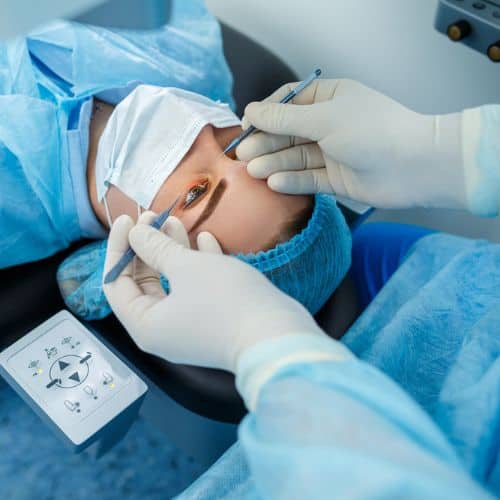
The CustomFlex is a pliable silicone disc rolled up and inserted through a 2.8 mm incision in the cornea (the eye’s clear outer covering). It is then unfolded to cover where the natural iris should be located. The iris implant can be introduced through the small incision, either on its own or during cataract surgery or lens fixation surgery.
This surgery is performed on an outpatient basis in our surgery center, meaning you will go home the very same day. Your ophthalmologist will likely ask you to visit for several follow-up visits to monitor your recovery. Postoperative care includes antibiotics and anti-inflammatory eye drops for 4-6 weeks.
Call now or book your appointment online.
Can an iris implant change the eye color?
No. Because it is a very dangerous and inadvisable use of these products, they are not designed for implantation in front of healthy irises. In addition, there is no FDA approval for cosmetic iris implants.
According to data from the American Academy of Ophthalmology, patients who undergo the procedure in other countries run the risk of developing:
- Eye inflammation, pain, swelling, and irritation.
- Blurred, reduced vision, and even permanent blindness.
- Corneal injuries (corneal decompensation). If severe enough, a corneal transplant may be needed.
- Glaucoma.
- Cataracts.
- Recurring uveitis and hyphema, the collection of blood in the anterior chamber of the eye.
Dr. Assil has been on the leading edge of reconstructive eye surgery for 30 years and is pleased to offer his patients the Human Optics CustomFlex Artificial Iris Implant. Suppose you or a loved one has congenital aniridia or a damaged iris. In that case, the Assil Gaur Eye Institute doctors are highly experienced and will review and discuss options for improving your vision and quality of life.
Assil Gaur Eye Institute, a leader in iris implant surgery and care
The Assil Gaur Eye Institute has been on the leading edge of reconstructive eye surgery for 30 years. It is pleased to offer its patients the Human Optics CustomFlex Artificial Iris Implant. Our advanced surgical techniques utilize cutting-edge technology and meticulous surgical skills to address various eye conditions and achieve optimal outcomes.
Our nationally recognized ophthalmologists and eye institutes are leaders in a wide range of ophthalmological conditions, including state-of-the-art LASIK refractive surgery, retinal treatments such as retinal detachment correction, cataract surgery, glaucoma care, and macular disease, to name just a few.
This is one of the reasons that Los Angeles Magazine named Assil Gaur Eye Institute as one of the Top ophthalmology eye care centers in Los Angeles, year after year.
For patients interested in other aesthetic improvements to the eye area, AGEI’s Oculoplastics and Aesthetics team offers a full range of procedures.
We are conveniently located for patients throughout Southern California and the Los Angeles area in or near Beverly Hills, Santa Monica, West Los Angeles, West Hollywood, Culver City, Hollywood, Venice, Marina del Rey, Malibu, Manhattan Beach, and Downtown Los Angeles.
-
Savant, and J. I. Prydal, “A new customized artificial iris diaphragm for treatment of traumatic aniridia,” Contact Lens & Anterior Eye, vol. 36, no. 2, pp. 93-94, 2013.View at: Publisher Site | Google Scholar
-
Y. S. Mostafa, A. A. Osman, D. H. Hassanein, A. M. Zeid, and A. M. Sherif, “Iris reconstruction using artificial iris prosthesis for management of aniridia,” European Journal of Ophthalmology, vol. 28, no. 1
-
Koch KR, Heindl LM, Cursiefen C, et al. Artificial iris devices: benefits, limitations, and management of complications. J Cataract Refract Surg. 2014;40:376–82.


17,073 TOTAL 1ST PARTY REVIEWS / 4.9 OUT OF 5 STARS


Here’s the latest from Our Seeing Eye Blog



social media for more