Intraocular Lens (IOLs) Refractive Lens Exchange (RLE)
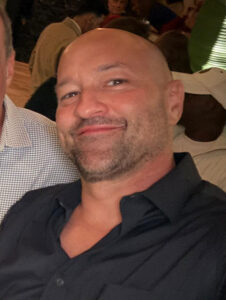
Man Ditches 1,460 Annual Eye Pokes with Extended Depth of Focus Lens Surgery
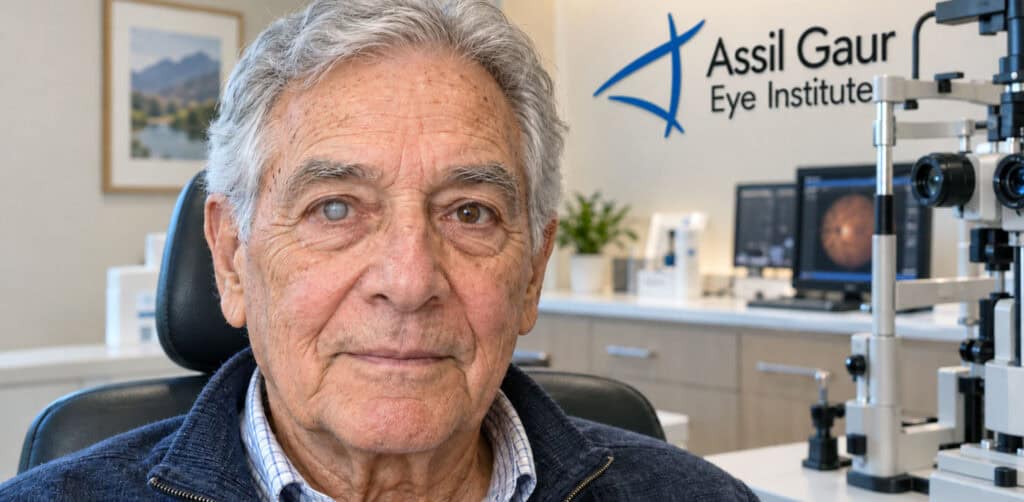
Scott Nelson had been wearing contact lenses for over ten years. He followed a daily routine like clockwork—popping them in every morning, removing them every night, and enduring the occasional dry eyes or misplaced lens. It was a minor inconvenience for clear vision, or so he had convinced himself.
Scott relied on contacts because he was farsighted and could not see anything up close. “My distance vision was okay, but I mainly wore them for close-up tasks since they were bifocals, allowing me to see both near and far,” Scott explains, adding that he could not wear his contacts when he surfed, which he hated!
Was Refractive Lens Exchange the answer to Scott’s vision woes?
Willing to try anything, he went to visit a local ophthalmologist who introduced him to the world of refractive lens exchange (RLE). He was told that lenticular surgery with a PanOptix lens would give him the vision he has wanted for so long.
Unfortunately, the surgery was a failure, and not only did he have to have another surgery to remove the bad implanted lens, but he was also back to sticking his fingers back into his eyes to put in his contact lenses.
“I did the math and figured out that I had put my fingers in my eyes to mess with my contacts a whopping 1,460 times a year,” he says.
Now more frustrated than ever, Scott, a San Jose resident, sought counseling from his sister, who lives in Los Angeles. Without hesitation, she advised him to travel to Beverly Hills and see Dr. Kerry Assil about a state-of-the-art IOL implantation. Though he was very leery to try RLE again, his sister assured him if anyone was going to make him happy, it was Dr. Assil.
Scott’s road trip to Beverly Hills in search of better vision
Scott listened to his sister and drove down to Los Angeles. After spending a lot of time on Google, he was unsure whether to try a LASIK vision correction or another refractive lens exchange (RLE) surgery. After an initial exam with Dr. Assil, Scott asked him about LASIK vs RLE. Dr. Assil told him that he had a simple test that would show him the best option.
First, Dr. Assil gave Scott a unique pair of glasses and told him to look at the eye chart and read the letters. This, he was told, is what the letters would look like after LASIK. Then, he wore another pair of glasses that simulated RLE. “I could tell the difference immediately; it was so much better with the RLE glasses,” he said. “I was told by Dr. Assil that my prior experience was not the fault of the RLE procedure, but that the wrong IOL lens was chosen for my particular eyes.
So Scott decided to trust Dr. Assil and his sister. and decided to go ahead with refractive lens exchange yet again. “I wanted my vision to be as close to perfect as possible, both far and near, which Dr. Assil told me I would have”
Dr. Assil explains, “He was sent to me because he was unhappy with the quality of his vision following his first RLE surgery elsewhere. He felt like he was seeing through a veil. Upon evaluation, it became clear that LASIK would not benefit him because he has naturally small pupils (which increase the depth of focus). We decided the best option would be an extended depth of focus intraocular lens coupled with a low degree of monovision.”
Unlike monofocal lenses, extended depth-of-focus IOLs provide reasonable distance and intermediate vision and improve near vision.
The idea of waking up every morning and seeing clearly without fumbling for contacts or glasses sounded like a dream. Scott decided to move forward.
A leap of faith for an extended range of vision
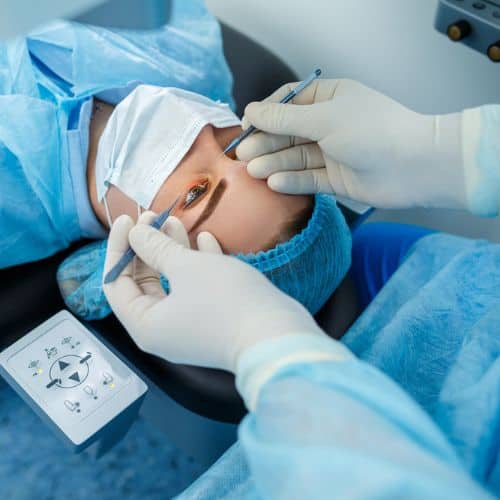
The day of the surgery arrived. Scott was a bit nervous, but the procedure itself was surprisingly smooth. It was performed under local anesthesia, and within a few hours, he was back home.
“You’ll notice a difference as soon as tomorrow,” said Dr. Assil. “But give it a few weeks for your brain and eyes to adapt to the extended depth of focus lens fully.”
The next morning, when he opened his eyes, the world came into focus—not just the big things, like the furniture in his sister’s house, but also near distances, like the weave of the quilt on her guest room bed and the soft rays of sunlight spilling through the blinds.
He blinked and turned to the alarm clock on the nightstand. For years, Scott had squinted to make out the numbers. Now, they were crystal clear. “I thought it would take a couple of weeks before I could see so effortlessly like this. I was thrilled” said Scott.
A week later, Scott sat in his own bathroom, staring at the collection of contact lens cases, solution bottles, and backup glasses. He smiled and gathered them into a box. That part of life was over.
“I think of all the time I’ve saved not having to hassle with contacts,” he says. “Five minutes in the morning, five minutes at night, plus optometrist visits. Just 10 minutes a day is 60 hours saved annually. The time savings are insane!”
Driving to work felt surreal. He marveled at how effortlessly he could read road signs, see them in the distance, and glance down at the dashboard without straining. At the office, he breezed through emails on his computer and read handwritten notes without the nagging thought that he needed reading glasses.
Now, in his free time, Scott rides the wild surf, able to observe the waves as they form far out on the horizon.
Request Your Consultation
Call now or book your appointment online.
The world reimagined with EDOF
The EDOF lenses aren’t just about better vision. They spell freedom. Freedom from the routines and limitations that had defined life. Every day feels like a minor miracle.
EDOF offers a reduced risk of halos, glare, and contrast sensitivity, while multifocal intraocular lenses are more likely to experience these issues.
“If you have a chance to undergo RLE with Dr. Assil, don’t wait,” he says, adding that he has not experienced any halos post-surgery. “My quality of life has improved so much. I only wish I’d done it sooner.”
Why choose Assil Gaur Eye Institute for Refractive Lens Exchange vision correction?
The Assil Gaur Eye Institute (AGEI) is renowned for its expertise in the refractive lens exchange procedure and ophthalmology care. Their eye care team of seasoned optometrists and ophthalmologists is among the most experienced in the United States, specializing in monocular, myopia, multifocal IOLs, LASIK, PRK, cataract surgery, and RLE.
With cutting-edge technology and a commitment to patient care, AGEI provides highly patient-satisfied advanced treatment for various conditions, including hyperopia, emmetropia, bilateral implantation, glaucoma, macular degeneration, presbyopia-correcting retinal issues, corneal conditions, and trifocal intraocular lenses.
Take the first step toward crystal-clear vision.
Request Your Consultation
Call now or book your appointment online.
Assil Gaur Eye Institute is conveniently located for patients throughout Southern California and the Los Angeles area at locations in or near Beverly Hills, Santa Monica, West Los Angeles, West Hollywood, Culver City, Hollywood, Venice, Marina del Rey, Malibu, Manhattan Beach, and Downtown Los Angeles.
Sources
-
Clinical outcomes of a new extended range of vision intraocular lens: International Multicenter Concerto Study
-
Visual Outcomes and Patient Satisfaction for Trifocal, Extended Depth of Focus, and Monofocal Intraocular Lenses | Journal of Refractive Surgery
https://journals.healio.com/doi/10.3928/1081597X-20190618-01
-
Extended Depth-of-Field Intraocular Lenses: An Update
https://www.sciencedirect.com/science/article/pii/S2162098923002001?via%3Dihub
-
Visual Outcomes and Patient Satisfaction for Trifocal, Extended Depth of Focus, and Monofocal Intraocular Lenses
-
Visual Performance After Unilateral Implantation of an Extended Depth-of-Focus Intraocular Lens in Patients With Unilateral Cataract
More Stories You might be interested in

Refractive Lens Exchange (RLE)
Steve’s Refractive Lens Exchange with Dr. Gaur Reveals He’d Been Color-Blind for Decades!

Cataract Surgery Refractive Lens Exchange (RLE)
Woman Too Scared to Drive With Cataracts Gets Better-Than-Perfect Vision from Dr. Assil 20 Years After LASIK
Cataract Surgery Refractive Lens Exchange (RLE)