Assil Gaur Eye Institute Among First in USA to Implant TECNIS PureSee IOL to Patients
The PureSee Lens brings LASIK-Like Vision to Cataract and Refractive Lens Exchange Patients in Los Angeles
What Is the TECNIS PureSee IOL?
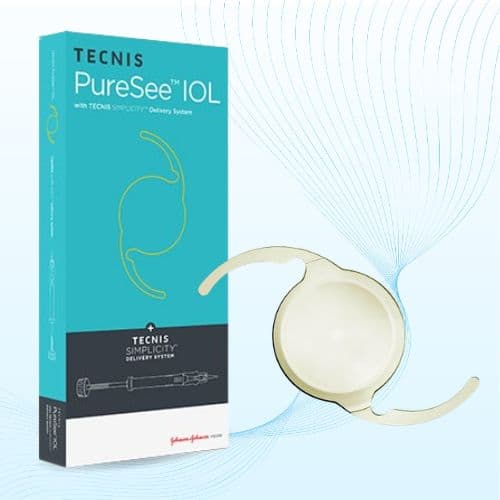
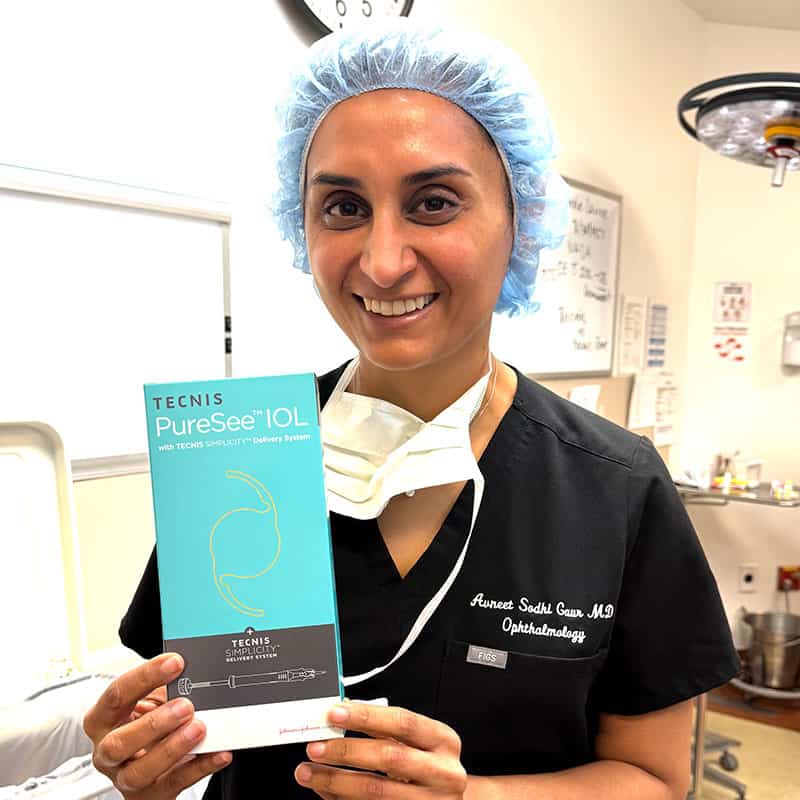
The TECNIS PureSee is a breakthrough intraocular lens (IOL) that is a premium artificial intraocular lens implant during cataract or Refractive Lens Exchange (RLE) surgery to replace the natural lens of the eye. Once implanted, it affords the patient LASIK-like vision quality for both near and far vision.
Developed by Johnson & Johnson Vision and recently approved by the U.S. Food and Drug Administration (FDA), it represents the next generation of extended depth-of-focus (EDOF) IOL technology, designed to deliver exceptional visual outcomes across a wide range of distances.
For patients facing cataract surgery or refractive lens exchange, or those who are not eligible for LASIK or are tired of contact lenses, the TECNIS PureSee offers something genuinely new: crisp, natural, clear vision quality previously associated only with LASIK. All without the need for laser surgery.
This is the second-generation evolution of TECNIS premium lens technology, setting a new standard for what patients can expect from an IOL implant, moving beyond older accommodative designs.
“The PureSee Lens further deepens our ability to serve patients seeking long-term solutions for vision correction. To achieve results that match patient expectations, it is important to custom-select lenses that best address the natural optical characteristics of each eye.
Just as the same shoe size and design is not the best solution for every foot, IOLs must be customized to optimally synergize with the optical reality of each patient’s eye. In this regard, the PureSee serves as our lens of choice for many of our patients who have certain eye characteristics, including small pupils, naturally flat-shaped corneas, previously treated with LASIK for nearsightedness, and a high degree of astigmatism, to name a few,” says Dr. Kerry Assil, Medical Director, Assil Gaur Eye Institute.
Who Is a Good Candidate for the TECNIS PureSee IOL?
The TECNIS PureSee was designed with a broad patient population in mind. You may be a strong candidate if you:
- Are you considering cataract surgery to remove a cloudy lens
- Have presbyopia (age-related difficulty focusing up close) and want to reduce or eliminate their dependence on reading glasses
- Are not a suitable candidate for LASIK due to corneal conditions such as a thin cornea
- Refractive errors outside of LASIK’s treatable range
- Are you considering refractive lens exchange (also called lens replacement surgery) to address vision correction without cataract surgery
- Have pre-existing corneal astigmatism (since the TECNIS PureSee Toric II IOL is one of the most advanced IOLs designed specifically to correct astigmatism)
- Want excellent distance vision and intermediate vision with reduced reliance on glasses for most daily activities
Please note that patients with medically uncontrolled glaucoma, active retinal detachment risk, or certain cornea conditions may not be appropriate candidates. Your ophthalmologist at Assil Gaur Eye Institute will evaluate your full eye health history during a thorough preoperative consultation to determine your individual lens suitability.
Call now or book your appointment online.
How the TECNIS PureSee Works: Purely Refractive EDOF Technology

Most current premium lenses, including traditional multifocal IOLs and some EDOF designs, represent a specific type of IOL that uses what is called “diffractive optics.” Diffractive optics uses tiny patterns to split light so the eye can focus on different distances simultaneously. That helps you see near, far, and in between.
But because the light is divided instead of going to a singular point, each image at a different distance can be a bit less sharp. The quality of the individual lens polymer of each IOL model can also factor into how crisp your vision may be under all circumstances.
An IOL’s diffractive optics design can also introduce other trade-offs for some patients. These can include reduced contrast sensitivity and light disturbances such as halos, glare, and starbursts, which some patients find bothersome, especially at night.
The TECNIS PureSee takes a fundamentally different approach. It uses a purely refractive, extended-depth-of-focus design, meaning it bends light using the lens’s physical shape rather than diffractive rings. The result:
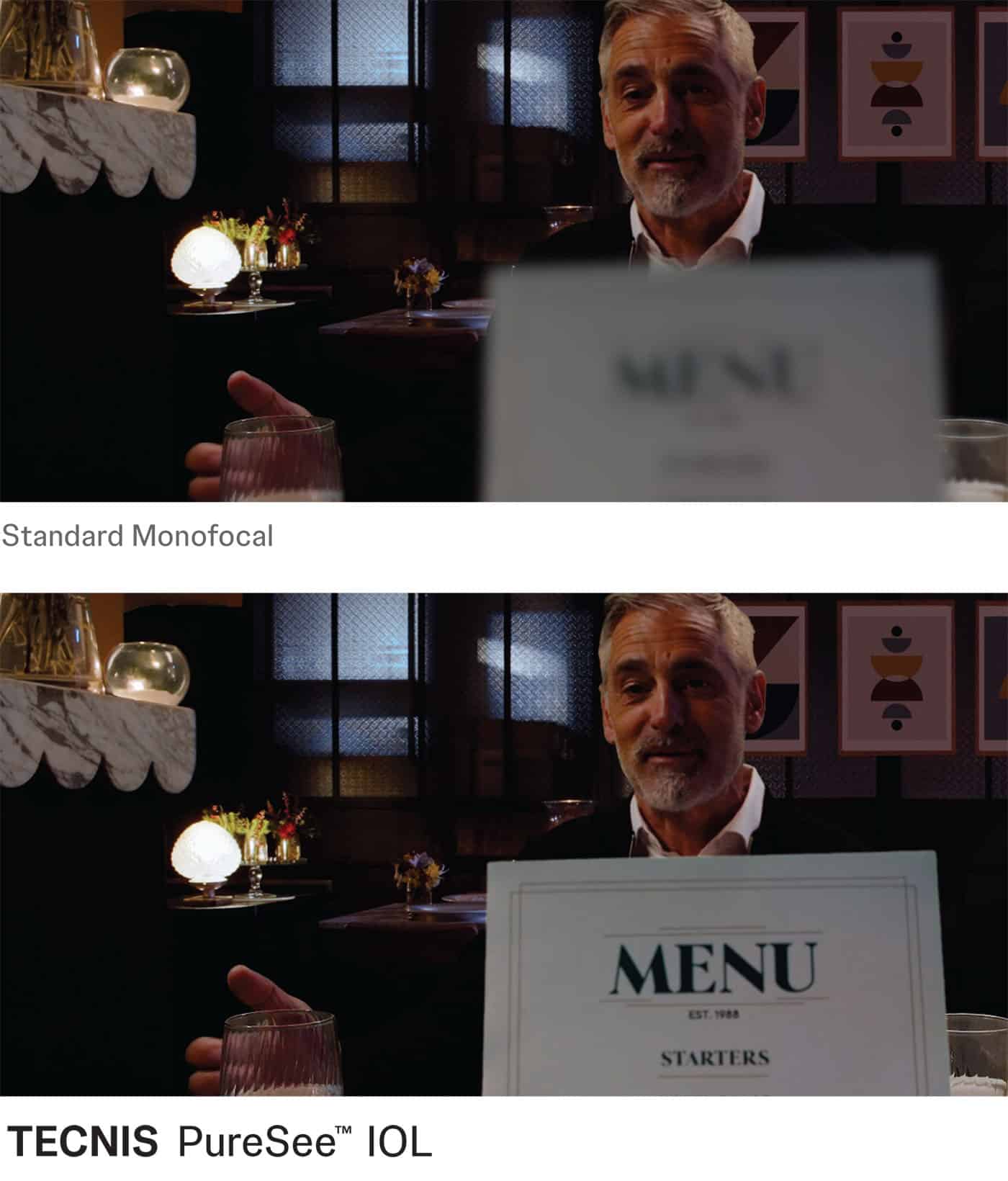
- Monofocal-like distance visual acuity — the sharp, reliable distance vision you’d expect from standard monofocal lenses, but with extended range
- Excellent intermediate vision — ideal for computer screens, dashboards, and most indoor tasks
- Some near vision — reduced but meaningful for many patients — also making it a great option for patients accustomed to monovision contact lenses, as it can surpass the visual quality of such lenses.
- Monofocal-like dysphotopsia profile — significantly fewer halos, glare, and visual disturbances compared to multifocal IOLs
- No warning for loss of contrast sensitivity — the TECNIS PureSee is the first and only EDOF IOL in the U.S. without an FDA-required warning on loss of contrast sensitivity
Despite some constraints, a prospective, randomized, multi-center clinical study found that 90% of patients occasionally or never wore glasses, 97% did not experience bothersome visual disturbances, and 97% said they would recommend the lens to a friend or family member.
“We approach the TECNIS PureSee lens option as a solution for our patients who are especially concerned about the recovery time for overcoming driving-associated nighttime haloes,” says Dr. Avneet Gaur, Assil Gaur Eye Institute.
The Surgical Procedure: What to Expect
Cataract surgery and refractive lens exchange with the TECNIS PureSee IOL follow the same well-established outpatient surgical procedure used for standard lens replacement. Here’s a general overview:
Preoperative evaluation
First, we do a comprehensive preoperative workup, including corneal topography, biometry, and a full eye health assessment. This determines the correct IOL power, confirms suitability, and allows your surgeon to plan for astigmatism correction if needed.
The procedure
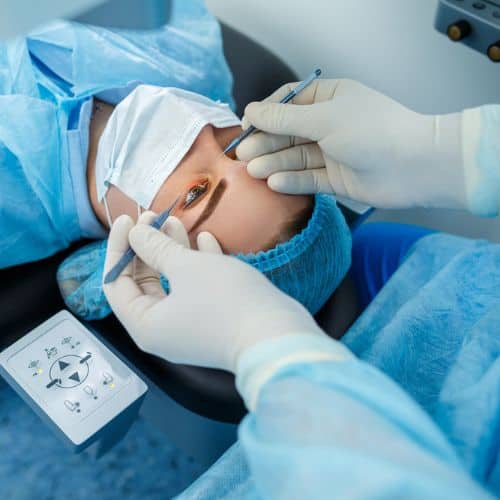
Performed as an outpatient surgical procedure, typically under local anesthesia with a mild sedative. Drs. Assil and Gaur create a small incision in the cornea and gently remove the stiffened or clouded contents of the natural lens using ultrasound energy (phacoemulsification).
With the cloudy lens now gone, we then employ real-time laser measurements of the eye to achieve a custom match of lens power and design, delivering perfect vision for each eye. Selecting that lens (from our vast on-hand inventory), they insert the folded TECNIS PureSee IOL using the TECNIS SIMPLICITY Delivery System.
The lens unfolds and positions itself in the capsular bag, the outer shell of your eye’s natural lens. The initial entry site seals spontaneously during surgery, typically allowing patients to resume their normal activities the next day.
Postoperative care
Most patients notice improved vision within 24–48 hours. You will be instructed to use prescription eye drops postoperatively to manage inflammation and prevent infection. Full healing and stabilization of visual outcomes typically occur over several weeks. Your care team at AGEI will schedule follow-up visits to monitor your progress and eye health.
Important considerations
Sometimes, though rarely, an opacification of the natural lens’s remaining outer shell (posterior capsular opacification – PCO) can occur. This clouding of the membrane behind the lens can develop months or even years after surgery. Fortunately, it is easily treated with a pain-free 30-second in-office laser procedure.
Rare risks associated with cataract-style surgery include infection, inflammation, and glaucoma-related pressure changes. Our cataract specialists will review all potential side effects and risks with you in detail.
Why Choose Assil Gaur Eye Institute for Your TECNIS PureSee IOL?
At Assil Gaur Eye Institute, our ophthalmologists have decades of combined experience with advanced IOL implants, LASIK, refractive lens exchange, and the full spectrum of surgical and medical eye surgery care. AGEI is recognized as one of the leading vision correction centers in the country, offering the most current premium lens technologies as soon as they become available — including the newly FDA-approved TECNIS PureSee.
Our approach is highly individualized. We don’t recommend a single solution to every patient. Instead, our preoperative process carefully evaluates your cornea, retina, glaucoma risk, refractive errors, and visual lifestyle before determining which IOL, or whether a different procedure like LASIK or monovision, is the right fit for you.
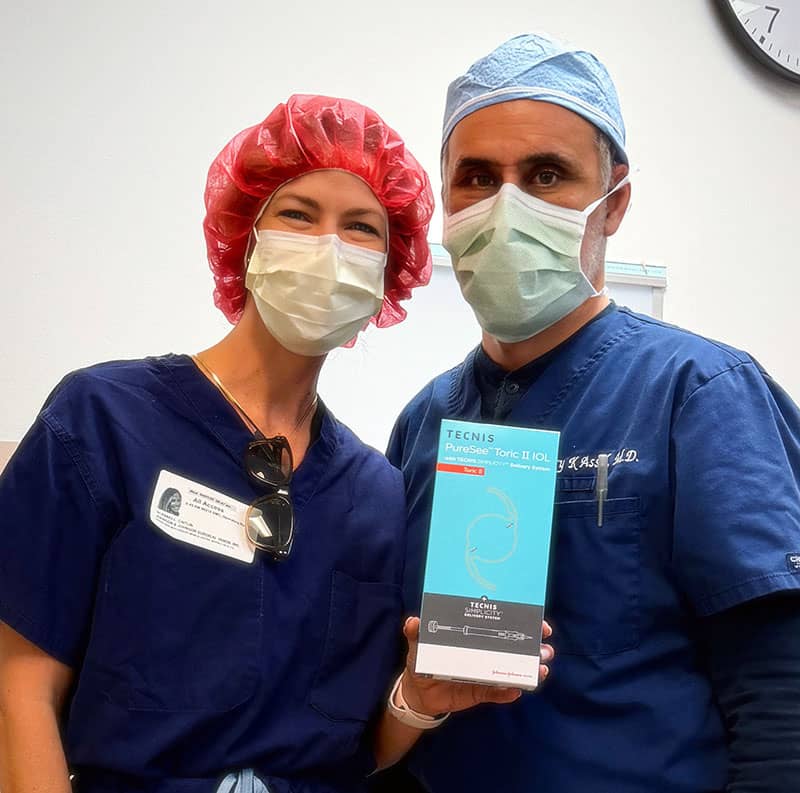
We also offer the TECNIS PureSee Toric II, an advanced toric lens, for patients who need to correct astigmatism alongside presbyopia or cataract, delivering precise outcomes for a wider range of visual needs.
“The PureSee has further deepened our toolbox for customizing the delivery of clear vision without glasses or contact lenses. Having already worked for over two decades, with the base polymer that the PureSee is crafted from, we know this lens will permanently remain crystal clear within the eye,” says Dr. Kerry Assil, Assil Gaur Eye Institute.
Call now or book your appointment online.
Ready to See Clearly Again? Schedule Your Cataract or RLE Consultation at Assil Gaur Eye Institute
If you’re exploring your options for cataract surgery, lens replacement, or vision correction and want to learn whether the TECNIS PureSee IOL is right for you, the first step is a comprehensive evaluation with one of our ophthalmologists.
At Assil Gaur Eye Institute, we offer the most advanced eye care available — with the expertise, technology, and personalized approach to help you achieve the clearest, most natural vision possible at every distance.
Please call (866) 945-2745 or make an appointment online.
We are conveniently located for patients throughout Southern California and the Los Angeles area at locations in or near Beverly Hills, Santa Monica, West Los Angeles, West Hollywood, Culver City, Hollywood, Venice, Marina del Rey, Malibu, Manhattan Beach, and Downtown Los Angeles.
Frequently Asked Questions About the TECNIS PureSee IOL
How is the TECNIS PureSee different from multifocal IOLs?
Unlike multifocal lenses, the TECNIS PureSee uses a purely refractive extended depth-of-focus design — not diffractive rings. This can potentially mean fewer halos, better contrast sensitivity, and a visual experience closer to that of a standard monofocal IOL, but with a much wider range of vision.
Will I still need reading glasses after the TECNIS PureSee?
In clinical studies, 90% of patients occasionally or never wore glasses after receiving the TECNIS PureSee. Some patients may still use reading glasses for small print or demanding near tasks. Your surgeon will discuss realistic expectations for your individual prescription and lifestyle.
Does the TECNIS PureSee correct astigmatism?
Yes. The standard TECNIS PureSee is intended for patients with less than 1 diopter of corneal astigmatism. The TECNIS PureSee Toric II is specifically designed for patients with 1 diopter or more of corneal astigmatism. The PureSee toric IOLs can correct astigmatism at the same time as lens replacement.
What is extended depth of focus (EDOF)?
Extended depth of focus is a category of premium IOL technology, one of several types of intraocular lenses, that extends the focal range rather than creating separate near and far focal points, as with multifocal lenses. The result is a smooth, continuous range of vision, particularly strong at distance and intermediate, with fewer of the light disturbances associated with multifocal designs.
How long does cataract surgery with the TECNIS PureSee take?
The outpatient surgical procedure typically takes 15–20 minutes per eye. Most patients go home the same day and notice improved vision within 24–48 hours.
What is posterior capsular opacification (PCO)?
PCO is the most common long-term side effect after an IOL implant surgery. It occurs when the capsule behind the lens becomes cloudy over time, causing blurred vision similar to a cataract. It is easily and painlessly treated with a quick in-office laser procedure called a YAG laser capsulotomy.
Is the TECNIS PureSee covered by insurance?
Standard cataract surgery is typically covered by Medicare and most insurance plans. However, premium IOLs like the TECNIS PureSee involve an additional out-of-pocket cost for the upgrade. AGEI’s team can discuss coverage and financing options during your consultation.
Can I have the TECNIS PureSee if I've previously had LASIK?
Possibly, but it requires additional preoperative measurements. Prior LASIK changes the cornea’s shape, which affects how IOL power is calculated. Your ophthalmologist at AGEI will use specialized measurements to determine whether you are a good candidate and which lens power is appropriate.
Sources:
Johnson & Johnson Announces FDA Approval of TECNIS PureSee Intraocular Lens, a Breakthrough Solution for U.S. Cataract Patients
https://www.jnj.com/media-center/press-releases/johnson-johnson-announces-fda-approval-of-tecnis-puresee-intraocular-lens-a-breakthrough-solution-for-u-s-cataract-patients
TECNIS PureSee™ IOL
https://www.jnjvisionpro.com/en-us/products/tecnis-puresee/
Factors to Consider in Choosing an IOL for Cataract Surgery
https://www.aao.org/eye-health/tips-prevention/best-artificial-lens-implant-iol-cataract-surgery

Written by The AGEI Educational Team

Medically Reviewed by Dr. Kerry Assil