XEN Gel Stent Surgery: A Complete Guide When Glaucoma Drops Fail
When Glaucoma Drops and Laser Treatments Fail
You’ve tried the eye drops. You may have tried laser treatment. And yet your intraocular pressure is still climbing, putting the vision you have left at risk. That’s an exhausting and frightening place to be, and it’s exactly the situation the XEN Gel Stent was designed to address.
This guide explains how the XEN Gel Stent works, who qualifies, what the procedure and recovery involve, and, just as important, when XEN is the right choice and when a different surgical approach may serve you better. If you’re a glaucoma patient who has exhausted medical therapy and needs a proven surgical next step, you’ll find the honest answers here.
Specifically, you’ll learn how the XEN Gel Stent lowers intraocular pressure through a subconjunctival drainage pathway, what the candidacy criteria and contraindications are in plain language, and what to look for in a glaucoma surgeon in Los Angeles. If you’d like a broader overview of your options, our comprehensive glaucoma care, led by fellowship-trained ophthalmologist Dr. Avneet K. Sodhi Gaur, covers the full treatment spectrum, from diagnosis through surgery.

When Drops and Laser Aren’t Enough: Why Refractory Glaucoma Patients in Los Angeles Are Turning to the XEN Gel Stent
Refractory glaucoma means your intraocular pressure (IOP) has not responded adequately to maximum tolerated medical therapy, including multiple eye drop classes and often selective laser trabeculoplasty. At that point, the clinical question shifts from “which medication?” to “which surgery, and in what order?”
The XEN Gel Stent occupies a specific and important position in that surgical sequence. It sits between canal-based minimally invasive glaucoma surgery (MIGS) devices like the iStent and Hydrus Microstent, which produce modest IOP reductions, and trabeculectomy, which is more powerful but carries a higher complication profile.
For patients who need more pressure reduction than MIGS can deliver but aren’t yet at the point where trabeculectomy is the only option, XEN is frequently the most appropriate next step. Because XEN drains fluid to a small reservoir beneath the conjunctiva, much like trabeculectomy, many specialists classify it as minimally invasive bleb surgery (MIBS), a category closely related to MIGS.
In Los Angeles, where patients often manage demanding professional and personal schedules, XEN’s minimally invasive nature and relatively short recovery window make it a practical choice. But “minimally invasive” should never mean “minimally considered.” The decision requires a fellowship-trained glaucoma specialist who can evaluate your full clinical picture.
What Is the XEN Gel Stent and How Does It Lower Eye Pressure?
The XEN Gel Stent is a 6-millimeter tube made from medical-grade porcine gelatin, manufactured by AbbVie as part of the XEN Glaucoma Treatment System. The FDA cleared it in November 2016 for refractory glaucomas, including cases where previous surgical treatment has failed, and for primary open-angle glaucoma, pseudoexfoliative glaucoma, and pigmentary glaucoma with open angles that are unresponsive to maximum tolerated medical therapy.
The device creates a new drainage channel from the eye’s anterior chamber to the subconjunctival space, the area just beneath the conjunctiva (the clear membrane covering the white of the eye). Aqueous humor flows through this channel and collects in a small reservoir called a bleb, where surrounding tissue gradually absorbs it. This bypasses the eye’s blocked natural drainage system entirely.
The clinical data behind this mechanism are specific. In the FDA pivotal trial for refractory glaucoma, XEN lowered mean IOP from 25.1 mmHg to 15.9 mmHg at 12 months, and the average number of glaucoma medications dropped from 3.5 to 1.7. A peer-reviewed study of XEN in medically refractory open-angle glaucoma in the United States confirmed the stent is effective and relatively safe out to one year, with sustained reductions in both IOP and medication burden. Longer-term multicenter data show these benefits persisting over three years.
For authoritative device specifications and full safety information, the official XEN Gel Stent manufacturer site provides the complete FDA indications and important safety information.
Are You a Candidate? Who Qualifies – and Who Doesn’t – for XEN Gel Stent Surgery
The ideal XEN candidate has open-angle glaucoma, specifically primary open-angle, pseudoexfoliative, or pigmentary glaucoma, with IOP that remains uncontrolled despite maximum tolerated medical therapy.
Patients who have previously undergone laser treatment without sufficient IOP reduction are also appropriate candidates. The procedure can be performed as a standalone surgery or combined with cataract surgery in the same operative session.
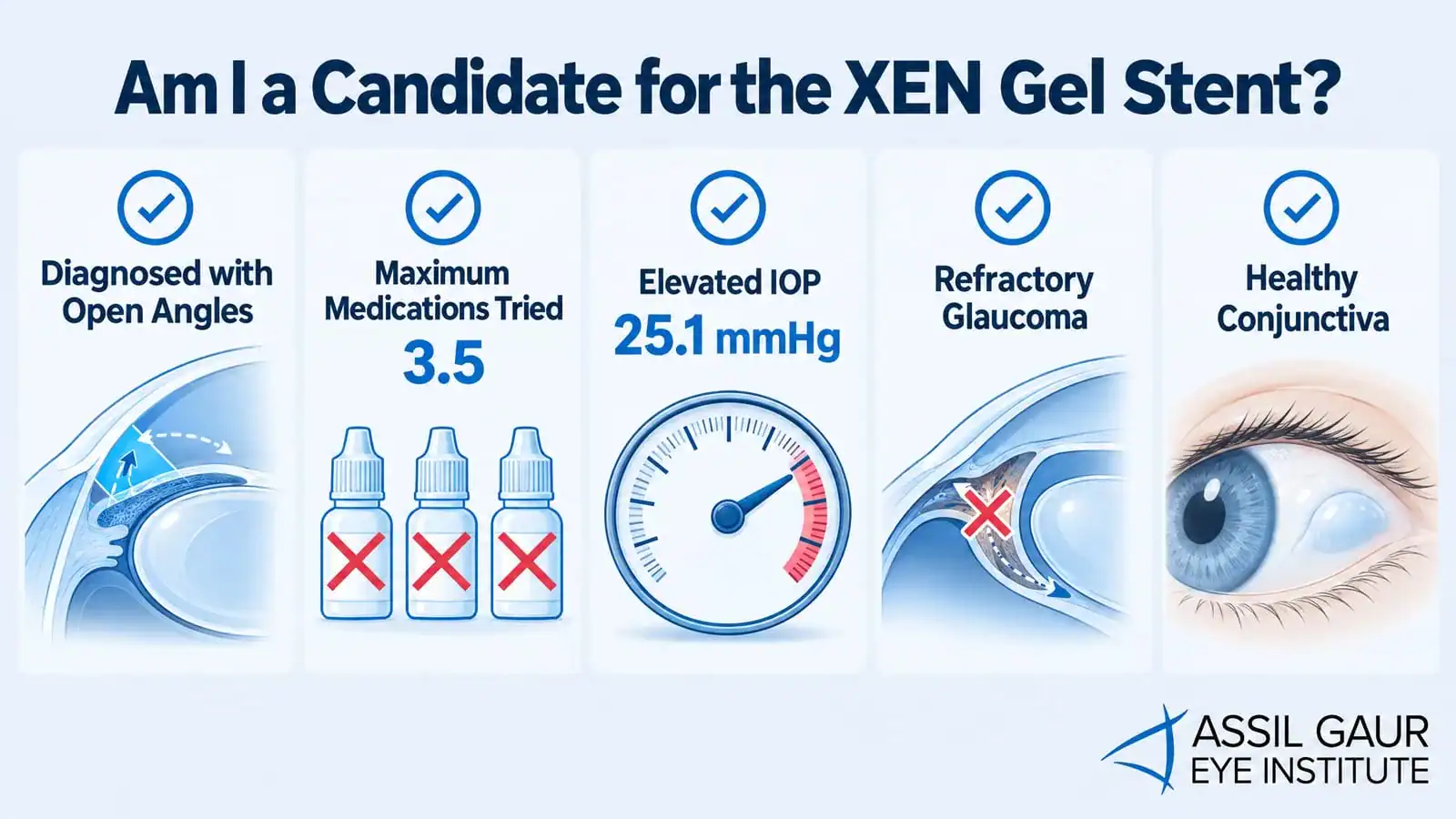
Candidates should have healthy conjunctiva where the stent will be placed, no active eye inflammation, and no prior glaucoma shunt or valve in that same area of the eye. Your surgeon will assess the drainage angle, conjunctival health, and overall disease severity before recommending XEN.
Who is a good candidate for XEN Gel Stent surgery?
The ideal XEN candidate has open-angle glaucoma, specifically primary open-angle, pseudoexfoliative, or pigmentary glaucoma, with IOP that remains uncontrolled despite maximum tolerated medical therapy. Patients who have previously undergone laser treatment without sufficient IOP reduction are also appropriate candidates. The procedure can be performed as a standalone surgery or combined with cataract surgery in the same operative session.
Candidates should have healthy conjunctiva where the stent will be placed, no active eye inflammation, and no prior glaucoma shunt or valve in that same area of the eye. Your surgeon will assess the drainage angle, conjunctival health, and overall disease severity before recommending XEN.
Who should not receive the XEN Gel Stent?
The XEN Gel Stent is contraindicated in several specific situations. Patients with angle-closure glaucoma where the drainage angle has not been surgically opened are not candidates. The procedure is also not appropriate for patients who have a glaucoma shunt or valve, or conjunctival scarring or disease, in the area where the stent would be placed; active eye inflammation (such as uveitis, keratitis, or blepharitis); active neovascularization of the iris, an anterior chamber intraocular lens, silicone oil in the eye, or vitreous present in the anterior chamber.
XEN is not the right device for every glaucoma patient. At AGEI, Dr. Avneet K. Sodhi Gaur performs trabeculectomy, tube shunts, and MIGS procedures in addition to XEN, so her recommendation is based on what your eye needs, not which device is available.
The XEN Gel Stent Procedure: What to Expect Before, During, and After Surgery
How long does XEN Gel Stent surgery take and what is recovery like?
The procedure itself typically takes 10 to 20 minutes and is performed in an operating room under local anesthesia. A small incision is made through the cornea, and the XEN stent is placed using a preloaded injector, creating the drainage pathway to the space beneath the conjunctiva. Because the stent is placed from inside the eye, no incision through the conjunctiva is needed, one of the key differences from traditional trabeculectomy.
Recovery is more involved than canal-based MIGS but less demanding than trabeculectomy. Most patients experience blurred vision, mild discomfort, and light sensitivity in the first week. You’ll use antibiotic and anti-inflammatory eye drops for several weeks post-operatively. IOP is monitored closely in the first month, as the bleb can scar down during this period, which is why proximity to your surgical center matters.
For Los Angeles patients on the Westside, in Beverly Hills, or in Santa Monica, the ability to attend follow-up appointments without navigating cross-city traffic is a genuine clinical advantage. The first four to six weeks require frequent check-ins, and missing them can affect outcomes.
Risks and Possible Complications
Like any eye surgery, XEN Gel Stent implantation carries risks. Most are uncommon and manageable, but you should understand them before deciding.
Possible complications include:
-
Low eye pressure (hypotony), which can cause blurred vision
-
Bleeding inside the eye (hyphema)
-
Fluid buildup behind the retina (choroidal effusion)
-
Movement of the stent (implant migration) or the stent becoming exposed through the conjunctiva
-
Leakage at the wound site
-
Scarring of the bleb, which may require needling or additional surgery
Dr. Gaur will review which risks apply to your eye and how they’re monitored during recovery.
XEN Gel Stent vs. Trabeculectomy: Understanding Your Surgical Options
Both XEN and trabeculectomy create a subconjunctival bleb to drain aqueous humor, but they differ significantly in surgical approach, IOP reduction potential, and complication profile. Here’s how the two compare:
|
Factor |
XEN Gel Stent |
Trabeculectomy |
|---|---|---|
|
Surgical approach |
Placed from inside the eye through a small corneal incision, without cutting the conjunctiva |
Surgical opening created through the conjunctiva and sclera |
|
Procedure time |
10-20 minutes |
45-90 minutes |
|
IOP reduction |
Moderate, often into the mid-teens |
Greater, often into the low teens or below |
|
Recovery |
Weeks, with close follow-up |
Months, with intensive follow-up |
|
Complication risk |
Generally fewer serious complications, though bleb scarring and needling are more common |
Higher risk of hypotony, infection, bleb leak, and faster cataract progression |
|
Best for |
Moderate refractory glaucoma; patients needing IOP in the mid-teens |
Advanced glaucoma; patients needing very low IOP targets |
|
Reversibility |
Needling can revise a failing bleb |
Revision surgery is more complex |
The honest answer is that XEN is not always the right choice. If your glaucoma is advanced and your target IOP is in the single digits or very low teens, trabeculectomy may deliver the pressure reduction you need. Dr. Gaur’s ability to offer both procedures means the recommendation you receive at AGEI reflects your clinical reality, not a limited surgical menu.
Can XEN Gel Stent Surgery Be Combined with Cataract Surgery?
Yes, and this combination is more common than most patients realize. When a glaucoma patient also has a visually significant cataract, performing XEN Gel Stent implantation and cataract removal in the same session means one surgery, one recovery, and one anesthesia exposure instead of two.

The combined procedure is particularly relevant for older patients with primary open-angle glaucoma who are approaching the point where cataract surgery is indicated anyway. Addressing both conditions at the same time is efficient and clinically sound. At AGEI, Dr. Gaur is a fellowship-trained cataract and glaucoma specialist, so the same surgeon can plan and perform both parts of the combined procedure.
Your surgeon will also help you choose an intraocular lens. Because glaucoma can affect contrast sensitivity, we approach lens selection carefully, and your options will depend on your optic nerve health and visual goals.
What happens if the XEN Gel Stent stops working? Is needling required?
The needling procedure is a minor in-office intervention performed when the bleb created by the XEN stent begins to scar down, reducing drainage and allowing IOP to rise again. It involves using a fine needle to break up the scar tissue around the bleb, restoring aqueous outflow. It is performed under topical anesthesia and typically takes only a few minutes.
Needling does not mean the original surgery failed. It is a recognized and expected part of XEN management for a subset of patients, and the rate varies depending on individual healing response, prior conjunctival surgery, and post-operative anti-scarring medication use such as mitomycin C (MMC). Some patients require needling once; others never need it. The key is having a surgical team experienced enough to identify early bleb failure and intervene before IOP climbs to dangerous levels.
This is why close follow-up matters. Recognizing early signs of bleb scarring allows your surgeon to intervene with needling before eye pressure rises significantly, often avoiding the need for further surgery.
Why Surgeon Expertise Matters: Glaucoma Care at Assil Gaur Eye Institute in Los Angeles
The XEN Gel Stent is a precision device. Its position beneath the conjunctiva affects both safety and results: placed too shallow, the stent risks exposure; too deep, and drainage may be limited. Accurate placement and careful follow-up come from surgical training and experience with the device.
At Assil Gaur Eye Institute, Dr. Avneet K. Sodhi Gaur, a fellowship-trained glaucoma specialist, leads glaucoma care and uses XEN, trabeculectomy, tube shunts, and the full range of MIGS devices, including iStent. Because she offers every surgical option, her recommendation is based on what your eye needs.
AGEI’s surgical team has performed over 100,000 vision correction procedures and has trained more than 14,000 surgeons worldwide, a depth of experience that directly benefits every patient who walks through the door.
Patient Lauren W. noted that “Dr. Gaur took the time to get up to speed on my case and was very thorough in her assessment of my condition and recommending a course of treatment that was appropriate.” For a condition as nuanced as refractory glaucoma, that thoroughness is not optional. It is the foundation of a good surgical outcome.
If you’ve been told you need glaucoma surgery and want an honest evaluation of whether XEN Gel Stent is right for your situation, the first step is a consultation with a specialist who can offer every option. Schedule your evaluation through our glaucoma care page and speak directly with Dr. Gaur’s team about your case.
Frequently Asked Questions
What is the XEN Gel Stent and how does it treat glaucoma?
The XEN Gel Stent is a 6-millimeter gelatin tube manufactured by AbbVie and FDA-cleared in 2016. It is implanted through a small corneal incision and creates a drainage channel from the anterior chamber to the subconjunctival space, forming a bleb where aqueous humor collects and is absorbed. This bypasses the eye’s blocked natural drainage system and lowers intraocular pressure. In the FDA pivotal trial, it reduced mean IOP from 25.1 to 15.9 mmHg at 12 months while cutting average medication use nearly in half.
How does the XEN Gel Stent compare to trabeculectomy?
Both procedures create a subconjunctival bleb, but XEN is implanted through a small corneal incision without cutting the conjunctiva, making it less invasive and faster to perform (10 to 20 minutes versus 45 to 90 minutes for trabeculectomy). Trabeculectomy typically achieves lower IOP targets and is preferred for advanced glaucoma requiring very aggressive pressure control. XEN is better suited for moderate refractory glaucoma where a target IOP in the mid-teens is sufficient. XEN generally has fewer serious complications, though it more often requires needling, and both procedures require close post-operative monitoring.
Is the XEN Gel Stent covered by insurance?
The XEN Gel Stent is an FDA-approved device for refractory glaucoma, and Medicare and most major commercial insurance plans generally cover the procedure when medical necessity criteria are met, including documented failure of maximum tolerated medical therapy. Coverage specifics vary by plan, and prior authorization is often required. AGEI’s team can assist with insurance verification and documentation during the consultation process.
Can XEN Gel Stent surgery be combined with cataract surgery?
Yes. Combining XEN Gel Stent implantation with cataract removal is a well-established approach for patients who have both conditions. The combined procedure means one surgery and one recovery instead of two. Your surgeon will also help you choose an intraocular lens suited to your eye health and visual goals. At AGEI, Dr. Gaur performs both cataract and glaucoma surgery.
The combined procedure means one surgery and one recovery, not two. Your surgeon will also help you choose an intraocular lens suited to your eye health and visual goals. At AGEI, Dr. Gaur performs both cataract and glaucoma surgery.
-
Allergan. XEN Glaucoma Treatment System Directions for Use.
https://www.rxabbvie.com/pdf/xen_dfu.pdf -
Grover DS, Flynn WJ, Bashford KP, et al. Performance and safety of a new ab interno gelatin stent in refractory glaucoma at 12 months. Am J Ophthalmol. 2017;183:25-36.
https://pubmed.ncbi.nlm.nih.gov/28784554/ -
Three-year effectiveness and safety of the XEN gel stent as a solo procedure or in combination with phacoemulsification in open-angle glaucoma: a multicentre study. Acta Ophthalmol. doi:10.1111/aos.14886
https://pubmed.ncbi.nlm.nih.gov/33973370/ -
Intraocular pressure and medication changes associated with Xen gel stent: a systematic review of the literature. Clin Ophthalmol. Vol 17.
https://pubmed.ncbi.nlm.nih.gov/36660309/

Written by The AGEI Educational Team

Medically Reviewed by Dr. Avneet Sodhi Gaur