Reading Vision LASIK®: The Procedure Built to Target Near Vision.
You held the menu a little farther away the other night. Then a little farther still. Somewhere in your mid-40s, your arms stop being long enough, and bifocals or reading glasses begin turning up in every drawer in the house.
For a long time, patients who wanted out of that cycle had two real options: Keep the readers or accept monovision (which corrects one eye for distance, the other for near, and asks your brain to sort out the difference). Reading Vision LASIK® was developed as a third path.
Below is what the procedure does, how it compares to monovision LASIK, where it came from, and who tends to do well with it.
Why reading gets harder in your 40’s
The condition behind all of this is called presbyopia—distinct from farsightedness or hyperopia—and essentially everyone develops it. Starting around age 40, your eye’s natural lens stiffens, so your focusing muscle has less to work with. As a result, it becomes increasingly difficult to focus on near objects and tasks.
Your distance vision often holds steady. Near vision is what slips first, causing an age-related form of farsightedness. The American Academy of Ophthalmology has a straightforward overview of presbyopia and what causes it.

Presbyopia isn’t a disease, and it isn’t a sign that something has gone wrong with your eyes. It’s a mechanical change that progresses into your 60s and peaks there. After that, your lens eventually loses transparency (forming a cataract).
What Reading Vision LASIK® does
Standard LASIK and PRK refractive surgery reshape the cornea, the clear dome at the front of your eye, to correct refractive errors like myopia or astigmatism, so light lands correctly on your retina. Reading Vision LASIK uses the same laser technology with a very different treatment plan.
Instead of reshaping the cornea uniformly, our surgeons sculpt only the segment you use for close work. The rest of the corneal surface stays as it is, so more of the intermediate and distance vision in that eye is preserved. Technically, this means the excimer laser applies a graduated pattern of corneal power across a precisely mapped treatment zone rather than a single, uniform ablation profile. The transition from the near-vision zone to the surrounding cornea is blended carefully so the optical shift feels natural to your visual system rather than abrupt.
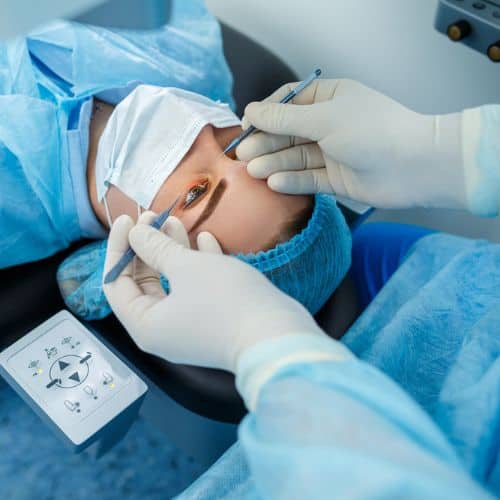
The procedure uses an advanced excimer laser platform and typically takes only a few minutes per eye once the corneal flap is created, keeping total chair time for most patients well under thirty minutes. The laser’s precision is measured in fractions of a micron, which is why individual corneal mapping before surgery matters so much to the outcome.
Picture a small reading zone placed directly on the surface of your eye, sitting exactly where your near vision happens. That is Reading Vision LASIK. Where standard LASIK targets a single focal point optimized for distance, Reading Vision LASIK is engineered to restore a functional near-vision range without sacrificing the clarity your distance vision depends on, a distinction that matters enormously when you are comparing your options.
Why pupil size matters with Reading Vision LASIK
Earlier efforts to treat presbyopia with a laser kept running into the same obstacle. Your pupil isn’t a fixed opening. It constricts inward in response to bright light and also when you focus on something close up. It opens back up in dim light or when you focus on something far away.
Pupillary narrowing during close work is very useful because it creates a reading zone centered on the cornea that gathers the relevant incoming light from a near object. The catch is that pupil size varies quite a bit from person to person. A treatment planned around an average pupil won’t behave the same way in every eye, which is why our surgeons measure your pupils under several lighting conditions and build the treatment around your numbers rather than a standard profile.
How Reading Vision LASIK differs from Monovision LASIK
Monovision LASIK is the older and better-known approach. Our surgeons correct your dominant eye for distance (treating your nearsightedness) and your non-dominant eye for near. Your brain quickly adapts to favor whichever eye fits the moment.
Plenty of people do well with it. It also requires a genuine trade-off, because the near-corrected eye gives up real distance clarity to get there. Patients who adapt poorly tend to report the same handful of complaints: softer depth perception, glare and halos after dark, and less confidence driving at night. Eye Wiki’s clinical overview of monovision LASIK candidacy and side effects walks through these in detail.
Reading Vision LASIK® offers a blended vision solution that comes at the same problem from a different angle. Because only one segment of the cornea carries the near correction, the treated eye retains more of its intermediate and distance function. You aren’t splitting distances between your two eyes; you’re extending depth of focus as both eyes work across a range.
That difference shows up most in the middle distance. Dashboards, price tags, computer monitors, and the face of the person across the table all live in that middle zone, and monovision is generally weakest right there.
No corneal procedure is completely free of trade-offs. Reshaping the cornea to serve two distances can still slightly reduce contrast in dim light (though less than with classical monovision), and our surgeons will review what that means for you before you decide.
Who invented Reading Vision LASIK, and why
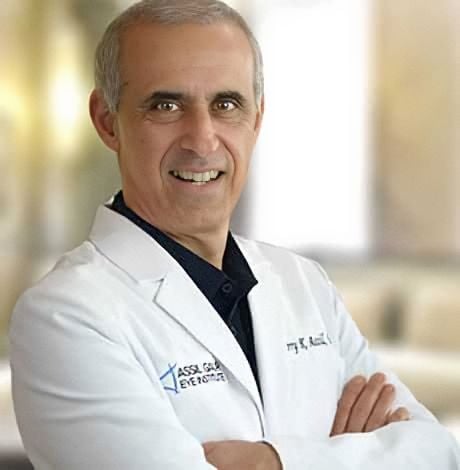
Dr. Kerry Assil developed Reading Vision LASIK® in 2008. He also helped pioneer LASIK in the United States and has spent his career refining laser vision correction and cataract surgery at the highest level.
The idea came directly from what he observed in the exam room. Patients in their 40s and 50s wanted freedom from reading glasses and constant eye strain, but the existing options asked too much of them. Standard monovision left gaps at intermediate distances, and early multifocal laser treatments produced inconsistent results from one patient to the next.
Dr. Assil traced much of that inconsistency back to a variable that earlier approaches ignored: each person’s pupil behaves differently. By designing the treatment around individual pupil measurements, he moved multifocal laser correction from a promising concept to a reliable, repeatable procedure.
The result is a sculpting pattern that delivers maximum focusing power at the center of the cornea for near vision, transitions gradually to intermediate power as the pupil expands for computer distance, and reaches zero additional power at full dilation for clear distance sight. Applied to one eye, the approach captures the near benefit of monovision while preserving binocular distance vision and adding the intermediate range that most patients rely on throughout their day.
That precision is what separates Reading Vision LASIK from earlier attempts at the same goal, and it is why patients who want world-class results seek out the surgeon who invented the procedure.
Call now or book your appointment online.
Who’s a good candidate for Reading Vision LASIK?
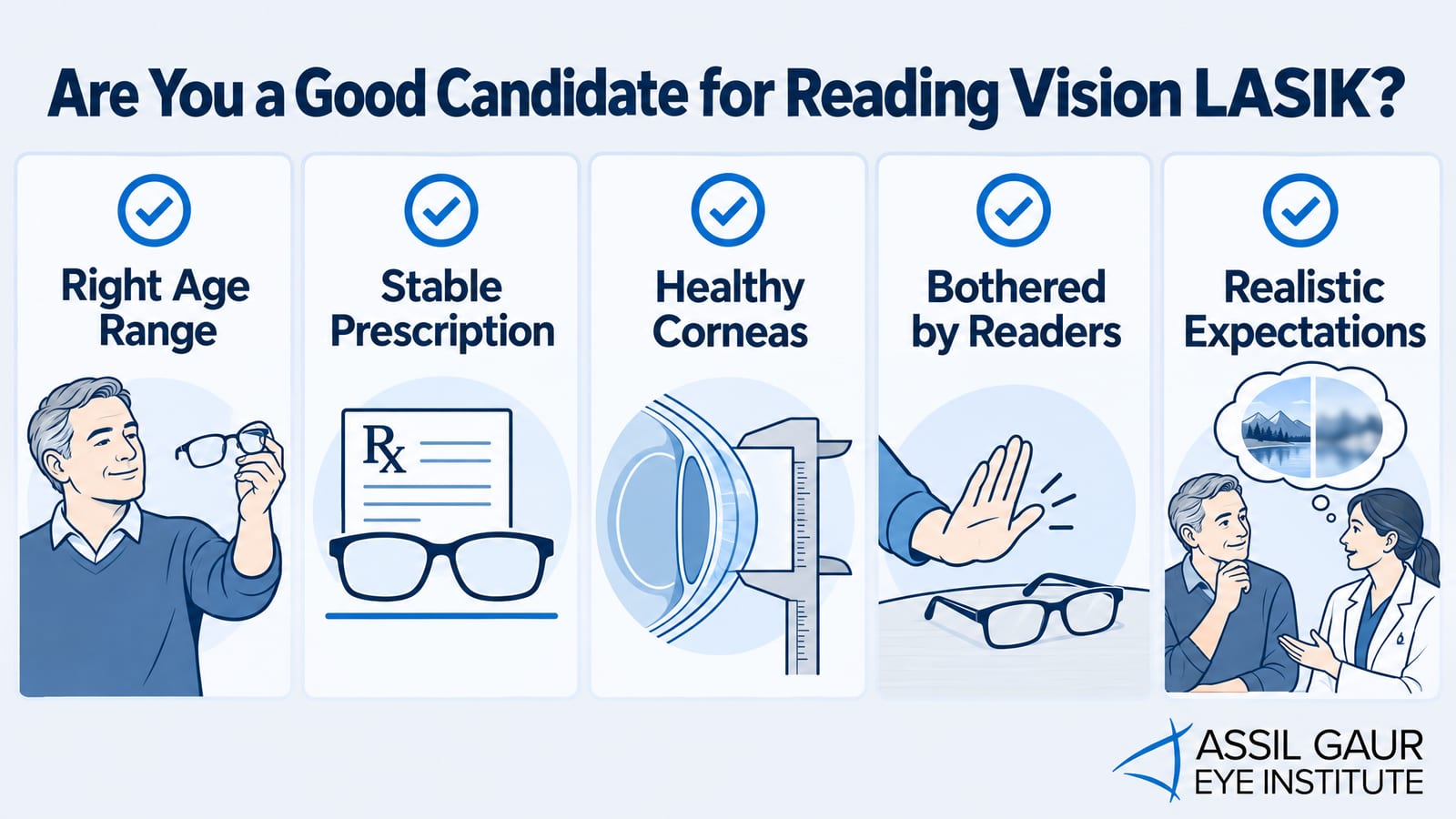
Our ophthalmologists weigh several factors before recommending the procedure. Broadly speaking, you’re a reasonable candidate if you:
-
Are somewhere in your 40s or 50s, when presbyopia is established, but your natural lens is still clear.
-
Have had a stable glasses or contact lens prescription (at distance) for over a year.
-
Have healthy corneas with enough thickness to safely treat with the laser.
-
Are bothered by reading glasses or your distance glasses, or need reading glasses with excellent distance vision.
-
Want to keep strong intermediate and distance vision when viewing with both eyes.
-
Have realistic expectations about what any laser procedure can deliver.
Patients who’ve already tried monovision, whether in surgery or through monovision contact lenses, and didn’t care for it are often a good fit here. The complaint that sends them looking for an alternative is usually the exact one this procedure was designed to answer.
Who isn’t a good candidate?
The procedure isn’t right for everyone, and our surgeons will tell you plainly if you fall into one of these groups:
-
Your prescription is still shifting from year to year.
-
You have keratoconus, another corneal disease, or corneas too thin to treat safely.
-
You have significant dry eye that hasn’t been addressed.
-
You have uncontrolled glaucoma, diabetic retinopathy, or another active eye condition.
-
You’re pregnant or nursing, since hormonal changes can temporarily shift your prescription.
-
You have advanced cataracts, in which case a lens-based procedure usually makes more sense.
A few occupations also call for a longer conversation. If you fly aircraft, drive commercially, or do fine detail work in low light, our doctors will walk you through how any presbyopia treatment might affect you on the job. The U.S. Food and Drug Administration keeps a plain-language page on when LASIK is not for me.
Age factors in too, though not as a hard cutoff. Patients past their late 50s sometimes get longer-lasting results from refractive lens exchange (RLE), since that procedure replaces the aging lens with an IOL instead of working around it.
What to expect: recovery and results
Once you’ve confirmed you’re a good candidate, it’s natural to wonder what actually happens after the procedure. The good news is that Reading Vision LASIK recovery is generally quick and straightforward for most patients.
Most people notice a meaningful improvement in their vision within the first 24 to 48 hours. Arrange a ride home after the procedure, and plan to rest your eyes for the rest of the day. Many patients return to desk work, reading, and light daily activities within a day or two, though your surgeon will give you personalized guidance based on your eyes specifically.
In the first week, some patients experience mild light sensitivity, a slight halo effect around lights at night, or a temporary sense that their vision is still “settling.” These sensations are common and typically fade as your eyes adapt to their new corneal shape. Because Reading Vision LASIK is precision-engineered to graduate corneal power from near to distance, your brain also goes through a short adaptation period as it learns to prioritize the right focal zone for each task. Most patients find this adjustment feels natural within a few weeks.
In terms of results, the goal is meaningful freedom from reading glasses for everyday tasks like menus, phone screens, computer work, and dashboards, while preserving solid distance vision. Results vary by individual, and your candidacy evaluation will give you a realistic picture of what to expect. The surgeons at Assil Gaur Eye Institute are trusted by elite patients worldwide precisely because they set honest expectations and deliver on them.
What happens at your consultation
We don’t decide anything in the first 10 minutes. Our team maps your corneas, measures your pupils under different lighting conditions, checks your tear film, confirms the health of the remainder of your eye, and reviews your prescription history.
You’ll also talk through how you use your eyes day to day. Someone who reads three books a week has different priorities than someone who spends 10 hours behind the wheel, and a good treatment plan reflects that.
And if Reading Vision LASIK® isn’t the right fit, our surgeons will tell you and recommend what is.
Assil Gaur Eye Institute of Los Angeles: leaders in LASIK technology
If you’re ready to find out whether you can put the reading glasses away for good, our ophthalmologists can tell you in a single visit whether Reading Vision LASIK makes sense for your eyes. They’ve been performing laser vision correction procedures and LASIK eye surgery in Southern California for decades.
That level of trust is earned. Elite athletes and performers who depend on their vision at the highest level have chosen AGEI for their care. LeBron James trusted our surgeons with his eyes, and the same world-class precision and exclusive EagleVision LASIK technology available to NBA All-Stars is available to every patient who walks through our doors. As one patient put it: “I knew I was going to the very best.” With over 100,000 vision correction surgeries performed and more than 14,000 surgeons trained worldwide, our team brings unmatched experience to every Reading Vision LASIK consultation. The enviable outcomes speak for themselves.
Please call (866) 945-2745 or book your complimentary evaluation online.
We’re conveniently located for patients throughout Southern California and the Los Angeles area, with locations in or near Beverly Hills, Santa Monica, West Los Angeles, West Hollywood, Culver City, Hollywood, Venice, Marina del Rey, Malibu, Manhattan Beach, and Downtown Los Angeles.
-
Presbyopia | National Eye Institute
https://www.nei.nih.gov/learn-about-eye-health/eye-conditions-and-diseases/presbyopi -
What Is Presbyopia? – American Academy of Ophthalmology
https://www.aao.org/eye-health/diseases/what-is-presbyopia -
KAMRA and Raindrop Corneal Inlays: What Patients Need to Know – American Academy of Ophthalmology
https://www.aao.org/eye-health/treatments/corneal-inlays-alternative-to-reading-glasses -
What Is Photorefractive Keratectomy (PRK)? – American Academy of Ophthalmology
https://www.aao.org/eye-health/treatments/photorefractive-keratectomy-prk
Call now or book your appointment online.

Written by The AGEI Educational Team

Medically Reviewed by Dr. Kerry Assil