Unveiling the Innovative Apthera™ IOL: A Leap Forward in Vision Restoration
Navigating the world of intraocular lenses (IOLs) can be confusing. So we’re shedding light on the innovative Apthera™ IOL from AcuFocus, Inc., a lens replacement option that stands out.
Unlike standard monovision lenses that restore vision at a single focus point (often distance), the IC-8 Apthera intraocular lens is a multifocal lens designed to improve near, intermediate, and distance vision. This reduces or even eliminates your dependence on prescription glasses, bifocals, and contacts.
How does the IC-8 Apthera Intraocular Lens improve vision?
So, how does the Apthera Intraocular Lens bring clarity back into your life? Using proprietary small-aperture technology, the Apthera IOL’s embedded FilterRing™ filters out unfocused light, allowing only focused light to reach your retina. Filtering out low-quality light provides a continuous range of vision, from near, far, and even intermediate vision – that’s like a triple-focus lens!

At the heart of this technology is a carbon black FilterRing™ embedded within the lens optic. This ring measures just 3.23 mm in diameter with a 1.36 mm central aperture, creating a pinhole-like effect that dramatically extends your depth of focus. Think of it like squinting to read fine print – except the lens does all the work automatically, all day long.
This approach sets the Apthera Intraocular Lens apart from diffractive EDOF lenses, which split incoming light into multiple focal points using microscopic ring-shaped steps etched into the lens surface. Diffractive designs can introduce halos, glare, and contrast loss, particularly in low-light conditions. The Apthera IOL avoids splitting light entirely. Instead, it blocks unfocused peripheral rays while passing only the sharpest central light to your retina, preserving contrast and delivering cleaner, more natural vision across a full range of distances.
The FDA-approved Apthera IOL can provide your best personal vision by treating cataracts, correcting for astigmatism, and mitigating the effects of presbyopia. For patients seeking premium, world-class cataract care in Los Angeles, our team at Assil Gaur Eye Institute is proud to offer this advanced lens as part of our commitment to enviable outcomes and freedom from glasses.
How does the Apthera IOL compare to other intraocular lenses?
When exploring premium cataract surgery options, understanding how the Apthera intraocular lens compares with other IOL types can make a real difference in choosing the right lens for your lifestyle. Here is a straightforward look at how the Apthera IOL fits into the broader world of vision correction options.
Standard monofocal IOLs correct vision at just one fixed distance, meaning most patients still need glasses for reading or distance tasks after surgery. They deliver sharp clarity at that single focal point, but the trade-off is ongoing dependence on corrective lenses for everyday activities.
Multifocal IOLs attempt to address multiple distances by splitting light into several focal points. While many patients enjoy reduced dependence on glasses, this design can introduce visual disturbances like halos and glare, particularly in low-light conditions, which some patients find frustrating over time.
Standard extended depth-of-focus lenses stretch the range of clear vision along a continuous focal path, which reduces some of the halos associated with multifocal designs. However, they can still struggle with significant astigmatism or irregular corneas.
The Apthera intraocular lens takes a different, more advanced approach. Its small aperture pinhole design filters and focuses light more precisely, delivering a full range of vision while naturally minimizing halos and glare. It is also uniquely suited for patients with mild to moderate corneal irregularities, a group that many other premium IOLs simply cannot serve as effectively. For patients who want world-class results and freedom from glasses, the Apthera IOL offers a genuinely distinctive solution.
Clinical outcomes and FDA approval for the IC-8 Apthera IOL
When considering any premium vision correction procedure, you want to know the science behind it. The good news is that the Apthera Intraocular Lens has a strong clinical track record and earned FDA approval through a rigorous review process that gives patients and surgeons real confidence in its performance.
The FDA approved the IC-8 Apthera IOL following a comprehensive clinical study that evaluated patients across multiple sites. The results were genuinely impressive. In the pivotal trial, most patients achieved functional vision across a full range of distances without needing glasses for most everyday tasks. Patients reported high satisfaction rates, particularly for reading, using digital screens, and navigating intermediate distances like a car dashboard or computer monitor.
One of the most meaningful findings was how well the Apthera IOL performed for patients with mild to moderate corneal irregularities, a group that has historically been harder to treat with standard premium lenses. The small-aperture design helped mask those imperfections, delivering clearer, more consistent vision than many patients expected going into surgery.
The FDA review also confirmed that the lens demonstrated a favorable safety profile, with adverse event rates comparable to standard monofocal lenses. That’s significant because it means patients can pursue advanced, full-range vision without taking on substantially greater risk.
If you are curious about how life improves after cataract surgery with a premium IOL like the Apthera, the clinical data strongly suggest the outcomes speak for themselves. World-class results start with world-class technology.
Am I a candidate for Apthera IOL?
The Apthera IOL is an excellent option for cataract patients and patients with low corneal astigmatism or presbyopia (age-related vision changes). Because the Apthera Intraocular Lens uses small-aperture optics to extend your depth of focus, the right candidacy evaluation can make the difference between a good outcome and a truly enviable one.
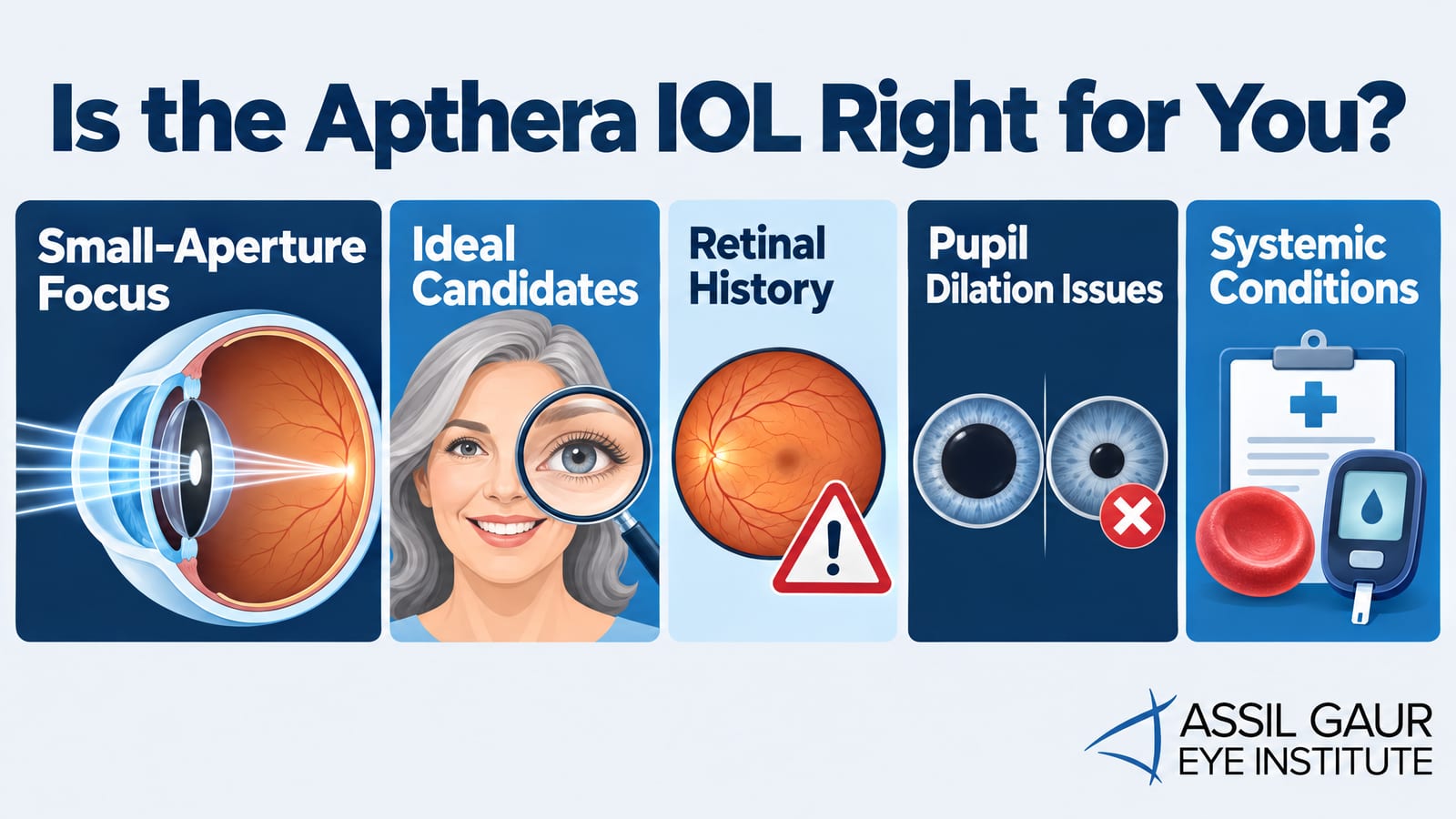
However, the Apthera small-aperture IOL isn’t appropriate for all patients. You might not qualify for the Apthera IOL if you have:
-
A history of retinal disease or predisposition to retinal disease.
-
Issues with pupil dilation.
-
Diabetes, sickle cell disease, or other medical conditions that affect your immune system or healing.
What happens during your candidacy evaluation?
At Assil Gaur Eye Institute, your complimentary evaluation goes well beyond a standard eye exam. Our surgeons take precise corneal topography measurements to map your cornea’s curvature and health, assess your pupil size and reactivity under different lighting conditions, and review your complete ocular history. These measurements help confirm that your corneal astigmatism falls within the low range the Apthera IOL is designed to address.
One of the most important steps is determining your dominant eye. The Apthera IOL is typically implanted in the non-dominant eye, while a complementary premium lens is placed in the dominant eye. This pairing strategy is designed to give you a full range of vision at near, intermediate, and distance without relying on glasses. Our team uses a simple, proven dominance test during your evaluation to identify the right eye for each lens, so your visual outcome is as precise and personalized as possible.
If you are curious whether the Apthera Intraocular Lens is the right choice for your lifestyle and vision goals, schedule your complimentary evaluation with our world-class surgical team today.
Call now or book your appointment online.
What to expect during and after Apthera IOL surgery
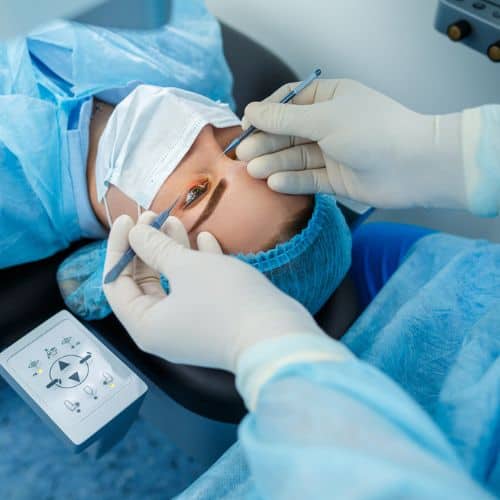
Once your candidacy evaluation confirms that the Apthera intraocular lens is the right fit for you, the surgery is straightforward and typically takes less than 30 minutes per eye. Your surgeon will administer numbing eye drops to keep you comfortable throughout, and most patients report only mild pressure, not real discomfort. The Apthera IOL is implanted through a small incision, replacing your eye’s natural lens with a precision-shaped lens backed by decades of surgical expertise.
You will need someone to drive you home afterward, and you should take it easy for the rest of the day. Most patients notice a meaningful improvement in their vision within 24 to 48 hours, though your eyes will continue to adapt and refine their focus over the following weeks. Mild light sensitivity or slight blurring early in recovery is normal as your visual system adjusts to the Apthera IOL’s small-aperture optics.
Follow-up appointments are an important part of the process. Your care team will monitor your healing and ensure you stay on track for the full-range vision results the lens is designed to deliver. Many patients find that everyday activities improve significantly in the weeks after surgery, from reading menus to driving at night, all with far less dependence on glasses. With world-class surgical care guiding every step, most patients describe the entire experience as far easier than they anticipated.
What are the benefits of the Apthera IOL?
With all the IOLs on the market, what makes Apthera IOL your best option? While Apthera isn’t for everyone, it has some advantages over other available intraocular lenses.
A wider range of visual acuity
The Apthera extended depth of focus IOL improves your vision at all ranges. Most patients won’t need reading glasses or other corrective lenses after their IOL procedure.
Corrects astigmatism and cataracts
Non-toric lenses are commonly used to treat cataracts — replacing the cloudy lens with a new artificial lens. Apthera IOLs have a good success rate for patients with irregular corneas — such as those with astigmatism or who have previously had laser vision correction. AcuFocus’s toric lens can also correct up to 1.5 diopters of astigmatism.
Minimally invasive
The IOL implant procedure is quick and painless, with a quick recovery time. Our patients go home the same day (although you will need someone else to drive you home).
Maintain contrast sensitivity
Extended depth-of-focus lenses can affect contrast sensitivity (the ability to distinguish an object from its background) by allowing your eye to focus on near, middle, and far vision simultaneously. To prevent this problem, it is advised to have the Apthera IOL inserted in your non-dominant eye and a monovision IOL in the other eye (the fellow eye)
Your dominant eye receives a different lens because of how your brain processes visual information. Your dominant eye leads when your brain is assembling a complete picture of the world, so placing a standard monovision IOL there preserves the sharpest possible distance vision, where your visual system relies on it most. The Apthera Intraocular Lens then handles the extended range in your non-dominant eye, and your brain blends the two inputs into a single, cohesive image with a full range of vision.
A monovision IOL is a single-focus premium lens calibrated to optimize vision at one specific distance, typically far. When paired with the Apthera IOL, the two lenses work together as a complementary system rather than competing with each other, which is what helps protect contrast sensitivity across lighting conditions, including low-light situations like driving at night.
Most patients adapt to this pairing within a few weeks as the brain learns to favor the appropriate eye depending on the task at hand. During your complimentary evaluation at Assil Gaur Eye Institute, our world-class surgical team will confirm your eye dominance and walk you through exactly what to expect during the adjustment period, so you feel confident and informed before your procedure.
Do you have more questions about the IC-8 Apthera IOL?
Are you intrigued by the possibilities of the IC-8 Apthera IOL and curious whether you’re a good candidate for this state-of-the-art intraocular lens? Schedule a visit with the experts at Assil Gaur Eye Institute today. Our dedicated team will review your eye health and family history to determine whether you’re a good candidate for this life-changing treatment.
Dr. Gaur is one of the few surgeons in Southern California now implanting the IC-8 lens, providing patients with exceptional near, intermediate, and distance vision. Dr. Gaur is thrilled to be at the forefront of this medical advancement.
Trust Assil Gaur Eye Institute’s decades of experience
At the Assil Gaur Eye Institute, your vision is our mission. With us, you are not just a patient, but part of our family. We are committed to providing exceptional, personalized care to protect and improve your vision.
Assil Gaur Eye Institute combines world-class technology, expert surgeons, personalized care, patient education, and a strong track record to deliver the best and most trusted cataract surgery care. Trust us to provide the care you deserve because every eye is precious at Assil Gaur Eye Institute.
Our eye centers are conveniently located throughout Southern California and the Los Angeles area, including Beverly Hills, Santa Monica, West Los Angeles, West Hollywood, Culver City, Hollywood, Venice, Marina del Rey, Malibu, Manhattan Beach, and Downtown Los Angeles.
In addition to laser cataract surgery, the ophthalmology experts at AGEI are nationally recognized for their eye care and treatment options for a full range of conditions, including macular degeneration, glaucoma, floaters, and flashes, dry eye, presbyopia, keratoconus, and diabetic retinopathy, as well as LASIK laser eye surgery and much more.
Call now or book your appointment online.
Apthera IOL FAQs
What sets the Apthera IOL apart from other lens replacement choices?
In contrast to conventional monofocal lenses and monofocal toric IOLs, which only enhance vision at a single focal point (typically distance), the Apthera IOL improves near, intermediate, and far vision. This can reduce or eliminate the need for prescription glasses, bifocals, and contact lenses.
When is it possible for me to return to my usual routines?
Many of our patients can return to their normal routines within a few days of their Apthera IOL operation. However, individual recovery times may vary. Your physician will provide the most precise recovery timeline for you.
What can I anticipate during the post-operation recovery phase?
We will prescribe medicated eye drops to support healing and relieve any post-operative discomfort.
Will I require glasses or contact lenses after the operation?
You might still need prescription eyewear for optimal vision, but your dependence on them will be significantly less than with other lens implants.
How can I determine if I’m a suitable candidate for the Apthera IOL?
Conditions like preexisting retinal diseases and other serious eye issues may heighten the risk of complications and make patients ineligible for the Apthera IOL. Consult with our healthcare providers if you have other medical conditions that may impact your candidacy for IOL implantation. We conduct a thorough eye examination before devising a personalized treatment plan to confirm your candidacy for this procedure.
How long does the Apthera IOL last?
The Apthera intraocular lens is a permanent implant. Once placed, it does not need replacement, and because it sits inside the eye rather than on the surface, it requires no daily maintenance.
Will I still need glasses after the Apthera IOL?
Most patients experience a meaningful reduction in their dependence on glasses for everyday tasks. The small-aperture design extends your depth of focus across near, intermediate, and distance ranges, giving many patients the freedom from glasses they have been looking for. Individual results do vary, so your surgeon will set realistic expectations during your consultation.
Is the Apthera IOL FDA approved?
Yes. The IC-8 Apthera IOL received FDA approval, and clinical studies have shown reliable, consistent outcomes for patients with cataracts and corneal irregularities.
Can the Apthera IOL correct astigmatism?
One standout advantage of the Apthera intraocular lens is its ability to deliver clear vision even in patients with mild to moderate corneal astigmatism, making it a strong option for people who previously felt they had limited premium lens choices.
If you are curious how life can improve after cataract surgery, our team is ready to walk you through every detail. Schedule a complimentary evaluation with Assil Gaur Eye Institute today.

Written by The AGEI Educational Team

Medically Reviewed by Dr. Avneet Sodhi Gaur