Intraocular Lens (IOLs)
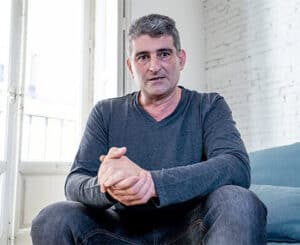
Engineer Reads Eye Chart from Across the Hall After Getting Revolutionary Cataract Lens
One day after his groundbreaking Odyssey IOL lens implantation during cataract surgery, Aram Kaloustian, 56, was astonished by the remarkable results. He had never experienced such clear eyesight, especially over the past year when a cataract in his left eye grew large and affected his vision.
After his surgery, he took a test to measure the sharpness of his vision. Reading aloud the tiny letters at the bottom of the chart, he was told he was incorrect. He tried again and was still told he was wrong.
“I was frustrated,” said Aram, “so I got out of my chair and pointed to the correct letters I was reading out loud.” What the doctor didn’t realize was that Aram was reading a chart from a room on the other side of the hall!
“Everybody should get these lenses. Everything is now so clear. The Odyssey lens is perfection.”
A successful journey to an IOL lens
In April of 2023, the vision in Aram’s left eye began to get worse. As it happens, Aram is married to his optometrist, Dr. Tamar Kaloustian. After she changed his prescription glasses five times, Dr. Kaloustian said it was time to pay a visit to Dr. Kerry Assil, with whom she had a working relationship.
The American Academy of Ophthalmology (AAO) says nearly 4 million Americans undergo cataract surgery for vision correction every year. Cataract surgery is a procedure to remove the clouded lens of the eye and replace it with an artificial lens.
“I do a lot on the computer, and I couldn’t see how I used to,” says the civil engineer. “I could feel the difference between my two eyes.”
After a thorough examination, Dr. Assil informed Aram that he was evaluating a type of IOL called the Odyssey, which he was testing for the manufacturer Johnson & Johnson.
“I asked him how many Odyssey implants he had done,” explains Aram. “I decided to wait until he had more data.” While waiting, Aram studied his options. There are many types of intraocular lenses to choose from, including:
- Accommodative lenses that correct vision at all distances.
- Monofocal IOLS that correct distance vision.
- Light-adjustable lenses that can be adjusted after implantation.
- Extended depth-of-focus (EDOF) lenses with one long focal point that expands your corrected range of vision.
- Multifocal lenses have multiple focal points.
- Toric IOLs for patients with cataracts and astigmatism.
Two months later, it was time to replace Aram’s natural eye lens and establish clear vision.
The moment of eye lens replacement surgery
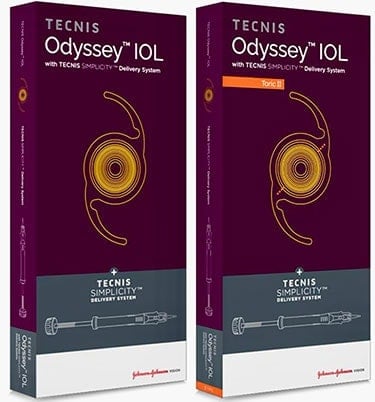
Dr. Assil, a corneal specialist, now has the opportunity to gather extensive data on the new, innovative Odyssey lens from Johnson & Johnson. He serves on the J&J board of directors, and he and his partner, Dr. Gaur, are the only ophthalmologists in the United States given early access to use the lens for patients.
The Odyssey multifocal IOL enhances both near and distance vision, while also presenting fewer potential side effects and drawbacks. According to Dr. Assil, patients who receive the Odyssey report experiencing fewer visual halos and light sensitivity post-surgery compared to those who receive other lenses.
The new lens differs from a conventional monofocal IOL, which focuses light only for distance vision. People who receive monovision lens implants often still need to wear glasses to see nearby objects.
Request Your Consultation
Call now or book your appointment online.
Composed of silicone and acrylic, Odyssey intraocular lens implants utilize J&J’s existing TECNIS Synergy™ technology. With millions of implants distributed over the past quarter century, TECNIS Synergy has proven to be safe and remains crystal clear within the eye over time. Additionally, this type of lens protects the eye from harmful ultraviolet rays.
Aram’s actual surgery was a non-event.
“The surgery was simple, in by 5 a.m. and out by 8 a.m.,” says Aram, who will have the right eye done when the cataract grows larger and affects his vision. “I was relaxed, and Dr. Assil talked to me during the entire operation.”
A focused life after surgery
Aram used eye drops for a limited time after receiving his Odyssey lens. The only minor inconvenience he has noticed is halos when looking at lights at night. However, this does not affect his driving and is expected to go away after a few months, once his brain adapts to the new lens.
Meanwhile, back at the civil engineering office, things are going well.
“I can see better than the young guys in the office,” Aram beams. “And when I’m outside, I can see the antennas on the mountains, details on the leaves, and everything in between.”
Of course, Aram speaks highly of Dr. Assil and the accomplished team of doctors and staff members at the Assil Gaur Eye Institute.
“I’m a picky engineer,” he says, adding that he’s pleased he did not receive a monofocal lens. “I can’t speak highly enough about the Assil Gaur Eye Institute.”
As a bonus, Aram no longer needs reading glasses or any kind of eyeglasses.
Why trust the Assil Gaur Eye Institute with your IOL implant surgery?
With 30 years of experience assisting patients with eye health, Dr. Assil is one of the most experienced cataract surgeons in the United States. He has performed over 70,000 eye surgeries and authored over 100 textbook chapters and articles on refractive and cataract surgery.
Assil Gaur Eye Institute has assembled a team of top ophthalmologists from around the country who offer their patients the highest quality of specialist eye care in the United States.
In line with the founding principles of AGEI, eye surgeons ensure their clinics are comfortable and familiar, similar to the way family-run medical practices once were.
In addition to refractive lens exchange and cataract surgery, the ophthalmology experts at AGEI are nationally recognized for their eye care and treatment options for a full range of conditions, including eye conditions such as hyperopia, glaucoma, retinal detachment (along with other diseases of the retina), corneal conditions, contact lens issues, floaters and flashes, dry eye, presbyopia, astigmatism correction (a refractive error), farsightedness, myopia, macular degeneration, nearsightedness, toric lenses, and other vision correction procedures (refractive surgery) like LASIK, PRK, and numerous other laser treatments.
Today, AGEI is nationally recognized for its compassionate, patient-centric health care, commitment to pioneering advancements in ophthalmology, and dedication to supporting the health and well-being of its patients and the community.
Request Your Consultation
Call now or book your appointment online.
We are conveniently located for patients across Southern California and the Los Angeles area, particularly in or near Beverly Hills, Santa Monica, West Los Angeles, West Hollywood, Culver City, Hollywood, Venice, Marina del Rey, Malibu, Manhattan Beach, and Downtown Los Angeles.
More Stories You might be interested in


Dry Eye Intraocular Lens (IOLs)
Mario’s Second Eye Lens Replacement Surgery, This Time With Dr. Assil, is the Charm

Cataract Surgery Intraocular Lens (IOLs)
Sylvia, 75, Goes Glasses-Free for First Time in a Decade After Premium Cataract Surgery with Dr. Assil
Cataract Surgery Intraocular Lens (IOLs)