LASIK vs PRK: Which Vision Correction Surgery Is Right for You?
We have been performing LASIK and PRK vision correction surgeries for patients who want clear vision for over two decades. And over the years, we have learned that patients often need help understanding how these two refractive eye surgeries differ.
We wanted to explain to you how they are different from each other and how they are similar. Let’s discuss the main differences between LASIK and PRK laser surgery!
How are PRK and LASIK similar?
PRK (photo-refractive keratectomy; FDA-approved in 1995) and LASIK (laser-assisted in situ keratomileusis; FDA-approved in 1999) are the two most popular laser-assisted procedures to correct vision-focusing deficits, known as refractive errors. Both techniques change the shape of the cornea, have very high success rates, and can be used to correct the following vision problems:
-
Nearsightedness (myopia) – the inability to see distant objects clearly
-
Farsightedness (hyperopia) – the inability to see objects up close clearly
-
Astigmatism – an irregularly shaped eye that results in blurry vision
-
Presbyopia – the inability to read the fine print that occurs with age
Both laser eye surgeries work by reshaping the cornea (the clear “windshield” over the seeing portion of your eye), which provides two-thirds of your eye’s focusing ability. The two techniques differ in how they access your corneal tissue to achieve vision correction.
Both procedures use numbing eye drops and, if needed, medication to help you relax and maximize comfort.
How do PRK and LASIK differ
With PRK, your eye surgeon removes the cornea’s outer layer (epithelium) before reshaping the underlying corneal tissue to correct irregularities that cause focusing errors. By removing the cornea’s outer layer, PRK exposes the surgical area until the corneal epithelium can regenerate naturally.
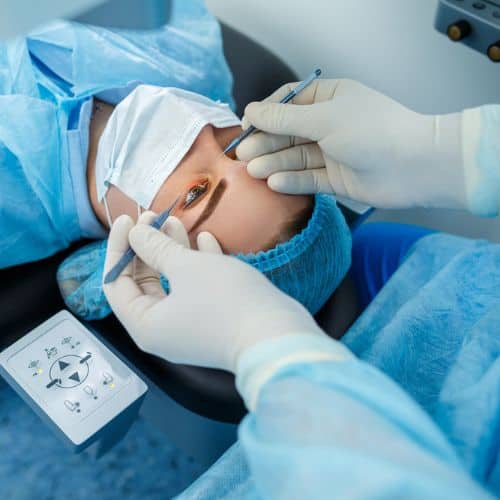
With LASIK, a femtosecond laser microkeratome creates a micro-thin flap from the outer cornea, which the surgeon then gently folds back to access a deeper corneal layer (the stroma), where a second laser reshapes the tissue.
What happens during the PRK surgical procedure?
PRK: A three-step surface ablation approach
-
The outer corneal layer (the epithelium) over the seeing portion of your eye is thoroughly removed to expose the middle corneal layer (the stroma).
-
Next, an excimer laser is used to smooth out (ablate) irregularities responsible for focusing errors in the newly exposed corneal tissue.
-
A contact lens bandage is placed over your cornea to promote healing as your outer corneal layer regenerates.
Because PRK works directly on the corneal surface without creating a flap, it is classified as a surface ablation procedure. This makes it a strong option for patients with thinner corneas or active lifestyles where a flap could pose a risk. Mitomycin-C (MMC) is a brief topical application your surgeon may use at the end of the laser step to reduce the risk of corneal haze during healing, a detail that matters most for higher prescriptions. At Assil Gaur Eye Institute, advanced wavefront-guided treatment maps the unique optical imperfections of your eye and guides the excimer laser with precision, producing outcomes that go beyond simply correcting your glasses prescription and targeting the very best possible quality of vision.
LASIK: A three-step flap-based approach
-
A femtosecond laser creates a microscopically thin hinged flap in the outer cornea. The flap is folded back like a book cover, with the hinge (imagine the “book’s binding”) just outside your field of vision.
-
Next, an excimer laser smooths out (ablates) irregularities responsible for focusing errors in the newly exposed corneal tissue.
-
Finally, the surgeon gently returns the flap to its original position (imagine the book cover closing), where it seals on its own without stitches.
Because the flap acts as a natural bandage, most LASIK patients notice dramatically clearer vision within 24 hours and experience minimal discomfort compared to PRK. The proprietary EagleVision LASIK procedure at Assil Gaur Eye Institute combines femtosecond flap creation with wavefront-guided excimer laser treatment, delivering the precision and consistency that has made it the trusted choice of elite athletes and patients who simply want the very best in vision correction.
Which is better: PRK or LASIK?
The honest answer is that neither procedure is universally better than the other. Both PRK and LASIK deliver equivalent long-term visual acuity outcomes, with studies consistently showing that the vast majority of patients achieve 20/20 vision or better after either surgery. Large-scale clinical data confirm that final corrected vision at one year is statistically identical between the two procedures, meaning the end result you see in the mirror is not what separates them.
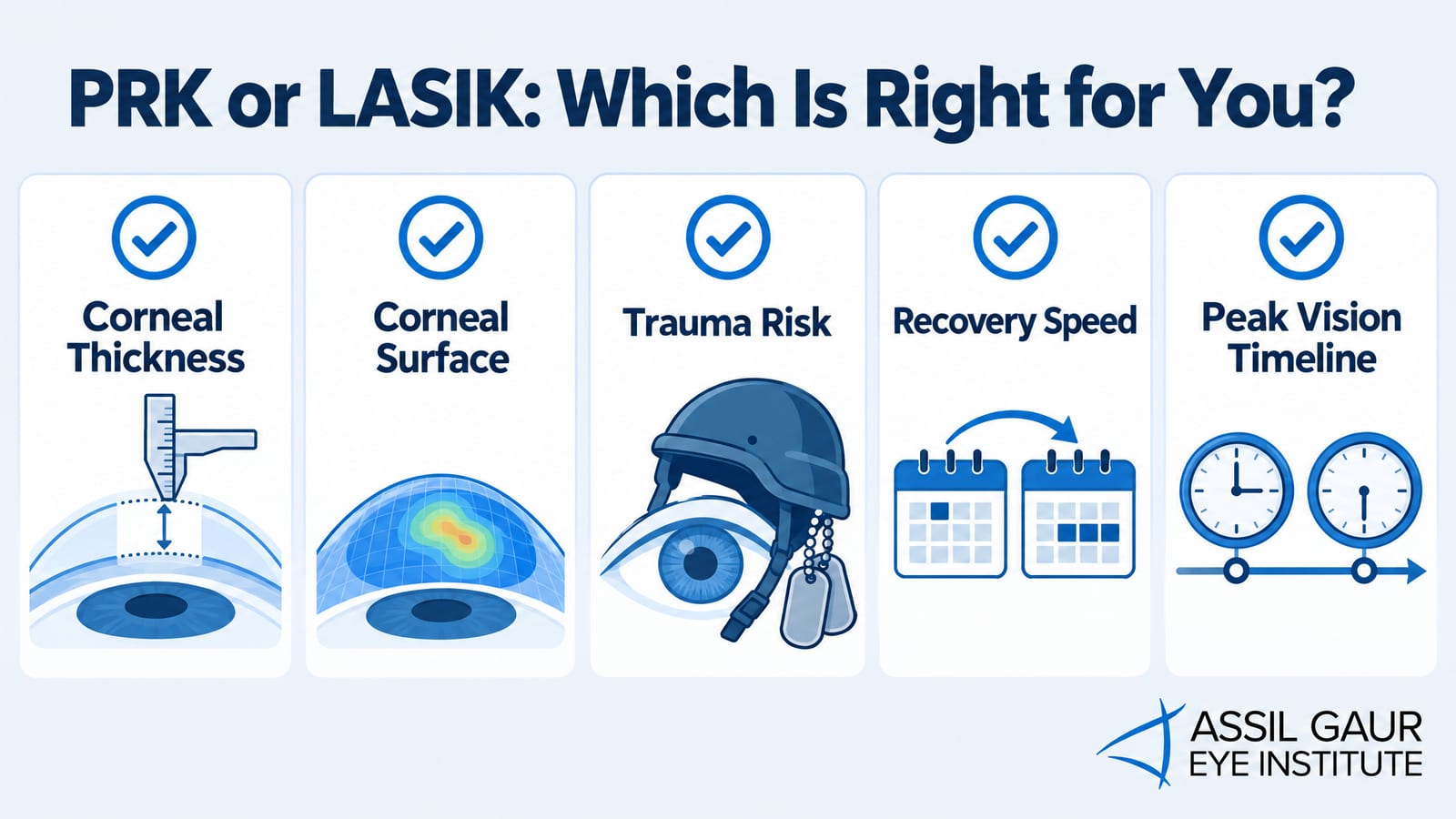
What actually determines which is better for you comes down to your individual anatomy and lifestyle. LASIK creates a thin corneal flap, so patients with thinner corneas, irregular corneal surfaces, or a higher risk of eye trauma – think contact sports, military service, or physically demanding work – are often steered toward PRK, which creates no flap and preserves more of the cornea’s structural strength. Patients with corneal thickness comfortably above the surgical threshold and a preference for the fastest possible return to daily life tend to be ideal LASIK candidates.
What is the recovery time of LASIK and PRK to achieve crisp vision
Whereas most LASIK patients can see clearly and may have near-perfect vision the day after surgery, typical PRK recovery can take two weeks to a month before patients achieve crisp vision. This is important because PRK patients cannot be cleared to drive until their vision has normalized.
Vision will be tested at each postoperative follow-up to monitor healing progress. Peak vision clarity will typically be attained at three months with a LASIK procedure and can take up to six months with PRK.
Recovering from PRK
PRK procedure recovery can be uncomfortable. Patients will wear a bandage contact lens for a week, which can cause distorted vision, blurriness, and irritation. They’ll also experience light sensitivity during the initial healing process. Your doctor will prescribe pain medications and lubricating or medicated eye drops to help manage discomfort.
Recovering from LASIK
LASIK patients typically don’t experience much post-operative pain or discomfort. Rarely, some patients might feel a burning sensation in their eyes, which typically resolves within several hours of surgery. As with PRK, lubricating or medicated eye drops will be prescribed to address discomfort, which should resolve within a few days.
Call now or book your appointment online.
What are the risks and side effects of PRK and LASIK?
As with any surgery, both procedures carry some risks. That’s why choosing a highly skilled surgeon you trust is critically important. While PRK and LASIK share many of the same potential complications, they don’t share them equally. Understanding which risks skew toward which procedure helps you and your surgeon make a more informed, personalized decision. Ophthalmologists agree that both laser vision correction procedures share the following risks:
-
Post-op eye dryness. Disruption of corneal nerves can reduce tear production for six months or more. It is more common with LASIK because the flap severs more nerve fibers, so patients with existing dry eye are often better PRK candidates. With EagleVision LASIK, available only at Assil Gaur Eye Institute, we have seen fewer post-op dry eye symptoms than with conventional LASIK.
-
Corneal haze. This risk is specific to PRK. As the corneal surface heals, mild cloudiness can occasionally develop. It usually clears within a few months and rarely persists. Surgeons may apply mitomycin-C (MMC) briefly during surgery to reduce this risk, and haze is rarely a concern with modern protocols.
-
Visual disturbances. Reduced night vision, glare, double vision, or halos can last for weeks or, rarely, longer. They are more common during PRK’s longer healing period but can also affect LASIK patients with larger pupils or higher prescriptions.
-
Under-correction. If too little tissue is removed, vision may not be fully corrected, and an enhancement procedure may be needed.
-
Corneal ectasia. Removing too much tissue can weaken the cornea and cause it to bulge, distorting vision and requiring prompt treatment. Ectasia is more closely linked to LASIK because the flap reduces corneal strength. Risk factors include thin corneas, irregular topography, very high prescriptions, and forme fruste keratoconus. AGEI screens for all of these with advanced topography and tomography at every evaluation.
-
Astigmatism. Uneven tissue removal can change corneal curvature, which may require further surgery or glasses. This risk is uncommon with precision laser platforms and experienced surgeons.
-
Permanent vision loss. Any eye surgery carries a very small risk of complications that could lead to partial or total vision loss. Both PRK and LASIK have excellent safety records when performed by experienced surgeons on properly screened candidates
Cost Comparison: PRK vs LASIK
After weighing the risks and recovery timelines, cost is often the next big question patients ask when comparing these two procedures. The good news is that PRK and LASIK are generally priced in a similar range, but there are a few factors that can push the final number in either direction.
On average, laser vision correction runs between $2,000 and $3,000 per eye, depending on the technology used, the surgeon’s experience, and the complexity of your prescription. LASIK tends to sit at the higher end of that range because it requires a femtosecond laser to create the corneal flap in addition to the excimer laser that reshapes the tissue. PRK skips the flap-creation step entirely, which can make it slightly less expensive at some practices. That said, the difference is rarely dramatic, and at a world-class center like Assil Gaur Eye Institute, pricing reflects the full scope of advanced technology and surgical precision involved in either procedure.
A few other cost factors worth knowing:
-
Technology level: Custom wavefront-guided treatments typically cost more than standard laser correction, but they deliver more precise, personalized results.
-
Enhancement procedures: If an enhancement is ever needed, ask how it is priced.
-
Financing options: Most practices offer payment plans that make both procedures accessible.
-
Complimentary evaluation: At AGEI, your complimentary LASIK evaluation includes a full candidacy assessment so you know exactly what to expect before committing.
Ultimately, the better investment is the one that matches your eyes, your lifestyle, and your long-term vision goals.
How do I know if I’m a good candidate for PRK versus LASIK surgery?
You and your eye doctor must consider several important factors when selecting whether PRK or LASIK is right for you. These include:
-
How bad is your vision? Patients with high prescriptions (around -8.00 or -9.00 diopters) or naturally thin corneas are often better PRK candidates. LASIK must leave at least 250 microns of stromal tissue beneath the flap, and PRK avoids that limit by treating the surface.
-
Do you have signs of keratoconus or corneal irregularity? Your evaluation includes corneal topography and tomography. Patients with keratoconus or other progressive corneal conditions are usually not candidates for LASIK or standard PRK, since removing tissue can worsen the condition.
-
How old are you? Most surgeons require patients to be at least 18, and many prefer 21 with two years of stable vision. There is no upper age limit, but patients in their mid-40s and older may want to consider refractive lens exchange or monovision LASIK, which can reduce your need for readers.
-
How much downtime can you spare? Most LASIK patients see clearly within hours and return to work the next day. PRK patients heal about 70 percent in the first week and 90 percent by one month, and usually can’t drive for at least a week.
-
Are you good at following doctors’ orders? LASIK patients must avoid rubbing their eyes. PRK patients wear a bandage contact lens for about a week and must avoid bright sunlight for four to six weeks to reduce the risk of corneal haze.
-
Are you very active? Athletes and people in high-impact jobs have often chosen PRK to avoid flap complications. Eagle Vision LASIK has reduced that concern and is the choice of NBA stars including LeBron James and Chris Paul.
How will I know if PRK or LASIK eye surgery suits me?
The truth is that researching refractive surgery can be daunting, given all the surgery options currently being marketed and the dizzying claims being tossed about. We can’t stress enough the importance of doing your homework before undergoing irreversible surgery on your eyes.
At Assil Gaur Eye Institute, we pride ourselves on offering the most advanced surgical techniques and state-of-the-art refractive technology to provide our patients with the safest, most effective procedure designed to optimize their surgical experience and visual outcomes.
We invite you to request your complimentary LASIK consultation and eye exam at Assil Gaur Eye Institute. Our eye doctors will ask about your overall health, lifestyle, and vision goals before advising you regarding your eligibility for different vision correction procedures. Our American Academy of Ophthalmology member LASIK surgeons will also explain how they perform the surgery and answer your questions. We want to make sure you feel comfortable with the information you need and confident you’re in the right hands for all your vision needs.
Why choose Assil Gaur Eye Institute for your eye care?
At AGEI, you will experience state-of-the-art eye health that brings revolutionary ophthalmology technologies together with experienced vision care professionals. Our goal is to help you achieve your best possible vision.
Call now or book your appointment online.
The Assil Gaur Eye Institute is California’s premier eye institute for glaucoma, cataract surgery, retina conditions such as macular degeneration, diabetic eye conditions, dry eye, and many others, with the best patient care available anywhere.
We are conveniently located for patients throughout Southern California and the Los Angeles area in or near Beverly Hills, Santa Monica, West Los Angeles, West Hollywood, Culver City, Hollywood, Venice, Marina del Rey, Malibu, Manhattan Beach, and Downtown Los Angeles.
Long-Term Vision Stability: PRK vs LASIK
When weighing LASIK vs PRK and which is better for your lifestyle, long-term vision stability is one of the most important factors to consider. The good news is that both procedures deliver durable results for the vast majority of patients, with studies consistently showing that over 90 percent of people maintain their corrected vision for a decade or more after surgery.
That said, there are some meaningful differences worth knowing. PRK tends to show slightly lower regression rates over time, particularly for patients with higher prescriptions. Because PRK reshapes the cornea from the surface without creating a flap, the structural integrity of the cornea is fully preserved, which some surgeons believe contributes to greater long-term stability. LASIK, on the other hand, delivers faster visual recovery and equally strong outcomes for most patients, especially those with mild to moderate prescriptions.
Regression, meaning a gradual drift back toward your original prescription, can occur with either procedure. It is more common in patients who started with higher levels of nearsightedness or astigmatism. If regression does occur, enhancement procedures are typically available for both PRK and LASIK candidates, and your surgeon can evaluate your corneal thickness to determine the best path forward.
At Assil Gaur Eye Institute, our surgeons bring world-class precision to every procedure, helping patients achieve enviable outcomes that hold up over time. Explore more about vision correction options on our blog, or schedule your complimentary evaluation to find the right fit for your eyes.
Frequently Asked Questions: PRK vs LASIK
Is PRK or LASIK more painful?
LASIK is generally more comfortable during recovery because the corneal flap protects the treated surface. PRK involves removing the outer epithelial layer, so the first three to five days can bring noticeable discomfort. Most patients manage this well with prescribed drops and oral medication, and the sensation fades as the surface heals.
Which procedure gives better long-term results?
Both PRK and LASIK deliver excellent long-term vision outcomes for the right candidates. Studies consistently show comparable visual acuity at the one-year mark and beyond. PRK actually carries a slight edge for patients with thinner corneas because no flap is created, preserving more corneal tissue over time.
How long does PRK recovery take compared to LASIK?
LASIK recovery is rapid, with most patients seeing clearly within 24 to 48 hours. PRK recovery follows a longer arc. Most patients reach roughly 70 percent of their final vision within the first two weeks, and about 90 percent by the four to six week mark, with full stabilization taking up to three months.
Can I choose PRK if I am not a LASIK candidate?
Absolutely. Patients with thin corneas, higher prescriptions, or active lifestyles that carry a risk of eye trauma are often steered toward PRK as the safer, equally effective alternative. Implantable contact lenses are another advanced option for those outside the typical laser correction range.
How do I find out which procedure is right for me?
The most reliable answer comes from a comprehensive evaluation with an elite refractive surgeon. Assil Gaur Eye Institute offers a complimentary evaluation so you can get a precise, personalized recommendation. Learn more about how to choose a LASIK surgeon in Los Angeles before booking your visit.