Aesthetic Eye Surgery Blepharoplasty
Jeannie Spent Thousands on Eye Treatments That Never Worked. Then Dr. Adele Saw What Everyone Else Missed
In 2021, Jeannie noticed her eyes looked different but couldn’t identify what was wrong. Over the next four years, she spent thousands on cosmetic procedures, administered by professionals who never noticed that she had a medical condition that was causing the problem.
When she attended Assil Guar Eye Institute (AGEI) for a simple stye appointment, she finally got an answer. Dr. Adele took one look at her and immediately said, “You have ptosis.” That diagnosis, delivered within seconds, explained years of confusion and wasted money. Now, weeks after ptosis surgery and upper blepharoplasty, Jeannie finally recognizes her eyes again.
How did Jeannie’s stye appointment turn into a ptosis diagnosis?
Jeannie ended up at AGEI seeking treatment for a painful stye, but Dr. Adele immediately noticed something else was amiss.
“I had a little stye on my left eye and was trying to get an appointment with another doctor, but their office was having problems scheduling me in,” Jeannie explains. “After a lot of back and forth, it occurred to me that I could just go to AGEI. My friend went there for a nevus removal, and my brother had also attended for treatment.”
A stye is a common, painful, red lump on the edge of your eyelid, similar to a pimple, caused by a bacterial infection in a blocked oil gland or eyelash follicle. While many can be managed with home care, persistent or extremely painful styes may need to be drained by a professional and treated with antibiotics.
But what started as Jeannie seeking treatment for a simple stye led her to the answer she’d been seeking for years.
Years of misdiagnosis were instantly corrected by a real expert
“Dr. Adele took one look at me and immediately said, ‘You have ptosis.’ I was so relieved,” explains Jeannie. That diagnosis, delivered within seconds by a board-certified oculoplastic surgeon, came after a lot of money had been wasted and ended years of confusion.
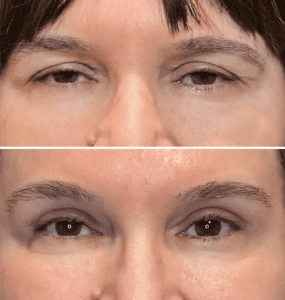
Dr. Adele instantly recognized that Jeannie had a type of ptosis known as “droopy eyelid ptosis.” This is where the upper eyelid droops, leading the upper lid to partially cover the pupil and impair vision. It is caused by weakness or dysfunction of the eyelid’s lifting muscle (the levator muscle). It can be present from birth (congenital ptosis) or develop later in life (acquired ptosis) from injury, disease, aging, contact lens use, or nerve problems.
“Dr. Adele came in, took pictures of my eyes, and administered some eye drops to help confirm her diagnosis,” Jeannie explains. “A few minutes later, she took another picture to explain her ptosis diagnosis, and it was clearly evident in the photo.”
That immediate recognition, seeing her droopy eyelid issues that multiple other professionals had missed, demonstrates the difference between cosmetic practitioners and oculoplastic surgeons trained in ophthalmology. Dr. Adele understood eye anatomy, the function of the levator muscle, and the presentation of upper eyelid ptosis.
How did Jeannie acquire ptosis, and how does it progress?
Ptosis can begin without you even noticing. But it does progress, often gradually worsening with age as the eyelid tissues weaken. Each patient’s rate of progression and severity depends heavily on the underlying cause.
“I noticed in 2021 that there was a difference in my eyes,” Jeannie recalls. “I do a lot of content creation, and I can remember the moment when I looked into my camera at myself and thought, ‘I don’t recognize my eyes, they look different,’ but I just chalked it up to aging.”
That moment, seeing yourself in the camera and not recognizing your own appearance, creates genuine distress. For a content creator whose face is constantly documented, the changes felt particularly unsettling.
“When Dr. Adele said I had ptosis, I felt such relief,” Jeannie emphasizes. “First, I had been right all along — my eyes did look different, and second, it wasn’t aging.”
Can aesthetic treatments fix ptosis?
While some aesthetic treatment options can help with very mild forms of ptosis, surgical repair usually provides the most significant and lasting correction. This is something Jeannie wishes had been made clearer to her.
“I’ve done microneedling, plasmapheresis, thermage, all of these things at other places, and I could have saved money if I had just gone to a specialist like Dr. Adele in the first place,” Jeannie reflects. “Someone who knew what was really going on with my eyes.”
She continues, “I told Dr. Adele that I’d seen many other doctors and no one had ever mentioned anything about ptosis to me, while she instantly recognized the problem.”
That instant recognition comes from specialized training. Board-certified oculoplastic surgeons understand the complex anatomy of the upper lid, the tarsus, the eyelid crease, and how ptosis presents differently from simple age-related skin changes.
“I wish a lot of professionals who do fillers, and things like that, to improve your eyes would say to their clients, ‘I can do this, but if I were you, I would go get a second opinion because this treatment can only do so much,’” Jeannie says passionately. “Particularly if they actually see something concerning or realize that an aesthetic treatment may not fix the problem.”
Jeannie says Dr. Adele’s ability to instantly identify the issue and address it honestly with the best possible solutions is invaluable. “I have spent a lot of money and would have probably wasted so much more trying to fix my eyes if it weren’t for Dr. Adele,” she admits.
Why did Dr. Adele recommend both ptosis repair and upper blepharoplasty?
“Dr. Adele said that even if she performed an upper blepharoplasty, it wouldn’t fully solve the problem,” Jeannie recalls. “She recommended an upper bleph, because I had some loose skin that I wanted her to tighten up, as well as ptosis surgery.”
This honest approach distinguishes excellent oculoplastic surgeons from those simply selling procedures. Dr. Adele could have performed blepharoplasty alone, addressing excess skin on the upper eyelid, but it wouldn’t resolve the drooping caused by levator muscle weakness. An upper eyelid surgery with ptosis repair allowed Dr. Adele to both lift the eyelid to a functional height and refine the excess skin, improving vision, symmetry, and overall eyelid contour in a single procedure.
Request Your Consultation
Call now or book your appointment online.
What was Jeannie’s recovery experience after ptosis surgery and blepharoplasty?
Jeannie is open about her recovery journey, noting that she did struggle at first. “I had both procedures, and I’ll admit it wasn’t as easy as people make it look on social media,” she says honestly. “I had a lot of swelling and uncomfortable sensations, like when the skin was tightening after the stitches. I was a little nervous.”
This realistic expectation-setting helps others considering ptosis treatment or cosmetic surgery. Social media often shows only the final results, not the healing process that any type of surgery requires. Swelling, sutures, temporary asymmetry, and discomfort are all normal parts of eyelid surgery recovery.
“But I’m healing now, and I love how my eyes are looking,” Jeannie continues. “It has really boosted my confidence. I no longer feel like my eyes are heavy, and they’re looking great.”
The functional improvement matters just as much as the aesthetic result. Upper eyelid ptosis can affect the field of vision and create a sensation of heaviness, leading to fatigue. Ptosis repair surgery restores normal eyelid position and function.
How did Dr. Adele’s availability make the post-op experience different?
Dr. Adele’s responsiveness provided crucial reassurance. “What I appreciate most about Dr. Adele, besides her amazing skill, is that she’s so responsive,” Jeannie emphasizes. “I mean, performing surgery on someone’s eyes is so critical — it’s such an amazing skill. And she’s such a successful surgeon, yet she quickly answered my texts and responded to my concerns, helping to alleviate any anxiety.
“And that just meant so much to me,” she continues. “I felt safe and heard, and that if there were an issue, she would tend to me right away.”
This accessibility during recovery, when questions and concerns naturally arise, provides immense reassurance. Eye surgery carries particular anxiety because vision is so precious and vulnerable. Having your surgeon available for quick responses transforms the recovery experience.
Why does Jeannie believe she was “guided” to Dr. Adele?
“I honestly feel like I was guided to Dr. Adele because of how perfectly things have worked out,” Jeannie reflects. “It may have taken four years, but I’m very happy now.”
Those four years, from 2021 to 2025, involved thousands of dollars spent, multiple providers visited, and countless treatments tried. But finding the right specialist who could actually diagnose and treat the underlying problem made all the difference.
“You can tell Dr. Adele loves what she does, and it spills over into how she treats all her patients,” Jeannie says. “I would highly recommend her to anyone.”
From not recognizing her own eyes in 2021 to a confident, refreshed appearance weeks after surgery four years later, Jeannie’s journey demonstrates what happens when aesthetic concerns meet a proper medical diagnosis.
Why choose AGEI for ptosis surgery and comprehensive eye care?
At Assil Gaur Eye Institute (AGEI), board-certified oculoplastic surgeons such as Dr. Adele recognize conditions that cosmetic practitioners miss. Whether you’ve noticed changes in your eyelid position, have tried treatments that didn’t work, or simply want expert evaluation before pursuing aesthetic procedures, comprehensive eye care and expert advice are available.
Request Your Consultation
Call now or book your appointment online.
AGEI serves patients throughout Southern California, including Beverly Hills, Santa Monica, West Los Angeles, and surrounding communities.
Frequently Asked Questions About Ptosis and Eyelid Surgery
How can you tell the difference between ptosis and normal aging of the upper eyelid?
Ptosis is caused by levator muscle weakness, which means the upper eyelid droops over the eye, potentially affecting the field of vision. Normal aging creates excess skin and wrinkles, but doesn’t typically cause the actual eyelid height to drop.
Why don't more cosmetic treatment providers recognize ptosis in their clients?
Providers offering cosmetic treatments such as fillers, Botox, microneedling, or skin-tightening procedures typically aren’t trained in ophthalmology or in the function of the eyelid muscles. They may attribute eyelid position changes to aging or skin laxity without recognizing levator muscle weakness. Oculoplastic surgeons specializing in reconstructive surgery and eye surgery have the medical training to diagnose conditions like upper eyelid ptosis that require surgical correction.
Can ptosis be fixed with non-surgical treatments like Botox or fillers?
Ptosis results from levator muscle weakness or dysfunction affecting eyelid height, which cosmetic treatments cannot fully address. Fillers add volume, Botox relaxes muscles, and skin treatments improve texture, but none can strengthen the muscle that lifts your upper lid. Moderate or severe ptosis can only be corrected surgically. Fortunately, many surgeries of this nature are outpatient and performed under local anesthesia.
What should you expect during recovery from combined ptosis surgery and upper blepharoplasty?
Surgery can cause swelling, bruising, and temporary asymmetry while tissues heal and sutures dissolve. During recovery, patients may also experience tightening sensations in the eyelid skin and muscles as they heal into their new position. Results continue to improve over the weeks following surgery as swelling resolves, revealing the corrected eyelid position and improved symmetry. Full recovery can take several months.
Sources
-
Ptosis Correction
https://www.ncbi.nlm.nih.gov/books/NBK539828/ -
Upper Eyelid Blepharoplasty
https://www.ncbi.nlm.nih.gov/books/NBK537078/ -
Hordeolum (Stye)
https://www.ncbi.nlm.nih.gov/books/NBK459349/
More Stories You might be interested in
Aesthetic Eye Surgery Blepharoplasty
With Heavy Eye Lids, but High Hopes, Stacey’s Quest to Find the Best Eye Surgeon ends with Dr. Adele
Aesthetic Eye Surgery Blepharoplasty
She Tried Every Eye Cream, Then One Surgery Changed Everything

Aesthetic Eye Surgery Blepharoplasty