LASIK Surgery Recovery Timeline
When you first open your eyes after LASIK surgery, most LASIK patients notice improved vision right away. Many describe the experience as opening your eyes underwater and, while everything isn’t immediately clear, being amazed at what you can already see.
Within a few hours, your vision will become a lot clearer, and you can usually drive after just 24 hours. Of course, it takes a bit longer for the eye to fully heal following surgery, usually 6 months. During this time, you should expect your vision to continue improving.
LASIK recovery timeline: a quick overview
So, how long does LASIK recovery take? The honest answer is that most people feel surprisingly normal within 24 to 48 hours, but your eyes continue refining their focus for several months. Think of recovery in layers: immediate comfort, functional recovery, and full visual stabilization. Each one unfolds on its own schedule.
Here is a plain-language look at what to expect and when:
|
Timeframe |
What is happening |
Typical milestone |
|---|---|---|
|
First 24 hours |
Corneal flap begins bonding; eyes feel gritty or watery |
Rest, protective shields worn overnight |
|
Day 1 to 3 |
Most discomfort fades; vision noticeably clearer |
Many patients drive and return to desk work |
|
Week 1 to 2 |
Light sensitivity and mild halos settle down |
Follow-up exam confirms healing progress |
|
Month 1 |
Vision stabilizes for the majority of patients |
Most activities, including light exercise, resume |
|
Months 2 to 6 |
Fine-tuning continues; night vision fully sharpens |
Full visual stabilization confirmed by your surgeon |
The sections below walk through each phase in detail, covering common side effects, activity restrictions, and exactly what to watch for along the way. Whether you are preparing for your procedure or already in recovery, this guide gives you the precision roadmap you deserve for a world-class outcome.
LASIK eye surgery recovery: the first 24 hours…
Immediately after LASIK surgery, you should notice improved vision, though it may feel a bit foggy, as if you are looking underwater. This clears within hours for most patients. Because you cannot drive for the first 24 hours, you will need a pre-arranged ride home, and your eyes will be covered with protective shields to guard against injury and light sensitivity.
Once the anesthetic wears off, the most common sensations are a gritty, sandy feeling, mild burning, and itching. These are completely normal signs that your cornea is beginning to heal, and they typically peak in the first two to four hours before easing significantly. Dryness is the single most reported post-op symptom, so you will be sent home with both prescription anti-inflammatory drops and non-prescription lubricating drops. A simple tip our team loves: store your lubricating drops in the refrigerator. The cool temperature adds an extra layer of soothing relief that patients consistently find helpful. We recommend resting with your eyes closed for the first four hours after you arrive home. After that window, most patients are pleasantly surprised by how much better they see and feel.
-
You may also notice tearing, light sensitivity, puffy eyelids, or halos and starbursts around lights at night. Your eyes may appear red or bloodshot. These side effects are a normal part of healing and not a sign that anything has gone wrong. They typically fade within a week, though halos and night-vision changes can linger a little longer as the cornea fully stabilizes.
-
Wear your protective eye shields whenever you lie down for the first week. Rubbing your eye against a pillow or blanket can disturb the healing corneal flap, so please avoid touching or rubbing your eyes entirely during this period, no matter how tempting.
-
You are cleared to shower, but keep soap, water, and any chemicals away from your eyes for the first week to prevent bacterial contamination.
-
Avoid heavy lifting or straining during the first week following surgery.
-
Plan to take a few days off work while your symptoms settle, and arrange help at home if needed.
If at any point during the first 24 hours you experience sudden sharp pain, a dramatic drop in vision, or discharge that is not clear, contact Assil Gaur Eye Institute right away. These are not typical recovery symptoms and deserve prompt attention from your care team.

LASIK surgery recovery: the day after…
-
On the day after surgery, you’ll return to our office for your initial post-op check. This helps your surgeon closely monitor your early healing and ensure everything is going as planned. Your doctor will remove your eye shield and test your vision so we can track your improvements over time. Your second visit will be in one week.
-
At your first post-op visit, you should tell your surgeon about your symptoms. We encourage you to ask questions so that we can address any concerns or misunderstandings to help ensure a smooth recovery.
-
We will review your post-op eye drop regimen and activity restrictions to clear up any doubts you may have.
-
One of the most reassuring milestones in LASIK recovery is how quickly you can return to everyday life. Most patients can return to desk work, light computer use, and non-strenuous daily tasks within 24 to 48 hours of surgery. Your vision may still feel slightly soft or hazy during this window, which is normal as your cornea continues to heal early on. If your job involves prolonged screen time, remember to use your prescribed lubricating drops frequently and take short breaks to reduce eye strain. We’ll discuss driving, more demanding physical activity, and other restrictions at your post-op visit, where your surgeon will confirm you are healing on track and clear you for each activity at the right pace.
LASIK recovery: The first few weeks after surgery…
The first few weeks after EagleVision LASIK are when your eyes do the most important healing work. Knowing what to expect and what to avoid helps you protect your results and get back to your life with confidence.
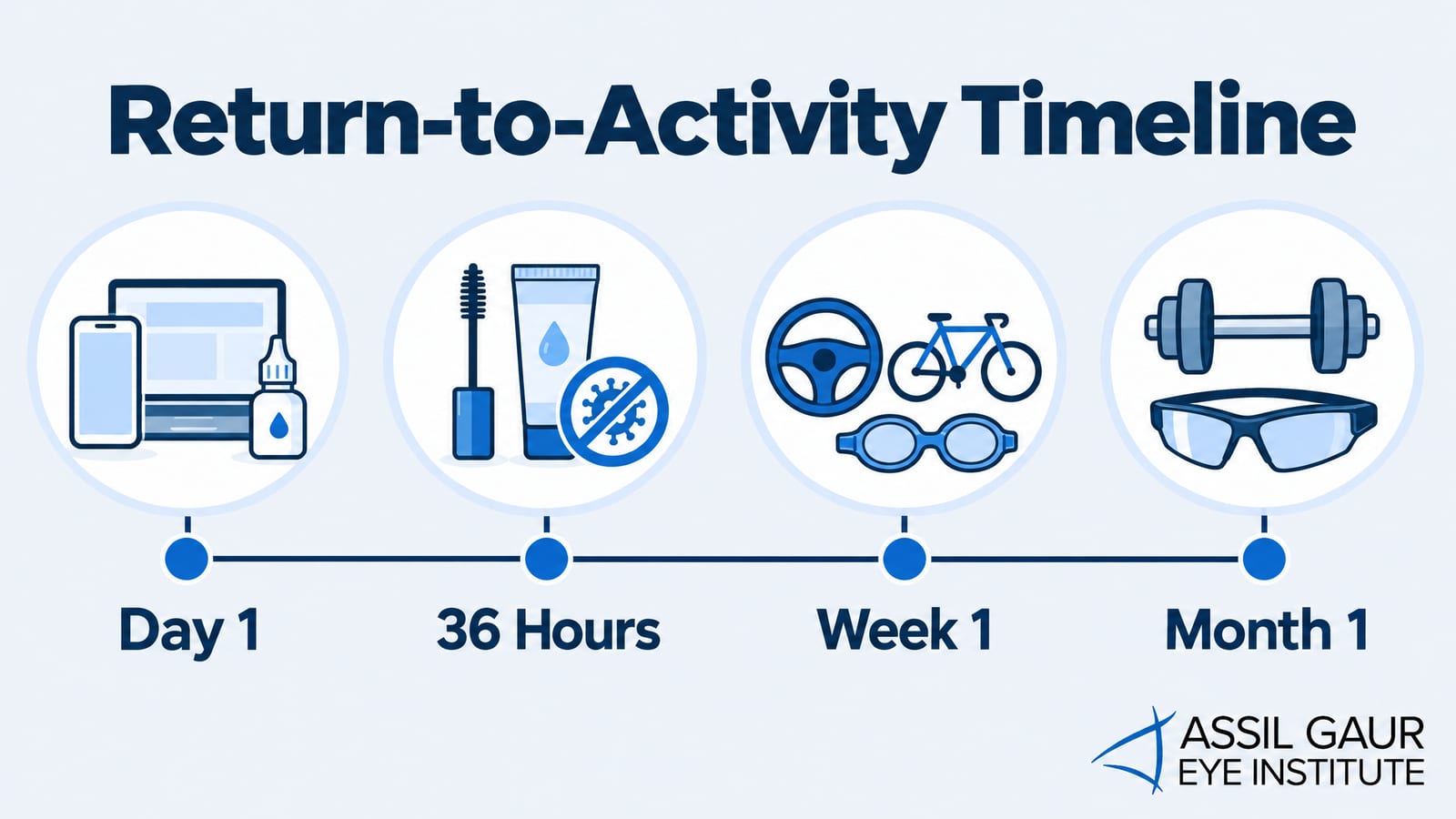
Return-to-activity timeline at a glance
|
Activity |
When you can return |
|---|---|
|
Driving |
Once your surgeon confirms your vision meets the legal standard, typically the day after your follow-up appointment |
|
Screen use (phone, computer, TV) |
Light use after 24 hours; take frequent breaks and use lubricating drops to prevent dryness |
|
Reading |
Rest your eyes for the first few days; resume gradually as comfort allows |
|
Eye makeup and facial products |
At least 36 hours after surgery to reduce the risk of bacterial contamination |
|
Light exercise (walking, cycling) |
After one week, once your surgeon clears you |
|
Swimming pools, hot tubs, open water |
At least one week after surgery to help prevent infection |
|
Weightlifting and contact sports |
One month post-op; wear polycarbonate sports glasses when you return |
|
Gardening and dusty environments |
At least one week after surgery |
Day-by-day guidance for the first week
-
Because your eyes will be working hard to heal, we recommend avoiding reading during the first few days after surgery and focusing instead on resting your eyes.
-
We advise our patients to avoid eye makeup, eye creams, any facial products, or hair coloring for at least 36 hours after surgery. This is to avoid bacterial contamination.
-
Please also avoid swimming pools, hot tubs, lakes, rivers, or oceans for at least a week after surgery. Also, avoid gardening and dusty environments. This is to help prevent infections.
-
Please wear sunglasses whenever you are outdoors to protect your eyes from glare and UV rays (a practice everyone should follow). You may also be sensitive to light during this time.
-
After one week, you will no longer need to wear your protective eye shield for sleep, and you will be cleared to begin exercising. That said, you’ll be asked to avoid contact sports or weightlifting until one month post-op and to use polycarbonate sports glasses when you return to these activities to protect your eyes.
-
We advise computer users to take frequent breaks and to lubricate their eyes with artificial tears because computer use can cause eye dryness.
-
It is not unusual to have fluctuations in your vision as your eye continues healing over the next several weeks. There’s no need for alarm; this is normal. Still, inform your surgeon if you have any concerns. And if you have new eye pain or worsening vision, contact our office right away.
Common side effects: what is normal and what is not
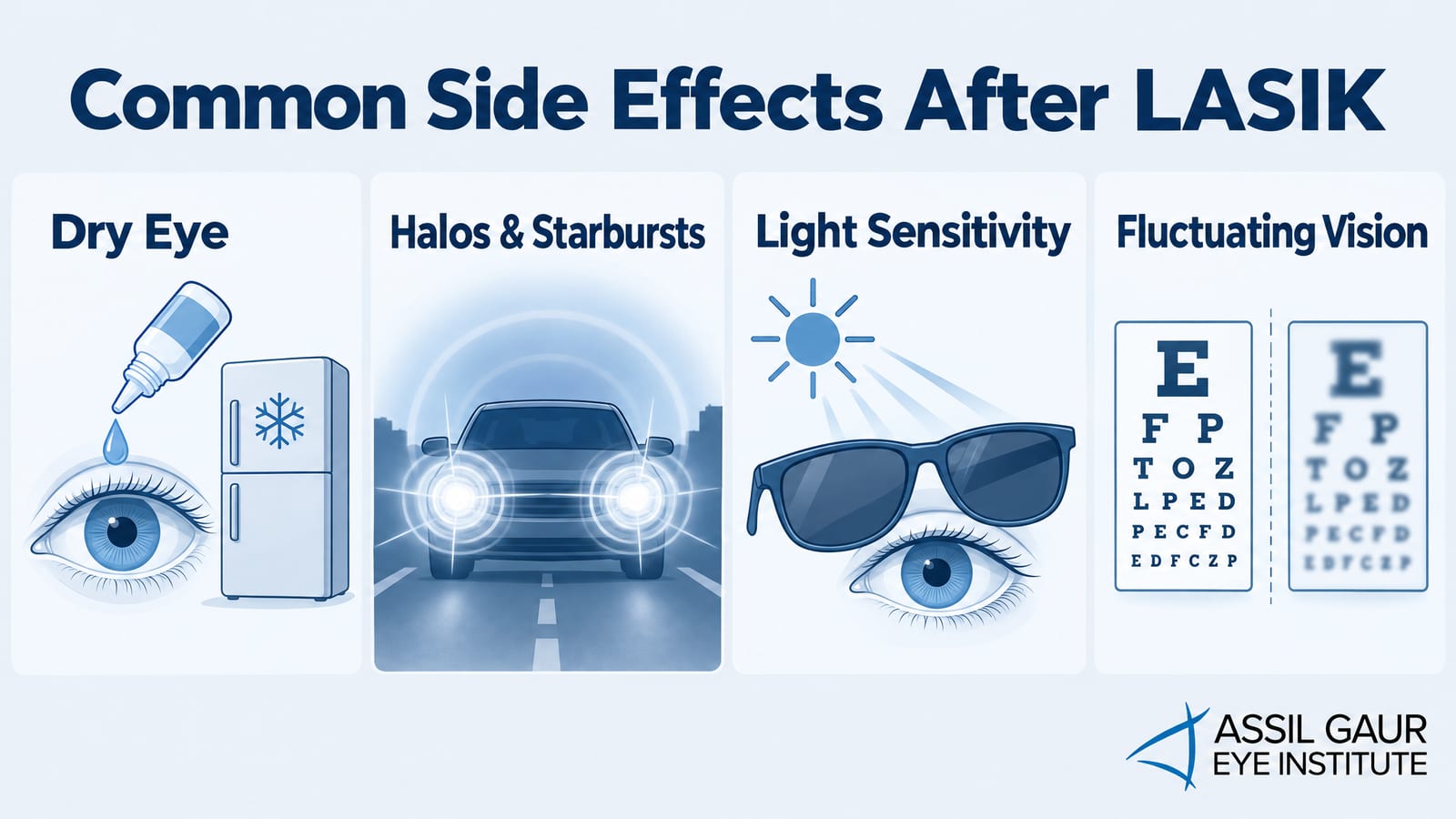
Most patients experience some combination of the following in the first few weeks, and most resolve on their own as healing progresses.
Dry eye is the most common side effect after LASIK. Your eyes may feel gritty, scratchy, or tired, particularly during screen use. Lubricating drops are your best tool here. A helpful tip from our team: storing your artificial tears in the refrigerator makes them noticeably more soothing when you apply them. Use them generously throughout the day, especially if you work at a computer.
Halos, starbursts, and reduced night vision are also very common in the first weeks. You may notice rings of light around headlights or streetlamps when driving at night. This is a normal part of the healing process as your cornea adjusts, and it typically fades significantly within the first one to three months.
Light sensitivity is expected, particularly in the first few days. Wearing quality sunglasses outdoors is essential during this period, both for comfort and to protect your healing cornea from UV exposure.
Fluctuating vision is normal. Your eyesight may shift slightly from day to day as your cornea stabilizes. This is not a sign that something has gone wrong.
Contact our office right away if you experience any of the following, as these are not typical and warrant prompt attention: sudden or worsening eye pain, a significant and rapid decrease in vision, increasing redness that does not improve, or any discharge from the eye. These symptoms are uncommon, but we want to hear from you immediately if they occur.
consultation with those Lebron James trusts with his eyes
LASIK recovery: months two to six…
-
Because it may take from three to six months for your vision to stabilize after surgery, you will return for follow-up visits to check your progress during this period. Please keep your follow-up appointments so we can identify and address any issues early.
-
During this stabilization period, you may continue to experience halos, glare, starbursts, and other symptoms which may take longer to resolve. For some patients, these symptoms might not resolve entirely.
-
Your eyes won’t be completely healed until about six months after surgery.
-
There is a three to five percent chance that a LASIK patient will need re-treatment with LASIK to restore the full benefits of laser surgery.
-
If visual acuity remains unchanged after two eye exams three months apart, we can consider re-treatment. If needed, we perform the procedure at no cost to you.
When to call your doctor after LASIK
Most people sail through LASIK recovery without any serious complications, and that is exactly what you should expect. That said, knowing which symptoms are normal and which are red flags gives you peace of mind and helps you act quickly if something needs attention.
The following experiences are completely normal in the days and weeks after surgery and do not require an urgent call:
-
Mild blurry or hazy vision during the first few days
-
Light sensitivity, especially to bright sunlight or screens
-
Halos and starbursts around lights at night, which typically fade within weeks
-
A gritty or sandy feeling in the eyes, often linked to temporary dry eye
-
Mild tearing or watery eyes
-
Slight fluctuations in vision throughout the day
However, you should contact your doctor right away if you notice any of the following:
-
Sudden or significant loss of vision in one or both eyes
-
Severe eye pain that does not ease with prescribed drops or over-the-counter relief
-
Increasing redness, swelling, or discharge that suggests possible infection
-
A visible flap displacement or the feeling that something has shifted in your eye
-
Worsening halos or starbursts beyond the first month rather than gradual improvement
-
Persistent double vision that is not resolving over time
If you ever feel uncertain about a symptom, the safest move is always to call. At Assil Gaur Eye Institute, our team is here to answer your questions and see you promptly when it matters. You can also learn more about LASIK side effects and how we manage them on our blog. Your vision is too important to wait and wonder.
Long-term eye health after LASIK
Great vision after LASIK is a wonderful outcome, but it does not make your eyes immune to other conditions that can develop over time. That is why our team recommends scheduling an annual comprehensive eye exam every year after your procedure. Regular check-ups allow your surgeon to monitor for glaucoma, macular degeneration, retinal changes, and other conditions that can quietly threaten your vision before you notice any symptoms. Catching these early makes a meaningful difference in outcomes.
LASIK results are typically long-lasting, and most patients need only one procedure in their lifetime. In the small percentage of cases that need a touch-up, AGEI offers a no-cost re-treatment policy, so you can feel confident your investment in clearer vision is protected for the long term.
Years after your LASIK, as your eyes naturally age, you may notice it becoming harder to read small print up close. This is caused by presbyopia, an age-related change in the flexibility of your eye’s natural lens and the muscles surrounding it. Because LASIK reshapes the cornea rather than the lens, presbyopia is completely unrelated to your procedure and is not a complication of surgery. Over-the-counter reading glasses for close-up tasks are a simple, effective solution for most people experiencing this change.
If you ever notice a sudden increase in floaters, flashes of light, a curtain-like shadow across your vision, or significant pain at any point after surgery, contact Assil Gaur Eye Institute right away. These symptoms are not part of a normal recovery and deserve prompt evaluation by your surgeon.
Is LASIK right for you?
It is easy to find out. Contact us if you are considering LASIK vision correction surgery to arrange a complimentary comprehensive consultation.
You will learn about your full range of LASIK options in a comfortable, professional, and relaxed environment. Our doctors will be happy to answer your questions and help clear up any doubts as you consider this important step.
Not every eye is the same, and candidacy depends on factors like corneal thickness, prescription stability, and overall eye health. During your complimentary evaluation, our world-class surgeons will map your eyes with advanced diagnostic technology and give you an honest, personalized assessment of whether EagleVision LASIK, PRK, or another vision correction option is the right fit for you.
Elite athletes trust us with their most valuable asset. EagleVision LASIK is the procedure of choice for LeBron James and NBA All-Stars who cannot afford anything less than precision, clarity, and a fast return to peak performance. We offer that same standard of care to every patient who walks through our doors.
Schedule your complimentary LASIK evaluation today by calling 866-945-2745 or requesting an appointment online. At Assil Gaur Eye Institute, world-class vision correction and enviable outcomes are within reach.
Call now or book your appointment online.

Written by The AGEI Educational Team

Medically Reviewed by Dr. Kerry Assil