 About Keratoconus Contact Lenses
You’ve been told your blurry, distorted vision can’t be fixed with regular glasses or contacts – and that’s true, but it’s only half the story. For patients with keratoconus living active, demanding lives in Los Angeles, the real question isn’t whether specialty lenses can help. It’s whether they can keep up with you.
We understand how exhausting trial and error can feel. You’ve probably cycled through prescriptions that stopped working, lenses that irritate by midday, and appointments that leave you with more questions than answers. If you’re an athlete, entertainer, or professional who depends on sharp, reliable vision from morning to night, that frustration is compounded by real performance stakes.
This guide covers three things no other resource currently addresses together: every specialty lens type proven to work for keratoconus and which stage of the condition each suits, what an expert fitting process actually looks like at a world-class Los Angeles eye institute, and exactly when lenses alone are no longer the smartest path forward. If you’re already wondering whether surgery might be the answer, our keratoconus treatment options page is a good place to start.

Why Does Keratoconus Make Standard Contact Lenses and Glasses Ineffective?
Keratoconus causes the cornea – normally a smooth, round dome – to progressively thin and bulge into an irregular cone shape. That structural change drives the problem. Light entering the eye scatters instead of focusing cleanly on the retina, producing blurred vision, ghosting, halos around lights, and severe difficulty with nighttime tasks like driving.
Standard soft contact lenses drape over the corneal surface and conform to whatever shape lies beneath. When that surface is irregular, the lens simply follows the distortion rather than correcting it. Glasses face the same limitation: they can compensate for sphere and cylinder, but they cannot neutralize the higher-order aberrations created by a cone-shaped cornea. As the National Keratoconus Foundation notes, the best lens for keratoconus is the one that fits your specific eye – and that determination requires specialist expertise, not a standard optometry appointment.
For active patients, this matters beyond comfort. A professional whose vision fluctuates throughout the day, or an athlete whose depth perception is compromised under stadium lights, faces a functional problem that standard correction simply cannot solve. Keratoconus is typically diagnosed in the late teens to early twenties, according to Bausch + Lomb, which means many patients spend decades managing a progressive condition – and the lens strategy that works at 22 may be completely inadequate at 35.
Can you wear regular contact lenses with keratoconus?
In the earliest stages of mild keratoconus, some patients can still achieve functional vision with soft lenses or glasses. But as corneal irregularity increases, standard lenses become progressively less effective and eventually fail to provide adequate visual acuity. Most keratoconus patients require specialty lenses within a few years of diagnosis, and continuing with standard lenses as the condition advances risks both poor vision and inadequate corneal monitoring.
The Four Types of Specialty Contact Lenses for Keratoconus – and Which Stage Each Suits
Specialty keratoconus contact lenses work on a fundamentally different principle than standard lenses. Rather than conforming to the irregular corneal surface, they create a new, optically smooth front surface for the eye. A tear film fills the space between the lens and the cornea, effectively replacing the distorted surface with a uniform optical layer. When fitted correctly, the result is dramatically improved visual acuity.
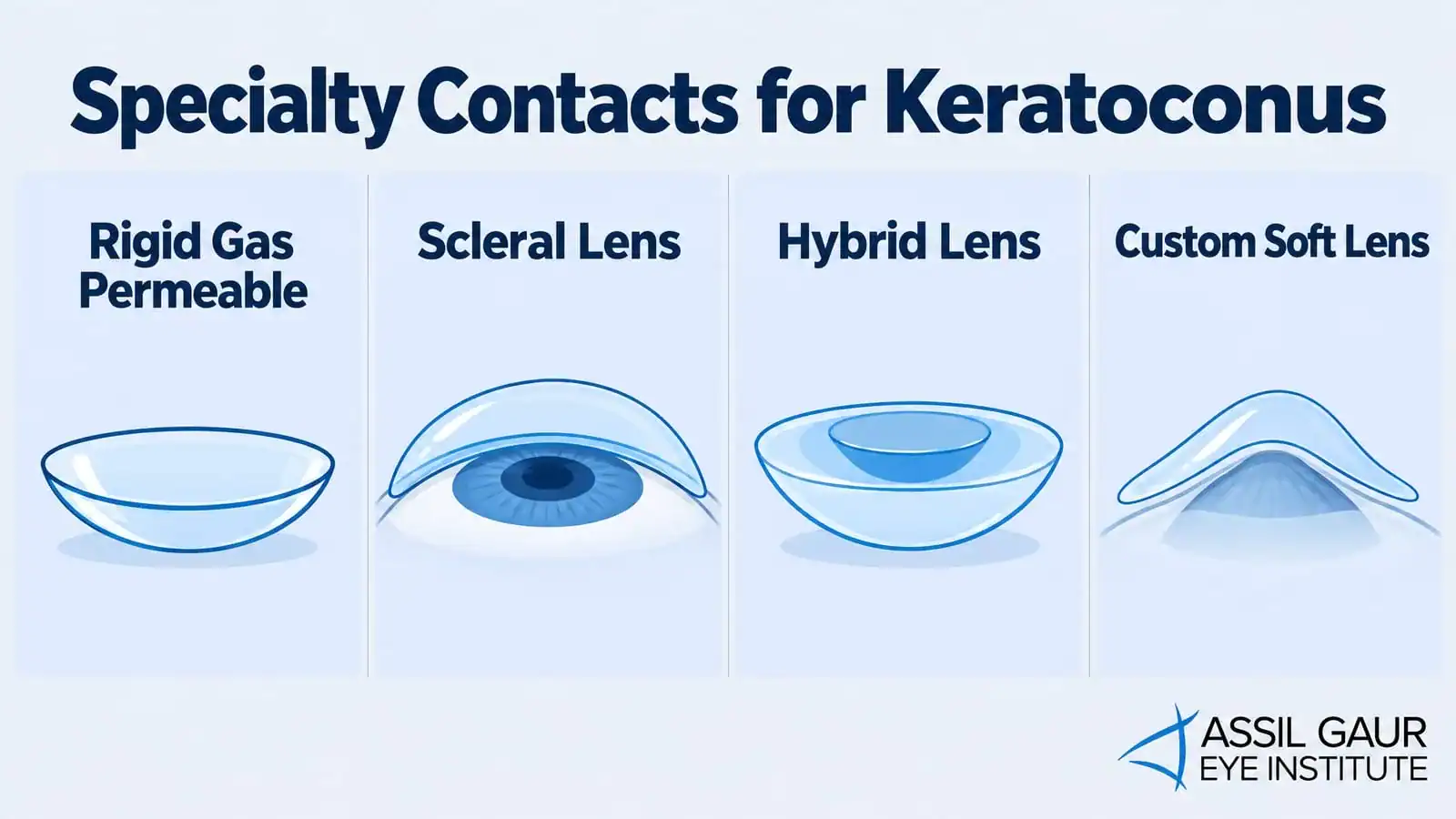
There are four main categories, each suited to different stages of keratoconus and different patient lifestyles.
Rigid Gas Permeable (RGP) lenses are the most commonly prescribed lens type for keratoconus. They are custom-designed to match the unique shape of the affected cornea and allow oxygen to pass through the lens material, supporting corneal health. RGP lenses provide excellent optical clarity and are typically the first specialty lens prescribed for mild to moderate keratoconus. The trade-off is adaptation time: the rigid material takes weeks to feel comfortable, and active patients often find them prone to dislodging during physical activity.
Scleral contact lenses are large-diameter rigid lenses that vault entirely over the cornea and rest on the white of the eye (the sclera). They are filled with preservative-free saline before insertion, creating a liquid reservoir between the lens and the cornea. This design makes them significantly more stable and comfortable than RGP lenses, and they are the preferred option for moderate to advanced keratoconus. For athletes and performers who need all-day lens stability, sclerals are often the most practical specialty lens available.
Hybrid contact lenses combine a rigid gas permeable center with a soft silicone hydrogel skirt. The rigid center corrects the optical distortion; the soft skirt provides the comfort and stability of a soft lens. Hybrids are a strong option for patients who cannot tolerate the feel of a full RGP lens but need better optical correction than custom soft lenses provide. They suit mild to moderate keratoconus and are especially popular with patients new to specialty lens wear.
Custom soft contact lenses are designed specifically for keratoconus using detailed corneal mapping. They offer the best comfort profile of any keratoconus lens but provide the least optical correction. They are generally reserved for patients with very mild keratoconus or those who genuinely cannot tolerate any rigid lens material. For most active patients with progressing keratoconus, custom soft lenses are a temporary solution, not a long-term strategy.
What type of contact lenses are best for keratoconus?
No single lens works best for every keratoconus patient. The right choice depends on the stage of the condition, the specific corneal shape mapped by corneal topography, the patient’s tolerance for rigid materials, and their daily activity demands. A peer-reviewed study published in PMC/NIH confirms that RGP lenses remain the most widely used option, while scleral lenses have become the preferred choice for advanced cases due to their superior stability and comfort.
An experienced keratoconus specialist will use corneal topography data to match the lens design to your specific corneal geometry rather than applying a one-size-fits-all protocol.
Call now or book your appointment online.
Scleral Lenses for Keratoconus: How They Work and Why They’re Often the Gold Standard
Scleral lenses deserve their own section because they represent the most significant advancement in keratoconus contact lens management in the past two decades. Their large diameter, typically 14.5mm to 24mm compared to a standard RGP lens at 9-10 mm, means they completely vault over the irregular cornea without touching it at all. The tear reservoir that fills this space acts as a liquid optical surface, neutralizing the corneal irregularity and delivering sharp, stable vision.
For active patients, the stability advantage is significant. Because scleral lenses rest on the sclera rather than the cornea, they are far less likely to dislodge during physical activity. A patient who plays competitive tennis or performs on stage cannot afford a lens that shifts or pops out at a critical moment.
Scleral lenses also provide continuous hydration through the saline reservoir, which reduces the end-of-day dryness that makes RGP lenses increasingly uncomfortable for patients who wear them for 10 or more hours.
Consider Klaus Ito, an optometrist who wore hard contact lenses and experienced significant dry eye during patient examinations. When he came to Assil Gaur Eye Institute for a consultation with Dr. Avneet Gaur, the team discovered a previously missed retinal tear and repaired it before attempting any vision correction.
That level of diagnostic thoroughness, catching what others missed, is exactly what patients with complex corneal conditions need before committing to any lens or surgical plan.
Fitting scleral lenses is more involved than fitting standard lenses, which is why the quality of the fitting specialist matters enormously. A poorly fitted scleral lens can cause corneal hypoxia, lens fogging, or inadequate vault – all of which compromise both vision and corneal health.
Are scleral lenses the best option for keratoconus?
For moderate to advanced keratoconus, scleral lenses are frequently the best contact lens option available. They provide superior stability, all-day comfort, and excellent visual acuity by completely vaulting the irregular cornea. However, they require a skilled fitting specialist, a longer adaptation period than soft lenses, and a more involved insertion-and-removal routine.
For patients with mild keratoconus, RGP or hybrid lenses may be equally effective with less complexity. The right answer depends on your specific corneal topography and lifestyle demands.
What a Keratoconus Contact Lens Fitting Actually Involves (And How Many Visits to Expect)
Most patients are surprised by how different a keratoconus lens fitting is from a standard contact lens appointment. It is not a single visit. It is a multi-session process that combines advanced diagnostic imaging with iterative lens trials, and it requires a specialist who understands both the optics and the biomechanics of the keratoconic cornea.
The process typically begins with corneal topography – a detailed map of the corneal surface that captures thousands of data points about its curvature, elevation, and irregularity. This map underpins every lens design decision that follows. At AGEI, this diagnostic step is taken seriously: as patient Julie H. described, “Dr. May had the technician take high-tech scans of my eyes, and six months later compared new scans with the originals.
With such careful procedures, he was able to determine my exact needs.” That kind of longitudinal imaging lets a world-class practice track keratoconus progression and adjust the treatment plan accordingly.
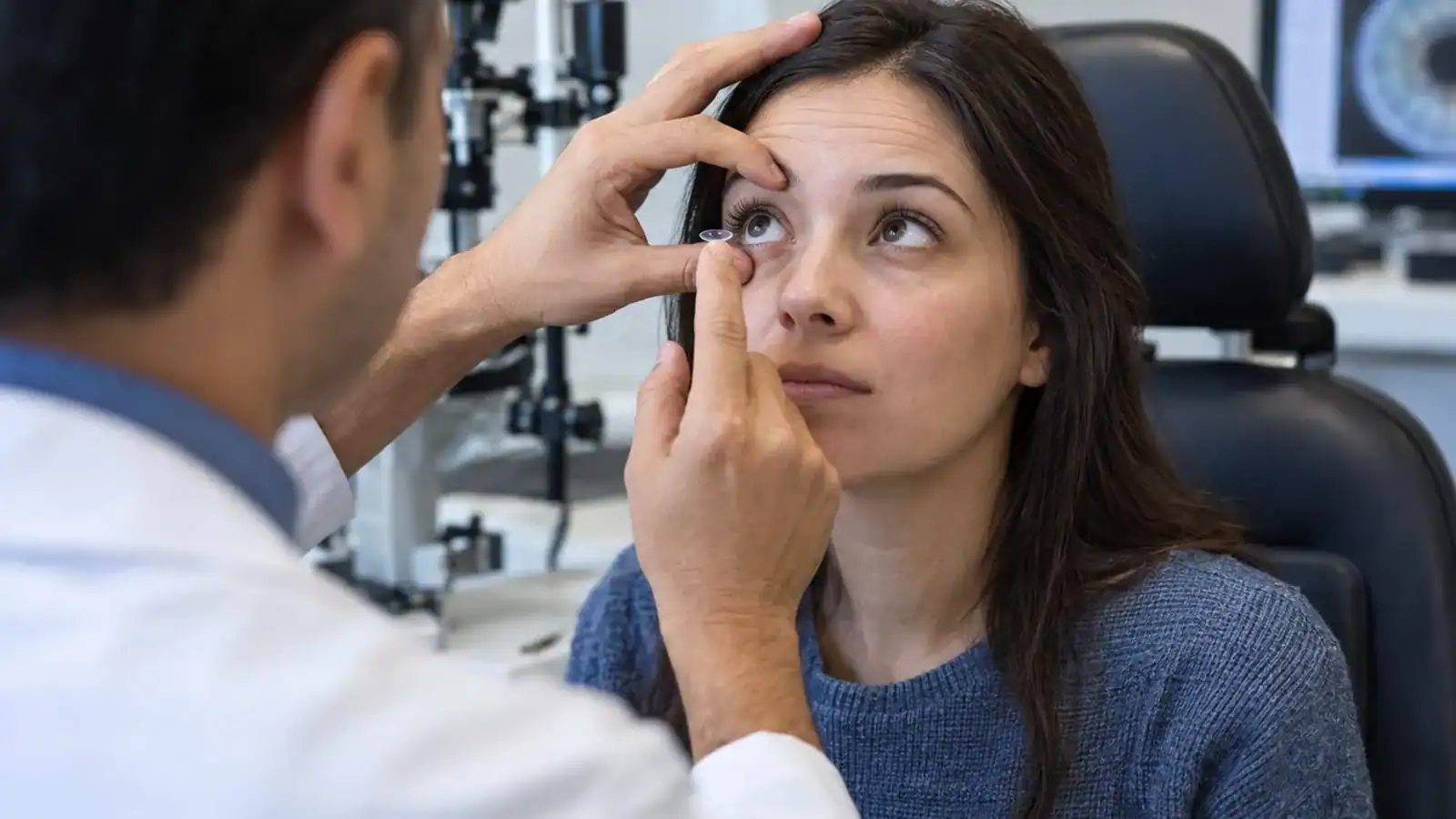
After topography, the specialist selects a trial lens based on the corneal map and the patient’s prescription. For scleral lenses, the fitting involves assessing the vault height over the cornea, the landing zone on the sclera, and the lens-to-cornea relationship under a slit lamp. Clinicians typically evaluate multiple trial lenses in a single session. Most patients need two to four fitting visits before ordering a final lens, plus an additional adaptation period of several weeks before the lens feels fully comfortable.
For active patients, the fitting conversation should also include a frank discussion of lens performance under real-world conditions: how the lens behaves during exercise, how long it remains comfortable, and what to do if it needs to be removed and reinserted during the day. These are practical questions that a specialist experienced with high-performance patients will address proactively.
Cost of Keratoconus Contact Lenses in Los Angeles and What California Insurance Covers
Specialty keratoconus contact lenses are significantly more expensive than standard lenses, and the fitting process adds to the total investment. Scleral lenses typically cost more than RGP or hybrid lenses because they’re larger, require more complex manufacturing, and demand greater fitting expertise. Custom soft lenses are generally the least expensive specialty option.
In California, many health insurance plans – including Medi-Cal managed care plans and most major commercial insurers – recognize keratoconus as a medical condition rather than a refractive error. This distinction matters because it can mean specialty lenses are covered under medical benefits rather than vision benefits, which typically have lower allowances.
Coverage varies significantly by plan and by the specific lens type prescribed. Patients should request a letter of medical necessity from their specialist and confirm coverage for both fitting fees and the lenses before proceeding.
Some California patients also qualify for coverage through the California Children’s Services program if they were diagnosed as minors. Adults can use flexible spending accounts (FSAs) and health savings accounts (HSAs) to offset out-of-pocket costs for specialty lenses and fitting fees. A practice experienced with keratoconus patients – like AGEI – will have staff familiar with navigating these coverage pathways.
Call now or book your appointment online.
When Contact Lenses Are No Longer Enough: Surgical Options for Advanced Keratoconus
This is the question no other resource currently answers clearly: what happens when contact lenses stop working? For some keratoconus patients, the cornea progresses to a point where even the best-fitted scleral lens cannot provide adequate visual acuity. For others, lens intolerance – chronic discomfort, inability to wear lenses for a full workday, or repeated fitting failures – makes contact lens management unsustainable regardless of the stage.
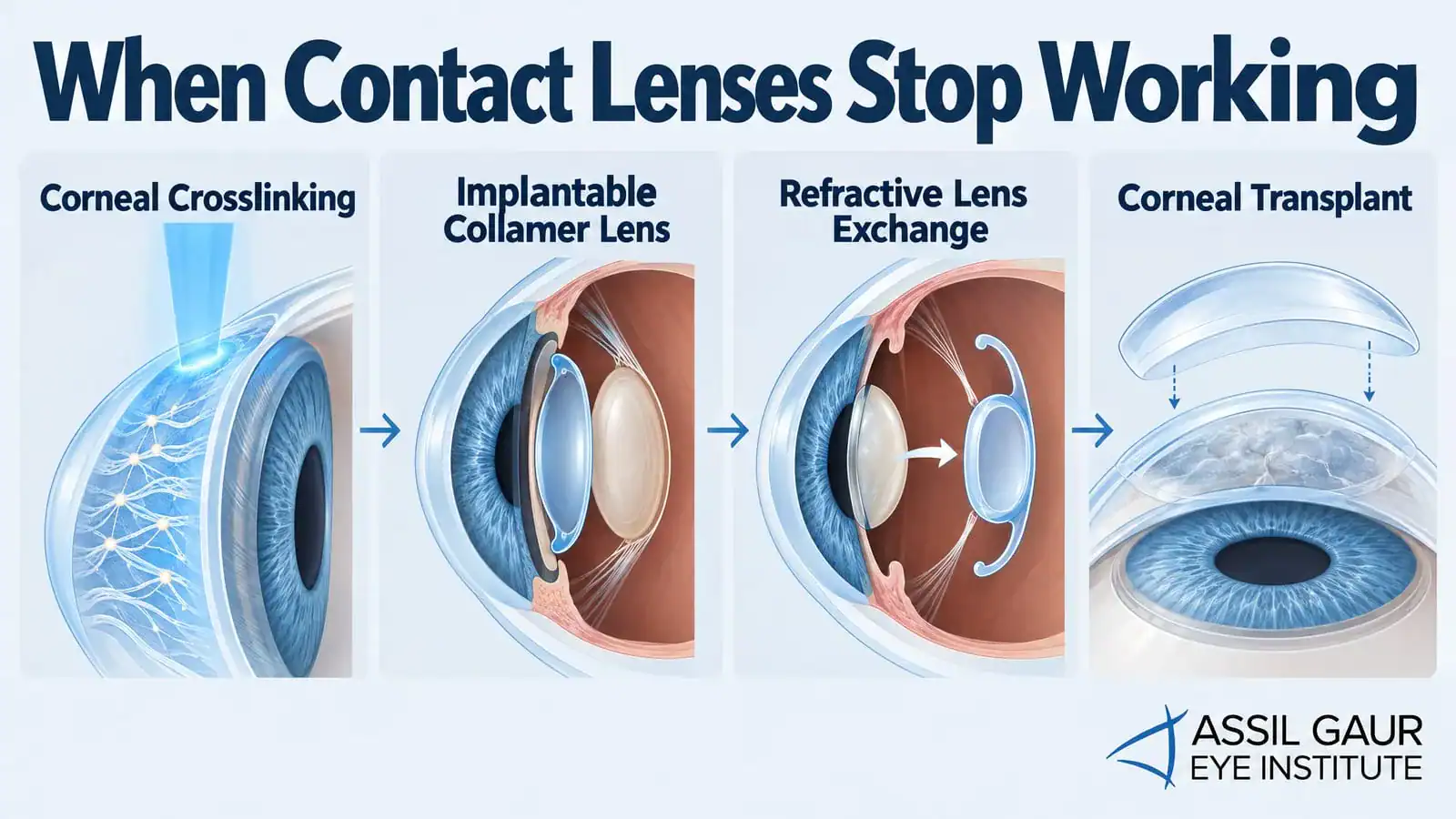
When you reach that threshold, several surgical and procedural pathways are worth understanding.
Corneal crosslinking (CXL) is the only treatment that directly addresses keratoconus progression. It uses riboflavin eye drops and UV light to strengthen the cornea’s collagen bonds, halting or significantly slowing the condition’s progression. CXL does not restore vision that has already been lost, but it can prevent further deterioration, making it a critical intervention for younger patients whose keratoconus is still progressing. It is often performed before other vision correction procedures to stabilize the cornea first.
Implantable Collamer Lenses (ICLs) are a surgical alternative for keratoconus patients who cannot tolerate contact lenses and whose corneas are not suitable for laser correction. An ICL is a thin, flexible lens implanted inside the eye, between the iris and the natural lens, without removing any corneal tissue. Because it does not alter the corneal surface, it can provide excellent vision correction even in eyes with significant corneal irregularity. ICL is particularly relevant for active patients who want freedom from daily lens management without the corneal risks associated with laser surgery on an irregular cornea.
Refractive Lens Exchange (RLE) replaces the eye’s natural lens with a premium intraocular lens, correcting refractive error while also eliminating the risk of future cataracts. For keratoconus patients over 40 approaching the age when presbyopia becomes a factor, RLE with premium intraocular lens options can address multiple vision needs at once.
In advanced cases where the cornea has become severely scarred or thinned, corneal transplantation may be necessary. This is a last resort, but it is worth knowing that modern partial-thickness transplant techniques (DALK) preserve more of the patient’s own tissue and offer faster recovery than full-thickness procedures.
What happens when contact lenses no longer work for keratoconus?
When contact lenses fail to provide adequate vision or become intolerable to wear, the next step is a thorough evaluation by a keratoconus specialist to assess corneal stability and identify the most appropriate surgical pathway. Options include corneal crosslinking to halt progression, ICL implantation for vision correction without removing corneal tissue, refractive lens exchange for older patients, or corneal transplantation in severe cases. The right choice depends on the patient’s age, the degree of corneal irregularity, and whether the condition is still actively progressing.
Keratoconus and LASIK: Why Standard Laser Surgery Is Not an Option – and What Is
One of the most important things a keratoconus patient needs to understand is why standard LASIK is contraindicated for their condition. LASIK works by removing corneal tissue to reshape the eye’s focusing surface. In a keratoconic cornea that is already thinned and structurally compromised, removing more tissue can accelerate cone progression and cause serious, potentially irreversible vision loss. This is why keratoconus disqualifies patients from standard LASIK, and why any practice that offers LASIK without thorough pre-operative screening is a risk.
At AGEI, we perform detailed corneal topography and evaluation before we consider any vision correction procedure. This is precisely why understanding why keratoconus disqualifies patients from standard LASIK matters: the screening process that protects keratoconus patients from inappropriate surgery is the same process that identifies the right alternative for them.
For keratoconus patients who want freedom from glasses and contact lenses, ICL is typically the most appropriate surgical vision correction option. Unlike LASIK, it does not remove corneal tissue. Unlike RGP or scleral lenses, it requires no daily insertion, removal, or cleaning routine. For an athlete, performer, or professional who has spent years managing specialty lenses, a permanent, maintenance-free solution is especially appealing.
Consider a competitive swimmer we’ve worked with at AGEI who managed moderate keratoconus with scleral lenses for six years. The lenses provided good vision on land but were impractical for training – she couldn’t wear them in the pool, and the transition between lens-in and lens-out vision was disorienting during competition preparation.
After corneal crosslinking stabilized her condition, she was evaluated for ICL and achieved functional vision correction without any lens management. Her words after the procedure echoed what we hear often: “I am so beyond grateful for Doctor Assil and his incredible staff. I could not have asked for a better experience.”
Does keratoconus disqualify you from LASIK surgery?
Yes. Keratoconus is a contraindication for standard LASIK because the procedure removes corneal tissue from an already structurally weakened cornea. LASIK on a keratoconic eye risks accelerating corneal thinning and progression, which can cause severe, irreversible vision loss. Patients with keratoconus who want surgical vision correction should be evaluated by a specialist experienced with irregular corneas for ICL, refractive lens exchange, or other non-ablative options.
Getting a Keratoconus Evaluation at Assil Gaur Eye Institute in Los Angeles
Assil Gaur Eye Institute has built its reputation on precision diagnostics and surgical outcomes that other practices cannot match. Our surgeons have performed over 100,000 vision correction procedures and trained more than 14,000 surgeons worldwide. That depth of experience matters when you’re dealing with a condition as nuanced as keratoconus, where the difference between a good outcome and a poor one often comes down to the quality of the initial evaluation.
Dr. Avneet K. Sodhi Gaur leads our keratoconus and glaucoma care, bringing specialist-level expertise to every patient evaluation. The diagnostic process at AGEI includes corneal topography, detailed slit-lamp examination, and a thorough review of the patient’s history and lifestyle demands. As patient Steven L. described after his experience with our retinal specialist: “She detected a retinal issue before having cataract surgery, which was a vision saver.” That same commitment to catching what others miss applies to every keratoconus evaluation we conduct.
Whether you’re exploring specialty contact lenses for the first time, frustrated with lenses that no longer work, or researching surgical alternatives, the best place to start is a thorough evaluation with a specialist who understands the full spectrum of options. We offer complimentary evaluations for patients exploring vision correction options, and our team will give you a clear, honest picture of where you stand and your best path forward.
If you’re ready to stop managing around your vision and start seeing clearly on your terms, schedule your keratoconus evaluation at AGEI to find the solution that fits your eyes, your lifestyle, and your goals.
Call now or book your appointment online.
Frequently Asked Questions
How long does it take to get fitted for keratoconus contact lenses?
The fitting process for specialty keratoconus contact lenses typically spans two to four visits over several weeks. The first visit involves corneal topography and an initial trial lens assessment. Subsequent visits refine the fit based on how the lens performs under slit-lamp examination and in real-world wear. After the final lens is ordered and received, most patients need an additional two to six weeks of adaptation before the lens feels fully comfortable and vision stabilizes. Scleral lens fittings generally take longer than RGP or hybrid fittings because more parameters must be optimized.
Can keratoconus be corrected without contact lenses?
Yes, in certain cases. Corneal crosslinking can halt keratoconus progression but does not restore vision on its own. For patients who cannot tolerate contact lenses or whose keratoconus has advanced beyond what lenses can correct, surgical options such as implantable collamer lenses (ICL) and refractive lens exchange can provide meaningful vision correction without lens management. In severe cases with significant corneal scarring, corneal transplantation may be necessary. The appropriate non-lens pathway depends on the patient’s corneal stability, age, and degree of visual impairment, and a specialist experienced with keratoconus should determine it.
How much do keratoconus contact lenses cost?
Specialty keratoconus contact lenses cost considerably more than standard lenses, with prices varying by lens type, fitting complexity, and the practice’s location. Scleral lenses typically require the highest investment because of their manufacturing complexity and the specialist fitting time required. In California, many commercial health insurance plans cover specialty keratoconus lenses under medical benefits rather than vision benefits, since keratoconus is classified as a medical condition. Patients should request a letter of medical necessity from their specialist and verify coverage details with their insurer before beginning the fitting process. FSAs and HSAs can also offset out-of-pocket costs.

Written by The AGEI Educational Team

Medically Reviewed by Dr. Kerry Assil