Optometrist's RLE Journey: Glasses-Free with Odyssey Lens Surgery
After 10 years of wearing reading glasses, Dr. Greta Torossian had reached the end of her patience. Her glasses were always the last place she looked.
Greta, 52, suffered from presbyopia, a common age-related vision loss that affects the ability of the crystalline lens to focus on close objects. The crystalline lens is the flexible and transparent structure behind the iris.
The crystalline lens gradually loses flexibility as we age, making it more difficult for the eyes to focus on close-up objects (such as fine print).
The solution? A refractive lens exchange (RLE) procedure with the state-of-the-art Odyssey IOL Lens by Johnson & Johnson.
What is a refractive lens exchange?
RLE, also known as clear lens exchangeor lens replacement surgery, is used to correct refractive errors in the eyes, such as nearsightedness (myopia), farsightedness (hyperopia), and presbyopia. This procedure is similar to cataract surgery, but the eye’s natural lens is replaced with an artificial intraocular lens (IOL) to improve vision, not to replace a cataract-clouded lens.
RLE is often used for patients who are poor candidates for laser vision correction.
What challenges did Greta face before refractive lens exchange for presbyopia?
Greta faced significant challenges due to presbyopia, primarily struggling with the constant need for glasses in her busy professional life. As an optometrist with two mobile practice units, she found herself constantly searching for her glasses, especially when working extensively in front of a computer. She expressed a strong desire for a multifocal IOL to eliminate her reliance on glasses, stating, “I spend so much time in front of the computer that I get sick and tired of trying to locate my glasses.”
Greta cooperates with many other doctors and specialists through her medical group, Greta Torossian, Optometric Corp.
“I wanted a multifocal IOL, so I didn’t have to wear glasses anymore,” says Greta, who has been practicing optometry for 23 years. “I spend so much time in front of the computer that I get sick and tired of trying to locate my glasses.”
What solution did Dr. Assil recommend for Greta's presbyopia?
Dr. Assil recommended the cutting-edge Odyssey lens for Greta's presbyopic lens exchange, offering a straightforward solution to her dilemma. Greta, who has known Dr. Assil for 15 years and trusts him implicitly, was deemed a good candidate for multifocal lens surgery. She specifically desired a full range of vision after the IOL surgery, leading Dr. Assil to suggest the advanced Odyssey lens among the many available IOL options.
“I trust him. He’s taken care of many of my patients,” she says, adding that Dr. Assil said she would be a good candidate for the multifocal lens surgery. “Everyone loves him. You have to be in awe of his confidence.”
There are dozens of IOL options to choose from. Because Greta wanted a full range of vision after the IOL surgery, Dr. Assil recommended the cutting-edge Odyssey lens for her presbyopic lens exchange.
What makes the Odyssey RLE lens state-of-the-art?
Call now or book your appointment online.
Advanced RLE Procedure
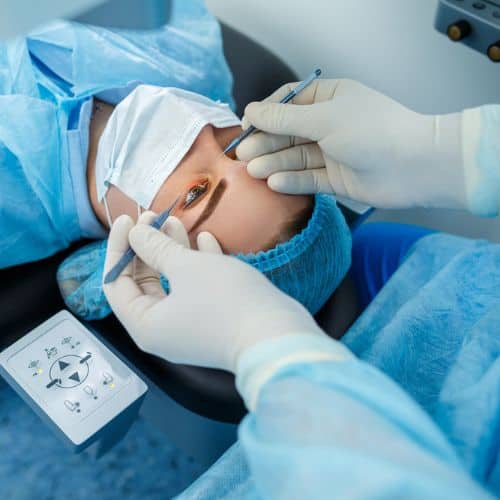
Though naturally somewhat apprehensive about her brief trip to the AGEI outpatient surgery center, Greta says the clear lens extraction was easy.
Because she did not have cataracts, Greta could have the RLE procedure done in both eyes at the same time. Typically, cataract patients have to wait a week or two between artificial lens procedures.
“I’m honestly happy. I went through it with no pain,” says Greta, who has referred more than a dozen satisfied friends to Dr. Assil during the last few years. “You are in and out, and he was constantly talking to me about the procedure.”
Because Greta’s lenses combine several prescriptions into one clear lens, those “bands” of prescription can cause light to split as they transition from one prescription strength to the next.
For this reason, she experienced the halo effect immediately after surgery. Fortunately, this condition usually disappears within three to six months as the brain acclimates to the new lens.
Greta was also given eye drops to eliminate the dry eye that sometimes follows the lens exchange procedure.
Is refractive lens exchange worth it?
Greta couldn’t be more pleased with her surgery.
“I honestly think it’s the best thing I’ve ever done for myself,” she says of her clear vision. “I’m thrilled with things.”
Why trust AGEI with your refractive lens exchange surgery?
With 30 years of experience assisting patients with eye health, Dr. Assil is one of the most experienced cataract surgeons in the United States. He has performed over 70,000 eye surgeries and authored over 100 textbook chapters and articles on refractive and cataract surgery.
Assil Gaur Eye Institute has assembled a team of top eye doctors from around the country who offer their patients the highest quality of specialist eye care in the United States.
In keeping with the founding principles of AGEI, eye surgeons keep their clinics comfortable and familiar, much like how family-run medical practices used to be.
In addition to refractive lens exchange and cataract surgery, the ophthalmology experts at AGEI are nationally recognized for their eye care and treatment options for a full range of conditions, including eye conditions such as hyperopia glaucoma, retinal detachment (and other diseases of the retina), cornea conditions, contact lens, floaters and flashes, dry eye, presbyopia, astigmatism (using a toric lens), farsightedness, myopia, nearsightedness, and other vision correction procedures (refractive surgery) such as LASIK surgery, PRK, and many more laser procedures.
Today, AGEI is nationally recognized for its compassionate, patient-centric health care, commitment to pioneering advances in ophthalmology, and dedication to supporting its patients and the community’s health and well-being.
Call now or book your appointment online.
More Stories You might be interested in

Mario’s Second Eye Lens Replacement Surgery, This Time With Dr. Assil, was the Charm
Steve’s Refractive Lens Exchange with Dr. Gaur Reveals He’d Been Color-Blind for Decades!

Woman Too Scared to Drive With Cataracts Gets Better-Than-Perfect Vision from Dr. Assil 20 Years After LASIK