RxSight Light Adjustable Lens: Customize Your Vision After Cataract Surgery
Assil Gaur Eye Institute is happy to introduce the RxSightTM Light Adjustable Lens: the first and only adjustable intraocular lens for cataract patients that can have its prescription power changed after it’s implanted in your eye.
These state-of-the-art monofocal lenses allow you to “test drive” your new eyesight and experience how the vision correction feels. Then, you can decide which prescription setting meets your vision goals and lifestyle needs. Once you’re happy with your prescription setting, the final adjustment is “locked” in place.
RXSight light adjustable lens delivers superior vision outcomes
For decades, cataract patients faced a frustrating reality: once a traditional intraocular lens was implanted, its power was fixed forever. If the outcome wasn’t quite right, glasses or contacts were the only fallback. The RxSight™ Light Adjustable Lens changes that equation entirely, and the clinical results speak for themselves. In an FDA-reviewed clinical study of 6-month outcomes, patients who received the Light Adjustable Lens were twice as likely to achieve 20/20 distance vision without glasses as patients who received a standard IOL lens implant. That single statistic captures what makes this technology so compelling for patients who want the very best possible outcome from their cataract surgery.
At Assil Gaur Eye Institute, our surgeons take that advantage even further. While the national average for achieving 20/20 vision after cataract surgery sits around 50%, our team consistently delivers 20/20 outcomes for approximately 97% of patients, a result made possible by pairing the Light Adjustable Lens with ORA intraoperative guidance technology that measures refractive power with 25 times greater precision than standard pre-surgical measurements alone. When you combine a lens that can be fine-tuned after surgery with real-time precision data captured during the procedure itself, you create conditions for truly enviable outcomes.
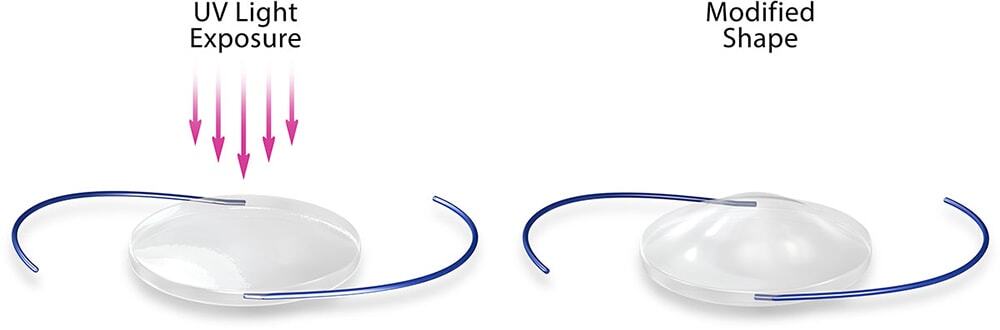
What’s so revolutionary about the RxSight™ Light Adjustable Lens is that it delivers outstanding vision outcomes that current fixed intraocular lenses simply cannot match. The latest generation, the LAL+, builds on this foundation with an expanded range of adjustability, giving surgeons even greater flexibility to correct myopia, hyperopia, and astigmatism after the lens is already in place. This is possible because the RxSight™ Light Adjustable Lens is made of special photosensitive silicone material that undergoes subtle changes in lens power and shape when exposed to carefully dosed ultraviolet (UV) light. This technology lets your doctor adjust your lens power and curvature after surgery, in a non-invasive office setting, until your vision is exactly where it needs to be.
For patients who have spent years depending on glasses or contacts, that level of personalized precision represents something genuinely life-changing. You are not accepting a best-guess result. You work with your surgeon to dial in your vision with a level of control no fixed lens can offer, guided by a team trusted by elite athletes, performing artists, and patients who refuse to settle for anything less than world-class care.
Who is a good candidate for the RxSight Light Adjustable Lens?
The RxSight Light Adjustable Lens is an excellent option for a wide range of cataract patients, but it tends to deliver the best outcomes for those who strongly want to reduce or eliminate their dependence on glasses after surgery. If achieving the sharpest possible vision without correction is a priority, this premium lens deserves serious consideration.
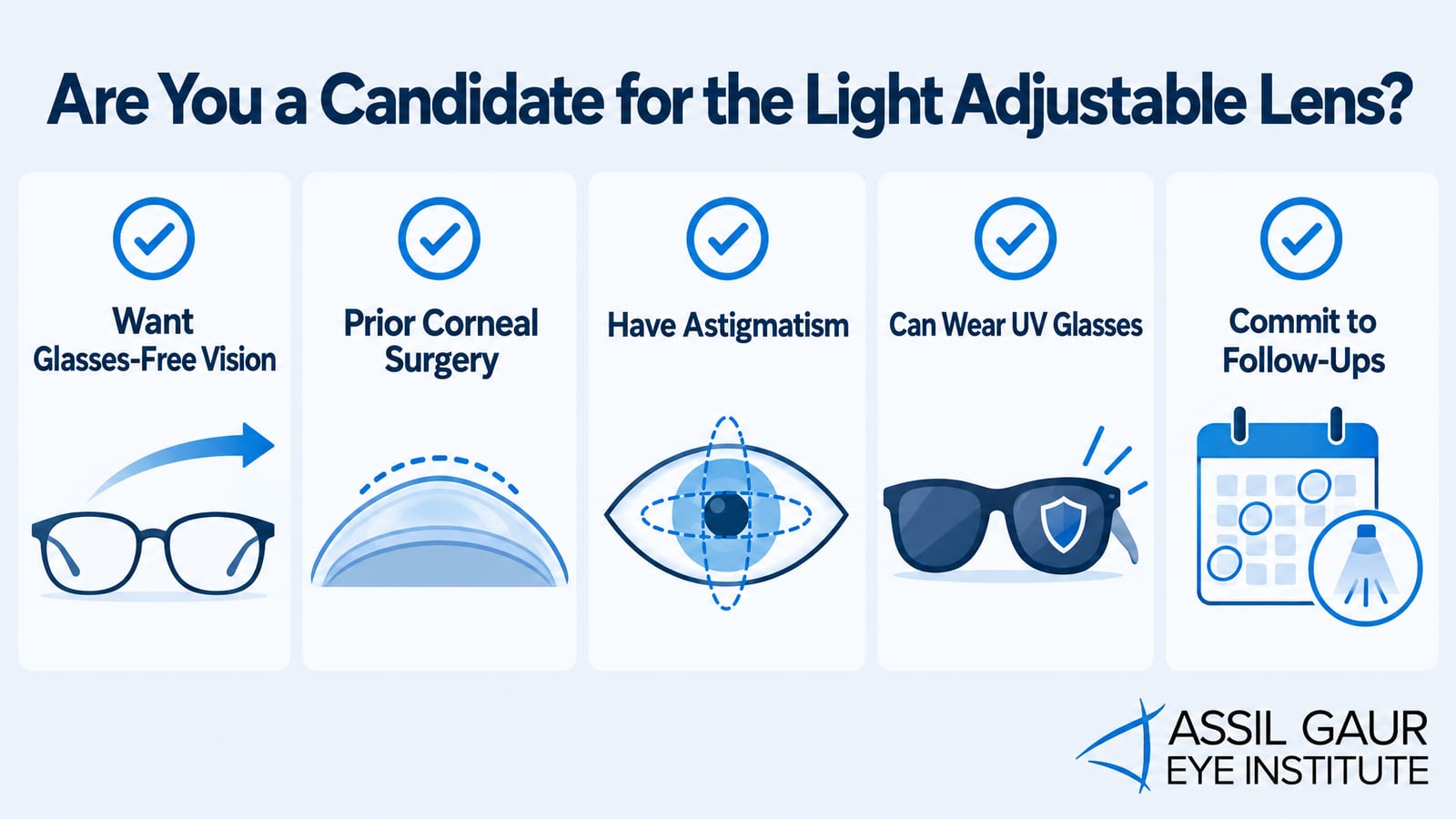
You are likely a strong candidate if you:
-
Are scheduled for cataract surgery and want a personalized, fine-tuned visual result
-
Have a history of LASIK, PRK, or other corneal procedures that make standard lens power calculations less predictable
-
Have astigmatism that you want corrected with precision
-
Are willing to wear UV-protective glasses between light treatment sessions to protect the lens before it is locked in
-
Can commit to the full series of follow-up light delivery appointments, typically spread over several weeks
On the other hand, the LAL may not be the right fit if you have certain retinal conditions, advanced glaucoma, or can’t wear UV-blocking eyewear consistently during the adjustment period. Patients with uncontrolled diabetic eye conditions may also need to address those concerns before moving forward.
The best way to know for certain is through a thorough evaluation with one of our world-class surgeons at Assil Gaur Eye Institute. Every candidacy decision is made with your full eye health picture in mind, so you can feel confident you are in the very best hands from day one.
How does the eye doctor adjust the lens power after it’s in my eye?
Your RxSightTM lenses are adjusted via non-invasive UV light treatments performed at your eye doctor’s office. The painless light treatments take just a few minutes and are performed over a two-week period following the IOL implantation surgery. The light treatments let the doctor further refine your visual acuity based on your personal preferences. Depending on your needs, you may require anywhere from two to four light treatments, three days apart, to reach your desired vision goals. Once you’re happy with your sight, a final light treatment “locks in” the desired prescription setting.
How does the RxSightTM Light Adjustable Lens work?
You’re probably wondering how it is that your eye surgeon can change the prescription of a permanent intraocular lens that’s been placed inside your eye. Kind of unbelievable, right?
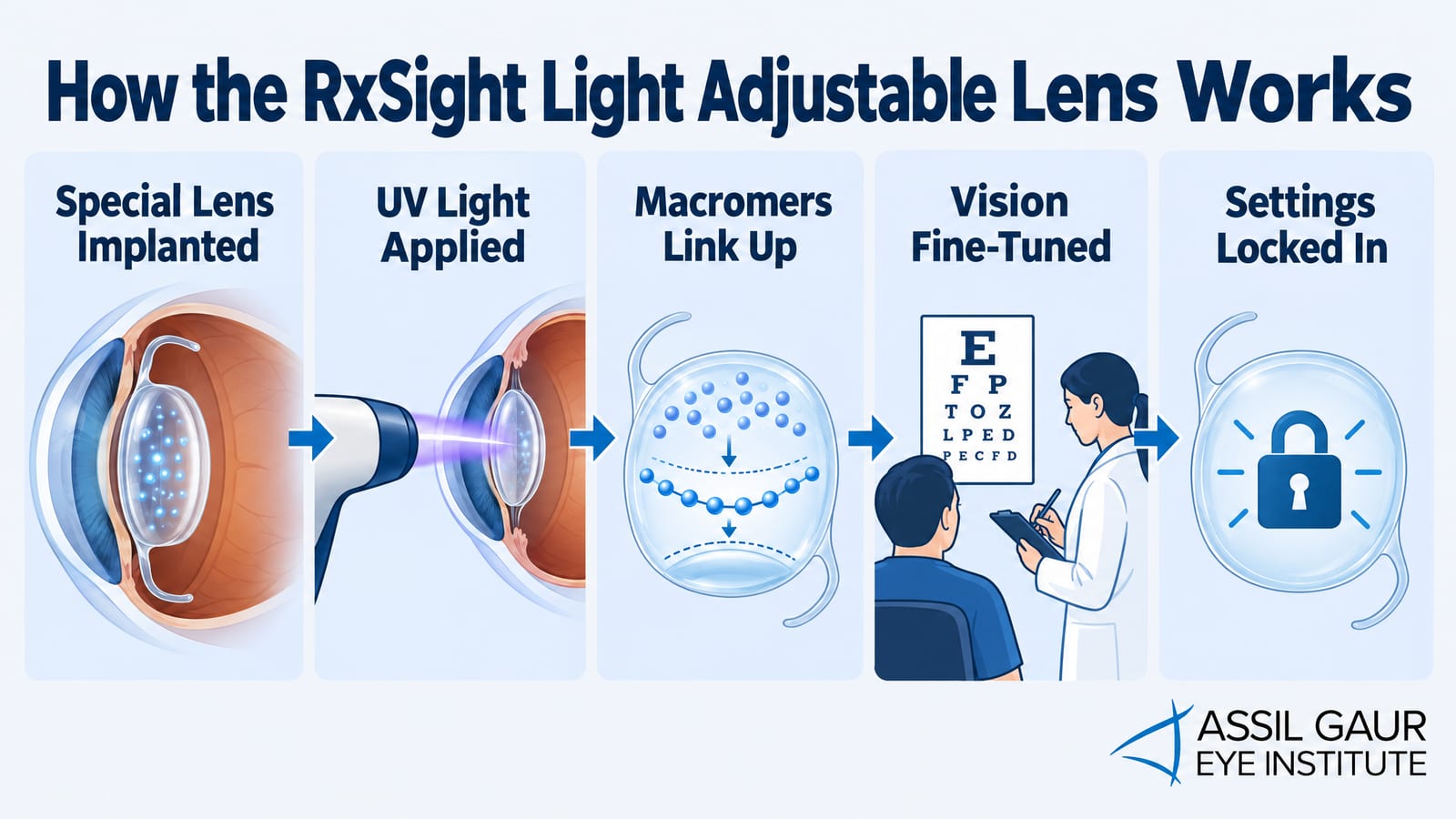
Well, these lenses contain special light-sensitive particles (known as macromers) dispersed throughout the lens, which make the magic possible.
A special Light Delivery Device (LDD) delivers carefully controlled beams of ultraviolet light to your eyes, causing the macromers in the beam’s path to link up and form polymers. The movement of the macromers as they refract the UV beam results in predictable changes in your lens’ curvature and refraction strength.
These subtle changes can impact the sharpness of your vision at various distances. Following each UV light treatment, your doctor will ask for feedback after you’ve lived with the vision “tweak” for a couple of days to see if it improves your visual experience.
During the first month after your implant surgery, you and your doctor will work together to optimize your vision until you’re satisfied that you’ve achieved the best possible vision. Once you’re happy with your vision, you will return to your ophthalmologist’s office to “lock in” your settings.
Schedule your consultation today with our internationally recognized cataract surgeons
Call now or book your appointment online.
What is the RxSight Light Adjustable Lens+ (LAL+)?
If you have been researching the RxSight Light Adjustable Lens, you may have come across the term “LAL+” and wondered whether it is simply a marketing label or something meaningfully different. The LAL+ is the current-generation version of the original Light Adjustable Lens, and it’s worth understanding before your cataract surgery consultation.
The core technology is the same: a photosensitive lens implanted during cataract surgery that your surgeon fine-tunes after the eye has healed using precise UV light treatments. The LAL+ adds an expanded range of correction. While the original LAL was primarily designed to optimize distance vision and reduce dependence on glasses for far-away tasks, the LAL+ extends that adjustability to include a broader astigmatism correction range, as well as improved intermediate and near vision performance. In practical terms, this means more patients can realistically aim for freedom from glasses across a fuller range of daily activities, not just distance viewing.
The LAL+ also supports additional light delivery sessions in some cases, giving your surgeon greater flexibility to dial in your prescription with world-class precision before permanently locking in the lens. For patients who want the most advanced, customizable vision correction available in a premium IOL, the LAL+ represents the current gold standard in adjustable lens technology.
How does the Light Adjustable Lens compare to other premium IOLs?
If you’re exploring premium cataract surgery options, you’ve probably come across a range of intraocular lenses, each promising impressive results. So how does the RxSight Light Adjustable Lens compare to other premium IOLs? The short answer is that it solves a problem the others simply can’t: fine-tuning your vision after the lens is already in your eye.
Most premium IOLs, including multifocal and extended depth of focus (EDOF) lenses, are fixed at implantation. Your surgeon can predict your ideal prescription before surgery, but healing is unpredictable. Even with advanced pre-surgical measurements, a fixed lens cannot be adjusted once your eye has settled. If your vision lands slightly off target, your options are limited.
The Light Adjustable Lens changes that equation entirely. Because your prescription is customized through a series of non-invasive light treatments after surgery, your final vision is based on real-world results rather than pre-operative estimates. That precision advantage is a big reason why LAL patients at AGEI achieve 20/20 vision or better at nearly twice the rate seen in FDA clinical studies compared to standard fixed IOLs.
That said, multifocal and EDOF lenses, like the premium IOLs we offer at AGEI, remain excellent choices for patients who want built-in near and intermediate vision correction. The right lens depends on your lifestyle, eye health, and personal vision goals. Our world-class surgeons will walk you through every option so you can make a confident, fully informed decision.
What to expect during and after a light treatment?
Following the surgery to insert your new Light Adjustable Lenses, you will need a minimum of two and a maximum of five office visits. These visits fine-tune your lenses to achieve the best possible vision outcome.
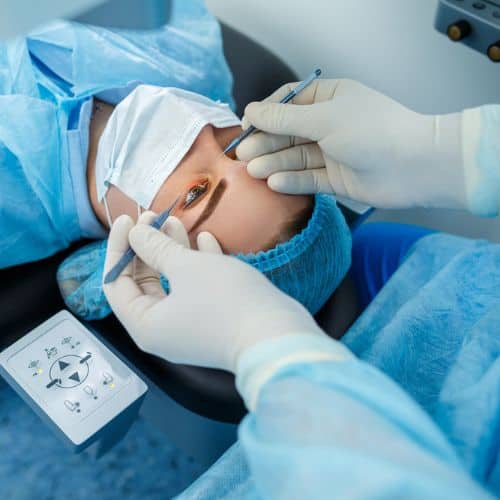
For each treatment, you’ll sit in a reclining treatment chair, and the doctor will apply eye drops to numb and dilate your eyes. Then, the doctor will apply a special gel to your eye before directing a fine light beam at it. You will only feel mild pressure during the light treatment, which should not be painful and is usually done within 90 seconds.
Immediately after treatment, your vision may be blurry because of the gel, but it should clear up quickly. Your eyes may remain dilated for a couple of hours after treatment, and it can take up to 24 hours before you notice improved vision.
Are there any downsides to getting a Light Adjustable Lens?
While this technology offers never-before-seen levels of visual acuity versus other IOLs currently available, it does come with a minor hitch. You will need to wear special glasses that protect your eyes from UV rays every waking hour from the time of your lens implantation until your final lens setting is “locked in”.
If you don’t comply, you may not achieve the desired visual outcome. You may even need to have the implanted lens removed or replaced to improve your vision.
So, it’s critical to ask yourself whether the recovery protocol fits your lifestyle. You should also consider the timing of your cataract surgery and whether you have any upcoming commitments you’ll want to work around. Leave yourself a five-week window after surgery in which to comply with your doctor’s orders faithfully.
Does dry eye disease affect the Light Adjustable Lens process?
Yes, and your surgeon will want to evaluate it carefully before and after your cataract surgery. Dry eye disease is actually quite common among cataract patients, and when left unaddressed, it can interfere with the precision that makes the RxSight Light Adjustable Lens so effective.
Here is why it matters: the light delivery treatments that fine-tune your LAL rely on accurate measurements of your eye’s surface. When the tear film is unstable or insufficient, those measurements can fluctuate, making it harder to dial in your ideal prescription with the level of precision the process is designed to deliver. In short, dry eye introduces a variable that can work against the customization advantage you are paying for.
The good news is that dry eye is very treatable, and addressing it proactively is a standard part of the world-class care at Assil Gaur Eye Institute. Our team thoroughly screens every patient before surgery and, when dry eye is present, builds a targeted treatment plan to stabilize the ocular surface before your light adjustments begin. Learn more about our approach on our dry eye care resource page.
Cataract surgery can also temporarily worsen dry eye symptoms because of the incisions made during the procedure. This is another reason having an experienced team monitor your recovery closely makes such a meaningful difference in achieving the enviable outcomes the Light Adjustable Lens can deliver.
What other restrictions are necessary after getting Light Adjustable Lenses (LAL)?
As with any surgery, you will need to modify or avoid some activities during your approximately five-week recovery period. These are:
-
Showering: If there’s a window or direct sunlight in your shower, wear your UV-blocking glasses while showering. Otherwise, you can remove your glasses only while in the shower and then put them back on immediately afterward.
-
Sports: You’ll need to delay returning to high-impact sports until your light treatments are finished and your doctor clears you.
-
Tanning: Since tanning beds emit very strong UV light, they can interfere with the lenses’ adjustability. Therefore, you may not tan until your doctor clears you to return to tanning.
-
Makeup use: Your doctor will advise when you can resume wearing eye makeup. When you do, you must avoid placing excessive pressure on your eyes. Postpone permanent makeup until your doctor clears you.
-
Travel: No travel restrictions apply, but you must wear your UV-blocking glasses at all times.
-
Work: You should be able to return to work within a few days of your implant surgery unless your job puts you at high risk for UV exposure. Again, you must wear your UV-protective glasses at all times until your doctor clears you.
-
Laser treatments: Delay any laser, IPL, or cosmetic treatments that use light sources until your doctor tells you to stop wearing your UV-protective glasses.
Why choose AGEI for Light Adjustable Lenses during your cataract surgery?
When considering using a brand-new technology that’s going into your body, and especially your eyes, you’ll want to do your homework to ensure that your surgeon has extensive experience with the new technology. Rest assured, our surgeons are internationally recognized leaders in cataract treatment and in developing new technologies.
AGEI was the first practice in the world to use ORA vision-measuring technology that lets our surgeons obtain intra-operative refractive error measurements after your natural lens is removed, ensuring you are fitted with lenses that best correct your vision deficits. In fact, the ORA system takes vision measurements that are 25 times more precise than any preoperative vision-measuring systems available today. This increased precision translates into better refractive outcomes.
On average, only 50% of cataract removal patients in the U.S. achieve their desired distance vision acuity after receiving a lens implant. At Assil Gaur Eye Institute, over 97% of our patients achieve this goal.
When you choose Assil Gaur Eye Institute for cataract surgery, you benefit not only from our state-of-the-art ophthalmology technology but also from our physicians’ extensive experience treating cataracts and a wide range of eye conditions. When it comes to your vision, only the best care will do.
Our patients consistently describe their experience at AGEI in terms that reflect exactly what we strive to deliver. One patient shared, “I knew I was going to the very best, and the results proved it. My vision after cataract surgery is clearer than it has been in decades.” Another noted, “The team walked me through every step of the Light Adjustable Lens process, and I felt completely confident from day one.” These enviable outcomes define world-class cataract care in practice, and they are the standard we hold ourselves to for every patient who walks through our doors.
The combination of our surgeons’ elite expertise, the precision of ORA intraoperative measurement technology, and the customizable power of the RxSight Light Adjustable Lens creates a level of vision correction that fixed IOLs simply cannot match. If you are ready to experience that difference for yourself, we invite you to schedule a complimentary evaluation with our team. During your visit, we will assess whether the Light Adjustable Lens is the right fit for your eyes, your lifestyle, and your vision goals, so you can move forward with complete confidence.
Call now or book your appointment online.
We are conveniently located throughout Southern California and the Los Angeles area. Our ophthalmologists are available at locations in or near Santa Monica and Beverly Hills. We are conveniently located near West Los Angeles, Culver City, West Hollywood, Downtown Los Angeles, Marina del Rey, Pacific Palisades, Malibu, Manhattan Beach, Sherman Oaks, and Encino, to name a few.
In addition to outpatient laser cataract surgery, the ophthalmology experts at AGEI are nationally recognized for their eye care and treatment options for a full range of conditions, including glaucoma, retinal detachment, cornea conditions, floaters and flashes, dry eye, presbyopia, refractive surgery such as LASIK, and much more.