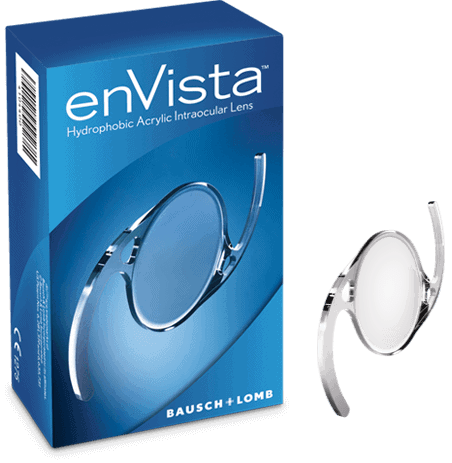
Experience Unprecedented Clarity with Bausch + Lomb enVista® IOL
If you’re living with cataracts, it might be hard to imagine returning to a world where colors appear more vibrant, edges are sharply defined, and distance viewing is crystal clear. But removing your cloudy vision-impairing lens comes with the opportunity for new vision thanks to vision-correcting intraocular implants (IOLs).
Different IOLs are intended to correct different vision problems, like nearsightedness, farsightedness and astigmatism. There’s no “one size fits all” IOL, so Assil Gaur Eye Institute supports more than a dozen of the best IOLs on the market, always choosing the best for our patients’ needs.
“We are proud to be among the first in the United States to offer the revolutionary enVista Envy Multifocal IOL by Bausch + Lomb. It offers a full range of exceptional “LASIK-like” visual acuity and clarity for distance, intermediate and close-up vision.
What’s so special about the Envy IOL lens?
The Envy lens is the latest addition to the Bausch and Lomb enVista IOL platform. Made from a special hydrophobic acrylic IOL material, it has demonstrated exceptional optical clarity. Assil Gaur Eye Institute (AGEI) ophthalmologists Drs. Kerry Assil and Avneet K. Sodhi Gaur have chosen to add this amazing lens to their arsenal of vision-correcting intraocular lenses (IOLs).
Unlike a standard multifocal IOL, which typically offers just two focal points, or an EDOF (extended depth of focus) lens, which stretches a single focal zone, the Bausch Lomb enVista Envy trifocal IOL uses proprietary ActivSync optic technology to deliver three distinct focal points covering near, intermediate, and distance vision in a single implant. The lens received FDA approval following a pivotal U.S. clinical trial enrolling 501 patients, in which it demonstrated superior intermediate and near acuity compared to a monofocal control lens. Bausch and Lomb also engineered the Envy with a light-scattering reduction feature that sets it apart from earlier trifocal designs, giving patients a cleaner visual experience across all lighting conditions.
“The Envy lens does especially well in cataract patients with medium-to-large-size pupils who also have a steeper corneal shape,” says Dr. Kerry Assil, adding that the lens has seamless trifocal vision, even for night driving. “This lens is great for correcting vision when procedures such as LASIK for farsightedness have lost effectiveness (after several decades), because patients’ eyes age and their vision naturally diminishes, due to a stiffening of the internal lens (loss of “Zoom” or accommodation).
“Our cataract and refractive lens exchange (RLE) patients are raving about the results of their Bausch and Lomb Envy Lens implants,” says Dr. Gaur. “In properly selected patients, this lens really delivers on the promise of seamless trifocal vision at near, intermediate, and distance.”
The Envy IOL’s secret sauce: ActivSync Optic Intelligent Energy Distribution
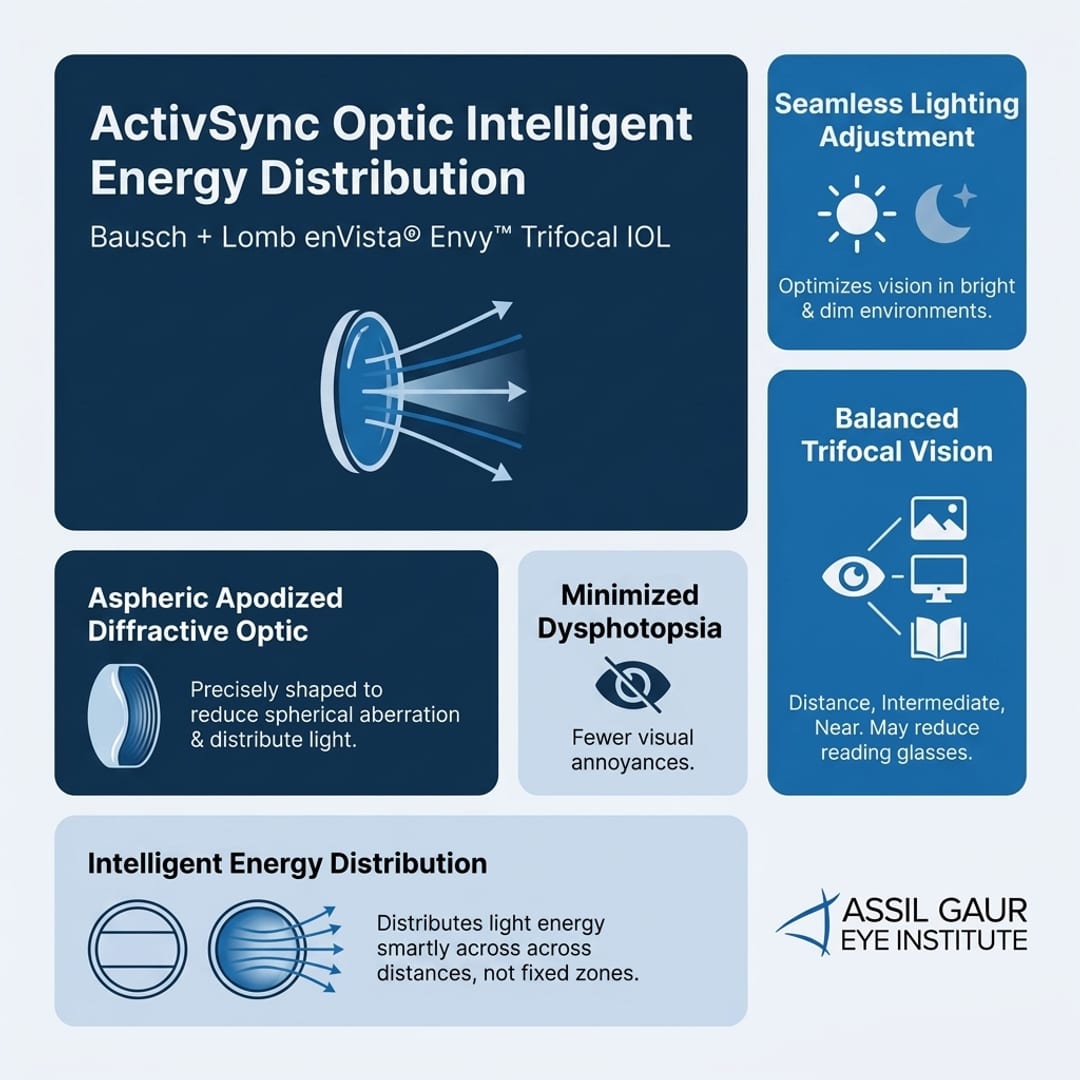
ActivSync Optic Intelligent Energy Distribution is a proprietary technology in Bausch + Lomb’s enVista Envy IOL that optimizes vision in numerous ways, including:
-
Adjusting seamlessly to different lighting conditions improves vision in bright and dim environments.
-
Balancing between distance, intermediate, and near vision may decrease or eliminate the need for reading glasses.
-
Minimizing common post-surgery “visual annoyances,” called “dysphotopsia.”
To understand why ActivSync works so well, it helps to look at the optical architecture underneath it. The enVista Envy is built on an aspheric apodized diffractive optic design, which means the lens surface is precisely shaped to reduce spherical aberration while its diffractive rings are graduated in height from the center outward.
That gradual tapering is what allows the lens to distribute light energy intelligently across distances rather than splitting it into fixed, equal zones, as older multifocal designs did.
The Envy’s add powers are calibrated to match how people actually use their eyes throughout the day. It delivers a 1.60 D intermediate add, which targets the arm’s-length range most patients use for computer screens and dashboards, and a 3.1 D near add for close-up tasks like reading a menu or a text message. Those two focal points, layered on top of a full distance correction, are what give the lens its “full range of vision” designation rather than simply a bifocal or extended-depth-of-focus profile.
Bausch + Lomb also engineered a proprietary light-scattering-reduction technology into the Envy’s optical material. Light scatter is one of the main culprits behind the glare and halo complaints patients sometimes report after multifocal IOL surgery, particularly at night. By minimizing internal scatter at the material level, the Envy is designed to deliver cleaner contrast and a more comfortable visual experience in low-light conditions.
It is worth being candid here: some patients do notice mild halos or rings around lights at night, especially in the first weeks after surgery while the brain adapts to the new optic. For most patients, this fades significantly over time, and the tradeoff of genuine freedom from glasses across all distances is one that the vast majority find well worth it.
At AGEI, our surgeons factor in individual eye characteristics, including pupil size and corneal shape, when evaluating whether the Envy’s specific optical design is the right match for each patient, which is a level of precision that goes well beyond simply recommending a premium lens.
enVista Envy IOL: Clinical Trial Results and Real-World Performance
So we’ve talked about how ActivSync Optic Intelligent Energy Distribution works its magic inside your eye. But you might be wondering: does all that clever engineering actually hold up when real patients use it in the real world? The short answer is yes, and the clinical data backs that up convincingly.
The enVista Envy IOL underwent a rigorous pivotal U.S. clinical trial involving 501 patients and met all FDA-specified primary endpoints. That’s not a small thing. These trials are designed to be tough, and clearing every benchmark is a meaningful signal that the lens performs as promised across a broad population of cataract patients.
Here’s what stood out most in the results. Patients implanted with the Envy IOL demonstrated superior intermediate and near visual acuity compared to those receiving a standard monofocal lens. In plain terms, that means sharper vision for reading a menu, working at a computer, and checking your phone, without sacrificing the distance clarity you’d expect from a premium lens. The trial also confirmed excellent performance across all lighting conditions, which matters enormously for patients who drive at night or work in variable indoor and outdoor environments.
Beyond the controlled trial setting, real-world outcomes have reinforced these findings. Patients consistently report a high rate of spectacle independence after surgery, which is ultimately the goal most people are chasing when they invest in a premium IOL. If you’re curious about how far intraocular lens technology has come to reach this point, the journey is genuinely fascinating.
At Assil Gaur Eye Institute, our surgeons review this kind of evidence carefully before recommending any lens, because world-class outcomes start with world-class decisions.
A few words about dysphotopsia and the Envy IOL
A concern for all IOL implant patients is dysphotopsia, which is a spectrum of visual disturbances (usually transient) that some patients may experience following IOL transplantation during cataract or RLE surgery. Patients describe them as:
-
Halos
-
Starbursts
-
Streaks of light
-
Shadows
-
Arcs of light that occur around the periphery of their visual field.
“In patients with the optimal profile for the new Bausch and Lomb Envy IOL, we have found that it has a lower rate of halos and glare (or higher dysphotopsia tolerance), even during the early adjustment period, which our patients love,” states Dr. Assil.
Request Your Consultation
Call now or book your appointment online.
Pros and Cons of the enVista Envy IOL: What to Expect
Now that you have a clearer picture of how the Envy IOL addresses dysphotopsia, it’s worth stepping back to look at the full picture. Like any premium lens, the Envy IOL has genuine strengths and a few honest trade-offs worth knowing before you commit. Here’s a balanced look at both sides.
|
Pros |
Cons |
|---|---|
|
Full range of vision: The Envy IOL is designed to deliver clear sight at distance, intermediate, and near, so most patients enjoy real freedom from glasses for everyday tasks. |
Nighttime halos and glare: Some patients notice mild halos or starbursts around lights at night, especially in the early weeks after surgery. For most, these fade significantly over time. |
|
Advanced dysphotopsia tolerance: Thanks to ActivSync technology and proprietary light-scattering reduction, the Envy IOL is engineered to minimize visual disturbances more effectively than earlier full-range lenses. |
Not ideal for every eye profile: Patients with certain pre-existing conditions, very small pupils, or highly irregular corneas may not achieve the same enviable outcomes as the average candidate. |
|
Proven clinical performance: The pivotal U.S. clinical trial enrolled 501 patients and met all primary endpoints, with superior intermediate and near acuity compared to a monofocal lens. |
Neuroadaptation period: Your brain needs time to adjust to the new lens. Most patients settle into their best vision within a few weeks to three months after surgery. |
|
Toric option available: Patients with astigmatism can choose the enVista Envy Toric, addressing an additional refractive variable in a single procedure. |
Premium cost: As a premium IOL, the Envy lens carries an out-of-pocket cost beyond standard cataract surgery coverage. |
The good news is that at Assil Gaur Eye Institute, our world-class surgeons use a proprietary IOL-selection philosophy to match each patient’s unique eye profile to the right lens, so you’re never choosing blindly. A complimentary evaluation is the best first step toward understanding whether the Envy IOL is the right fit for your vision goals.
The B+L enVista Envy Toric IOL also corrects astigmatism
The enVista Envy Toric lens offers correction for our astigmatic patients. This version of the lens is designed to correct presbyopia, and a presbyopia-correcting toric version is to treat astigmatism. Its design reduces light scattering and enhances image contrast, contributing to clearer and sharper vision.
At AGEI, our team uses the enVista Toric Calculator as part of our proprietary IOL-selection process. This planning tool factors in your corneal measurements, astigmatism axis, and individual eye profile to determine the optimal lens power and orientation before you ever enter the operating room. That level of advanced pre-surgical planning is a cornerstone of the enviable outcomes our patients experience. If you are curious whether the enVista Envy Toric is the right fit for your eyes, we invite you to schedule a complimentary evaluation with our team.
Who is not a good candidate for the EnVista Envy IOL?
Multifocal IOLs work best in healthy eyes with 20/20 vision potential. Like other similar lenses, the Bausch and Lomb Envy IOL lens is not suitable for patients with certain serious pre-existing conditions, such as macular degeneration.
Beyond macular degeneration, our surgeons typically advise against the Bausch Lomb enVista Envy trifocal IOL for patients who have any of the following:
-
Advanced glaucoma or significant optic nerve damage, which can limit the visual potential the lens is designed to unlock
-
Diabetic retinopathy or other retinal disease that compromises central or peripheral vision quality
-
Severe dry eye disease that has not been adequately treated before surgery, since ocular surface instability can reduce optical clarity and increase the perception of halos
-
Irregular corneal shape, such as keratoconus or significant corneal scarring, which can distort the lens’s precise light-splitting technology
-
Very small pupils that restrict the amount of light reaching the full optical zone of the lens
-
Patients with very high demands for nighttime driving who are unwilling to accept any adaptation period, since multifocal optics can produce mild halos or glare in low-light conditions during the first weeks after surgery
It is worth noting that not every patient in one of these categories is automatically disqualified. At AGEI, our proprietary IOL-selection philosophy involves a detailed analysis of each patient’s individual eye profile, including pupil size, corneal curvature, and retinal health, before any recommendation is made. Dr. Assil’s clinical experience has shown that patients with medium-to-large pupils and favorable corneal geometry tend to achieve the most enviable outcomes with the enVista Envy lens. If you are uncertain whether this premium IOL is right for you, a complimentary evaluation with our world-class surgical team is the best place to start.
What Happens During the enVista Envy IOL Procedure and Recovery?
If you’ve confirmed you’re a good candidate for the Bausch + Lomb enVista Envy trifocal IOL, the next natural question is: what actually happens on surgery day, and how long until you’re seeing clearly? The good news is that the procedure is straightforward, and most patients are genuinely surprised by how smooth the experience feels.

The surgery itself typically takes around 15 to 20 minutes per eye. Your surgeon will make a tiny incision in the cornea, gently remove your natural lens using ultrasound energy (a technique called phacoemulsification), and then carefully place the enVista Envy IOL into the same capsule where your natural lens sat. The lens unfolds and centers itself. No stitches are required in most cases.
You’ll be awake but completely comfortable thanks to topical anesthetic eye drops and a mild oral sedative. Most patients describe feeling only gentle pressure, nothing painful. You’ll go home the same day, so plan to have someone drive you.
Recovery tends to move quickly. Many patients notice dramatically improved vision within 24 to 48 hours, though some mild blurring, light sensitivity, or halos around lights are normal in the first few weeks as your brain adapts to the new lens. This neuroadaptation period is a standard part of the process with any full-range vision IOL, and it typically resolves within four to eight weeks for most patients.
Your AGEI care team will schedule follow-up visits to monitor your healing and ensure your vision is on track toward those enviable outcomes. For tips on supporting a smooth recovery, our recovery guide offers practical advice that applies to lens-based procedures as well.
The enVista Envy is one of the latest IOLs in AGEI’s arsenal of premium cataract and RLE lenses
It would be a misnomer to say that the Envy IOL is the cherry on top of premium lenses. It would be more appropriate to say that it expands our doctor’s options in offering our patients the very best choice for their vision needs.
Says Dr. Assil, “Because every patient’s eyes are different — and sometimes even the two eyes of the same patient are different — there is no single IOL that is best for everyone. But now, with our currently available technology, nearly every person’s desire for permanent visual correction can be addressed.”
Why choose the Assil Gaur Eye Institute for your premium cataract surgery and RLE vision correction?
Having implanted tens of thousands of premium IOLs, Assil Gaur Eye Institute is renowned for its national leadership in premium cataract surgery and its proprietary algorithms for choosing the best IOL for each patient.
Their ophthalmology eye care team of seasoned ophthalmologists and optometrists is among the most experienced in the nation. They specialize in all types of vision correction methodologies, ranging from IOLs, including Monofocal, extended depth of focus (EDOF), and multifocal lenses, for cataract surgery and RLE vision correction surgeries to LASIK, PRK, and ICL (Phakic IOLs).
With cutting-edge technology and a commitment to patient care, AGEI provides highly patient-satisfying advanced treatment for virtually all ophthalmological conditions.
Bausch and Lomb enVista Envy IOL FAQs
Which brand of IOL is best?
There is no single “best” IOL brand, as the optimal choice depends on the individual patient’s needs, lifestyle, and vision goals.
Several leading manufacturers will offer high-quality options in 2025, including Bausch + Lomb, Johnson & Johnson, Clareon, PanOptix, and more. Assil Gaur Eye Institute’s proprietary IOL selection algorithms, developed for almost two decades, are key in choosing the best IOL for our patients.
Does anyone have experience with the Envista Envy multifocal IOL from Bausch + Lomb in Southern California?
Noted ophthalmologists Dr. Kerry Assil and Dr. Avneet K. Sodhi Gaur of the Assil Gaur Eye Institute in Beverly Hills and Santa Monica, CA, have implanted dozens of enVista Envy full range of vision IOL lenses as of February 2025.
Their patient feedback has shown that these lenses offer better image quality and fewer halos than other premium IOLs while maintaining an exceptional trifocal range of vision.
What are the key clinical trial results for the enVista® Envy™ IOL?
The clinical trial results of enVista Envy IOL were very favorable. Some of the highlights include:
- 86% of patients reported minimal to no issues with glare, halos, or starbursts
- 94% of patients reported little to no difficulty viewing close objects
- 93% of patients were moderately to completely satisfied with their post-surgical vision
These results are even more impressive considering the patient selection was not optimized for this particular lens (no algorithmic matching optimization).
How does the enVista Envy IOL improve vision compared to traditional lenses?
The enVista Envy IOL offers several significant improvements over traditional lenses, such as:
- Provides a continuous range of vision for near, intermediate, and distance viewing
- Features ActivSync Optic intelligent energy distribution technology for optimal vision across all lighting conditions
- 94% of patients report excellent near-vision visual acuity
- 86% of patients experience minimal to no issues with glare, halos, or starbursts
- Demonstrates superior dysphotopsia tolerance compared to traditional multifocal IOLs
- Its ClearPath technology helps reduce light scattering for clearer vision
- Available in both toric and non-toric versions for astigmatism correction
- 93% of patients report being moderately to completely satisfied with post-operative vision
- Built on the proven enVista platform, which is known for stable performance and predictability.
How long does recovery take after the Envy IOL is implanted?
Most patients notice a meaningful improvement in vision within the first 24 to 48 hours. Full visual adaptation, including the brain’s adjustment to the lens’s full range of vision, typically takes four to eight weeks. During that window, mild halos or glare at night are normal and tend to fade as neuroadaptation progresses.
Will the procedure be uncomfortable?
The surgery itself is performed under topical anesthesia, so the vast majority of patients feel little to no pain. Some mild pressure or light sensitivity in the first day or two is common, but serious discomfort is rare.
When can I return to work and drive?
Many patients return to desk work within a day or two. Driving is typically cleared once your surgeon confirms your vision meets the required standard, which often happens within the first week for most patients.
How does the Envy IOL compare to other premium lenses?
AGEI’s proprietary IOL-selection philosophy matches each patient’s unique eye profile, including pupil size and corneal shape, to the right lens. The Envy’s ActivSync technology and advanced light-scattering reduction make it a compelling option, though the best choice is always the one precision-matched to your individual eyes. You can also explore the history of IOLs to understand how far this technology has come.
Is a complimentary evaluation available?
Yes. AGEI offers a complimentary evaluation so our world-class surgical team can determine whether the enVista Envy is the right fit for your vision goals.
Request Your Consultation
Call now or book your appointment online.
-
Bausch + Lomb Receives FDA Regulatory Approval for enVista® Envy™ Full Range of Vision Intraocular Lens
https://www.bausch.com/news/?id=231
-
FDA approves Bausch + Lomb’s enVista Envy range of IOLs
https://www.ophthalmologytimes.com/view/fda-approves-bausch-lomb-s-envista-envy-range-of-iols
-
Bausch + Lomb receives Health Canada approval for enVista Envy full range Intraocular Lens after enVista Envy Canadian Clinical Study