Eyesight Problems Linked to Dementia: What That Means For You
Aging brings about many different health conditions, ranging from heart disease to vision and hearing loss. But are all these issues just caused by “growing old”? Or could they be caused by something else happening in the background?

The answer here is complicated. However, recent studies over the past few years have been shedding light on previously missed links. The latest news to hit our practice? A new study from February of this year compared the donated tissue of 86 patients with mental decline. The researchers uncovered retinal changes correlated with changes in brain areas responsible for memory and the perception of time.
This aligns with a study from last year showing that eyesight and dementia aren’t just occurring at the same time but may be actively affecting one another.
Eyesight, dementia, and Alzheimer’s disease: How are they linked?
In 2022, two major studies examined the link between dementia and vision problems.
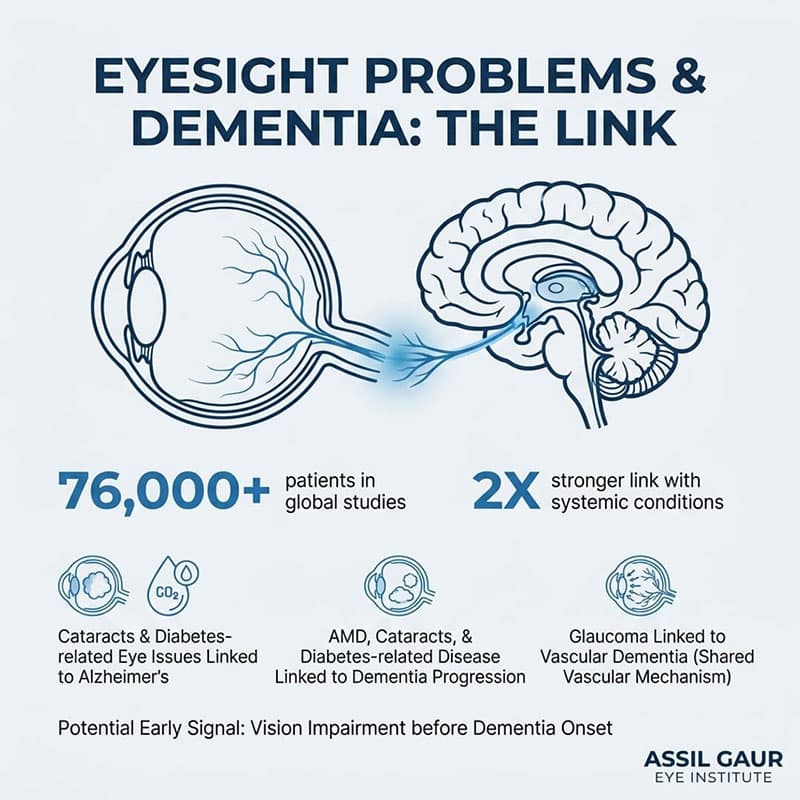
The first one was published in the Aging & Mental Health journal and was a meta-analysis of past research. The research team compiled the data from 16 other studies that looked at different forms of dementia (such as Alzheimer’s disease, vascular dementia, or Lewy body dementia) and their warning signs.
In total, these studies encompassed 76,373 patients across multiple continents, providing a substantial body of evidence. Researchers found that different types of vision impairment problems are more likely to develop before dementia. In particular, cataracts and diabetes-related eye problems seem to have a strong link with Alzheimer’s disease.
The next study worth looking at was published in the British Journal of Ophthalmology. Here, researchers examined the association between the rate of dementia progression and the onset of other eye conditions using data from the UK Biobank.
Their conclusions were surprisingly specific: age-related macular degeneration (AMD), cataracts, and diabetes-related eye disease all seemed to announce an increased risk of dementia, especially Alzheimer’s disease.
On the other hand, glaucoma didn’t seem to relate to a higher incidence of Alzheimer’s disease at all, but it tended to happen alongside vascular dementia. This is a particularly important finding for anyone researching vascular dementia and eyesight. Vascular dementia is caused by reduced blood flow to the brain, and glaucoma is itself driven by impaired circulation within the eye. Researchers believe this shared vascular mechanism may explain why the two conditions so frequently appear together, making glaucoma a potential early signal worth monitoring in patients who already carry cardiovascular risk factors.
Finally, they found an additional part of the puzzle: the link between both conditions was nearly twice as strong in patients who were battling other “systemic conditions” – such as cardiovascular disease, type 2 diabetes, or chronic depression.
So far, the evidence of a link between eyes and minds seems remarkably convincing. But what about the causes? Does dementia cause eye problems, or is it the other way around? Here’s where a lot is still up for debate.
Recognizing the warning signs: vascular dementia and sudden vision changes
One of the most important things to understand about vascular dementia and eyesight is that the vision changes it causes can appear suddenly rather than creeping in gradually over months or years. This is because vascular dementia is driven by reduced or interrupted blood flow to the brain, often following a stroke or a series of small mini-strokes called transient ischaemic attacks. When blood supply to the visual processing areas of the brain is cut off, even briefly, the effects on sight can be immediate and striking.
So what should you actually watch for? Some of the most telling warning signs include sudden blurring in one or both eyes, double vision that appears without any obvious cause, loss of vision in one side of your visual field, and difficulty judging distances or perceiving depth accurately. Unlike the slow, progressive visual decline often associated with Alzheimer’s disease, these changes can feel like they come out of nowhere, which is precisely why they deserve urgent attention.
It is also worth knowing that vascular dementia can cause uneven vision changes, meaning one eye or one side of your visual field may be affected while the other remains relatively clear. This asymmetry is a key distinguishing feature compared with other dementias and reflects the patchy, location-dependent nature of vascular damage in the brain.
If you or someone you care for experiences any sudden shift in vision alongside memory or cognitive changes, it is important to consult both a neurologist and a world-class ophthalmologist as soon as possible. Early assessment can make a meaningful difference, and understanding what vision changes can and cannot be reversed is a vital first step in building the right care plan.
How vascular dementia specifically affects your eyesight
When most people think about dementia and vision, they picture the slow, gradual changes associated with Alzheimer’s disease. Vascular dementia works quite differently, and understanding that difference matters a lot if you or someone you love is trying to make sense of sudden or uneven vision changes.
Vascular dementia is caused by reduced blood flow to the brain, typically following a stroke or a series of small, sometimes unnoticed mini-strokes. Because blood flow can be cut off to very specific regions of the brain, the visual symptoms tend to appear suddenly rather than creeping in over years. Someone with vascular dementia might wake up one morning with a partial loss of their visual field, experience double vision, or notice that objects on one side of their environment seem to disappear entirely. These are not the same as the slow blurring or contrast sensitivity issues more commonly linked to Alzheimer’s.
There is also a well-documented connection between vascular dementia and glaucoma, since both conditions involve compromised blood flow and elevated pressure within the eye’s delicate vascular network. If you are already managing glaucoma, that shared vascular mechanism makes regular monitoring even more important.
Another key distinction is that vascular dementia symptoms can plateau and then worsen in steps, mirroring the pattern of new vascular events in the brain. This stepwise progression means vision problems may seem stable for a period and then shift noticeably after another episode. Recognizing this pattern early and bringing it to both a neurologist and a world-class ophthalmologist gives you the best chance of protecting your vision.
Vision problems and dementia: a “chicken or egg” problem
The studies above are all observational; that is, they limit themselves to observing what happens and draw conclusions from large numbers. As a result, they don’t give us a definite answer about causes, just correlation.
As a result, healthcare experts warn us that there is no simple, single cause behind eye problems and dementia. Instead, the “egg” of the issue will depend on the patient, their surrounding risk factors, and the type of dementia they’re experiencing.
The case for “just age”
The first, traditional explanation is that both problems are just typical of aging. Dementia – the progressive loss of cognitive functioning, including memory, reasoning, language, and the ability to perform mental calculations – can occur for a variety of reasons, although most involve irreversible changes in the brain. The risk for all dementias increases as you age.
The same is true for most types of vision loss. When it comes to age-related macular degeneration, the cause is even in the name! Likewise, other types of eye health problems develop slowly, from the cumulative damage caused by intraocular pressure on the optic nerve, high blood sugar, or other conditions. Naturally, the risk for any of these climbs with each year of life.
Are vision problems making dementia worse?
The simple answer of “age” doesn’t really align with the results of the latest studies. Loss of peripheral vision, problems with depth perception, or blurry vision don’t simply appear just before dementia – they also predict rapidly-progressing cognitive decline.
A possible explanation? The confusion created by vision problems often matches the early signs of dementia, especially Alzheimer’s Disease.

How? Let’s take a look at many of the classic early signs of Alzheimer’s:
Problems recognizing faces
Getting lost, even in familiar surroundings
Frequently missed appointments or misplaced objects
Problems creating new memories.
Any of these symptoms can become more severe and more noticeable when our brains aren’t receiving proper visual information. To make things more difficult, both dementia and loss of vision tend to progress slowly, making it harder to notice changes from one day to the next.
If we can’t see the objects around us, it will be harder to memorize and recognize faces – especially those of new acquaintances. Maps, schedules, and errand lists can get even harder to recall if you’re already expending extra mental energy in trying to see them properly. As both conditions combine, what may have seemed like simple forgetfulness can quickly precipitate a dementia diagnosis.
The “use it or lose it” theory
According to Dr. Nathaniel Chin, from the Division of Geriatrics and Gerontology in the Department of Medicine at the University of Wisconsin, the connection may go one step further: losing your eyesight doesn’t just worsen your confusion, but it may speed up the changes in your brain responsible for dementia.
According to him, the loss of vision will gradually reduce the amount of information our brains receive. In turn, “having less stimulation from vision leads to brain processes breaking down.” After all, the brain often acts like a muscle. If we don’t use our cognitive abilities, we slowly lose them. We become slower in our reasoning and have more difficulty with problem-solving.
The other way around: does dementia cause eye problems?
Depending on the type of dementia, we also need to consider the reverse possibility: that the loss of brain function could underlie the loss of vision.
So far, this doesn’t seem to be the case with Alzheimer’s disease. However, when we look at dementia with Lewy bodies (DLB) and vascular dementia, then yes – dementia itself could be impacting your eyes.
Vascular dementia and eyesight: how reduced blood flow damages vision
Vascular dementia is caused by reduced or interrupted blood flow to the brain, which starves brain tissue of oxygen and leads to cell death. Because the visual processing pathways run throughout the brain, any area with reduced circulation can disrupt the brain’s ability to receive and interpret visual input. This is why vascular dementia and eyesight problems are so closely linked, and why the pattern of vision loss looks different here than in other dementias.
Unlike Alzheimer’s disease, where visual symptoms tend to emerge slowly over years, vascular dementia can cause sudden or uneven changes in vision. A small stroke or a series of mini-strokes (transient ischemic attacks) can damage specific visual pathways almost overnight. One person might lose peripheral vision on one side. Another might struggle with visual processing speed, finding it hard to track moving objects or read a line of text. The changes depend entirely on which blood vessels are affected and where the resulting damage falls in the brain.
Common eyesight problems linked to vascular dementia include:
Sudden loss of vision in one eye or one visual field
Difficulty tracking moving objects or following text across a page
Problems with depth perception and spatial awareness
Reduced contrast sensitivity, making it harder to distinguish objects from their backgrounds
Visual processing delays, where the brain is slow to make sense of what the eyes see
It is also worth noting the connection to glaucoma here. Glaucoma is itself a vascular condition, driven by pressure-related damage to the optic nerve’s blood supply. Research suggests people with vascular dementia and glaucoma share overlapping risk factors, including hypertension and reduced cerebral perfusion, which is one reason a world-class eye care team and a neurologist should ideally work together when both conditions are present.
Dementia with Lewy bodies and vision
Dementia with Lewy bodies (DLB) is a specific type of dementia, although it often goes undiagnosed or bundled together with Alzheimer’s, Parkinson’s disease, or age-related cognitive decline. People with Lewy body dementia develop “Lewy bodies,” or small clumps of protein, in their brains.
We don’t know yet why people with DLB start developing these clumps. We do know that the more clumps build up, the bigger the impact on brain function. Often, these bodies can accumulate in brain regions that process what we see. The combination of Lewy body dementia and eyesight problems usually appears as:
Problems seeing distances or judging the space around you
Problems calculating the size of objects you see
Blurry edges, even in nearby objects
Seeing large floaters or blind spots
Changes in color vision
Not being able to make sense of what you see
The catch? In patients with DLB, these symptoms can all develop while leaving your eyes technically intact. This makes it harder to diagnose or treat them, as we don’t know where the Lewy bodies end and any other simultaneous problems, such as cataracts, begin. This is an important distinction from vascular dementia, where the timing and pattern of vision changes often point more clearly to a specific vascular event, giving clinicians a clearer starting point for investigation.
Posterior cortical atrophy: when dementia targets vision first
Most people assume dementia always starts with memory loss, but there is a fascinating and often overlooked subtype where vision problems come first. Posterior cortical atrophy, or PCA, is a rare form of dementia that primarily attacks the back of the brain, the region responsible for processing what your eyes see. The eyes themselves may be perfectly healthy, yet the brain simply cannot make sense of the visual information being sent to it.
This is quite different from vascular dementia and eyesight problems, where reduced blood flow causes sudden or patchy vision changes. With PCA, the decline tends to be gradual and progressive, and it often affects people in their mid-50s to mid-60s, making it one of the more common causes of young-onset dementia. Because memory stays relatively intact in the early stages, PCA is frequently misdiagnosed as an eye condition, sometimes for years.
Early symptoms can include difficulty reading, trouble judging distances, problems recognizing faces or objects, and sensitivity to busy visual environments. Someone with PCA might struggle to pick up a cup sitting right in front of them, not because of a physical eye problem, but because their brain cannot accurately locate it in space. You can read more about how age-related vision changes differ from those caused by neurological conditions to better understand the distinction.
If you or a loved one is experiencing unexplained visual difficulties alongside any cognitive changes, getting a thorough eye examination is a smart first step. A world-class ophthalmologist can rule out structural eye conditions and, where appropriate, refer you to a neurologist for further investigation.
What can you do to control dementia and eyesight problems?
In many cases, it may be impossible to pinpoint the exact cause of every problem. However, we can tweak our lifestyles and habits to minimize our overall risks. By protecting your vision, you can help contain the cascade of effects that increase your risk of dementia and cognitive impairment.
The first step is as simple as a comprehensive annual eye test with our optometrists, especially after age 60. This will help you detect issues quickly and to address them before they worsen. For example, prompt cataract surgery, retinal repairs, and even properly-fitted glasses can help you protect your visual acuity and eye health for longer.
Maintaining your overall physical health also supports healthy eyes and a healthy brain. Work with your doctor to keep cholesterol, blood sugar, and high blood pressure under control.
This last point is especially critical when it comes to vascular dementia and eyesight. Because vascular dementia is driven by reduced or disrupted blood flow to the brain, cardiovascular risk management is one of the most direct levers you have. Keeping blood pressure within a healthy range, managing cholesterol, staying physically active, and not smoking all help preserve the small blood vessels that supply your brain and retina. The same vascular damage that triggers sudden or uneven vision changes in vascular dementia patients is often preventable with consistent, proactive care. If you have been diagnosed with hypertension, diabetes, or atrial fibrillation, treating those conditions aggressively is one of the most evidence-backed steps you can take to protect both your sight and your cognitive health simultaneously.
On the environmental side, practical adaptations can make a meaningful difference for anyone already living with both vascular dementia and sight loss. Improving lighting throughout the home, particularly in hallways and bathrooms, reduces the risk of falls and helps the brain process visual information more easily. Increasing contrast, such as using dark placemats on light tables or brightly colored light switches against pale walls, compensates for the contrast-sensitivity losses common in vascular dementia. Large-print materials and anti-glare screen settings can also ease daily visual strain.
And what if you (or a close relative) just got diagnosed with dementia? Then, it’s important to actively try to slow down its progress. Your neurologist and ophthalmologist should work hand-in-hand here to spot any common eye conditions quickly and in their early stages. Being able to see clearly and process what you see will help ensure your quality of life remains intact for as long as possible.
At Assil Gaur Eye Institute, our world-class specialists are experienced in identifying early signs of vascular and systemic disease at the level of the eye, before vision loss accelerates. A complimentary evaluation with our team is a smart first step for anyone concerned about the connection between their cardiovascular health and their eyesight.
Coping with sight loss when you or a loved one has vascular dementia
When vascular dementia and eyesight problems occur together, the day-to-day impact can feel overwhelming. The good news is that some straightforward environmental and lifestyle adjustments can make a real difference for both the person living with the condition and the people caring for them.
Lighting is one of the most powerful tools you have. Bright, even lighting reduces shadows and helps compensate for loss of contrast sensitivity, which is especially common when reduced blood flow affects the brain’s visual processing areas. Natural daylight is ideal, but good-quality LED bulbs work well in rooms where someone spends a lot of time.
Contrast matters more than most people realize. Using plates, cups, and furniture in colors that clearly stand out against their backgrounds makes it much easier for someone with combined visual and cognitive difficulties to navigate their environment safely. A dark placemat under a white plate, for example, can genuinely help at mealtimes.
Magnification tools, large-print books, and audiobooks can help maintain independence and keep the brain engaged, aligning with the use-it-or-lose-it principle, which researchers believe slows cognitive decline.
Crucially, do not assume that new or worsening vision symptoms are simply part of the dementia. Conditions like glaucoma and macular degeneration are treatable, and a world-class ophthalmologist should be involved alongside any neurologist managing the dementia care. A comprehensive eye exam can uncover correctable problems that dramatically improve quality of life.
Vascular dementia vs. Alzheimer’s: how the vision symptoms differ
If you or a loved one is experiencing vision changes alongside cognitive decline, understanding which type of dementia may be involved can genuinely change how you respond. Vascular dementia and Alzheimer’s both affect eyesight, but they do so in noticeably different ways, and knowing the difference matters.
With vascular dementia, vision problems tend to appear suddenly or in distinct steps. That is because the underlying cause is reduced blood flow to the brain, often following a stroke or a series of small vessel events. When blood supply to the visual processing areas is interrupted, vision can change almost overnight. You might notice a sudden loss of peripheral vision on one side, difficulty tracking moving objects, or patchy blind spots that seem to appear out of nowhere. These changes often mirror the uneven, stepwise cognitive decline that characterizes vascular dementia overall.
Alzheimer’s disease follows a very different pattern. Vision symptoms here tend to creep in gradually over months or years. The brain’s ability to interpret what the eyes see gradually deteriorates, leading to problems with depth perception, color contrast, and spatial awareness. A person with Alzheimer’s may struggle to judge distances or recognize faces, even when the eyes themselves are perfectly healthy. This is a processing problem rather than a circulation problem.
Lewy body dementia adds another layer, often producing vivid visual hallucinations as one of its earliest and most distinctive features, something rarely seen in early vascular dementia.
Spotting these differences early is one reason regular eye examinations are so valuable. An advanced ophthalmology team can identify retinal and vascular changes that may point toward the right diagnosis, helping neurologists and eye specialists work together for the best possible outcome. You can also explore whether age-related vision loss can be reversed as part of a broader conversation about protecting your sight in the long term.
Assil Gaur Eye Institute: The top facility for eye care in California
The team of experts at AGEI includes eye doctors, surgeons, and technicians who are all committed to improving their patients’ holistic health.
We specialize in highly innovative surgeries that can halt many eye conditions typical of older adults, such as cataracts, glaucoma, retinal detachments, and myopia. We also provide routine eye exams and are happy to work with your family doctor to ensure a welcoming and thorough health care plan.
Please call 866-945-2745 or make an appointment online.
We are conveniently located for patients throughout Southern California and the Los Angeles area at locations in or near Beverly Hills, Santa Monica, West Los Angeles, West Hollywood, Culver City, Hollywood, Venice, Marina del Rey, Malibu, Manhattan Beach, and Downtown Los Angeles