Shape-Shifting Hydrogel: A New Era for Dry Eye Treatment

A novel shape-shifting hydrogel developed by University of Pennsylvania researchers shows significant promise in making dry eye a thing of the past by offering sustained, long-term relief. This innovative hydrogel adapts to the eye's surface, forming a protective layer that continuously releases medication, thereby addressing the root causes of dry eye disease more effectively than current treatments. The technology aims to reduce the frequency of eye drop application and improve patient comfort, potentially transforming dry eye management.
Millions of Americans need to weep more. No, they’re not emotionally stunted. Their eyes just don’t retain enough moisture to keep them properly lubricated. The result? A widely prevalent condition known as dry eye syndrome.
What are the symptoms of dry eye?
The benefits of over-the-counter eye drops are often short-lived because the maximum application rate of four times a day isn’t enough to keep eyes moist, leading to significant dissatisfaction among users. Approximately 5 million Americans annually undergo a procedure known as punctal occlusion due to this ineffectiveness.
A 2012 Gallup poll revealed an estimated 26 million Americans suffer from dry eye syndrome. That number will increase to 29 million by 2022. An estimated 64 million Americans use over-the-counter eye drops five or more times a week.
Why are the benefits of over-the-counter eye drops short-lived?
The maximum application rate of four times a day often isn’t enough to keep eyes moist. Of the 64 million Americans who regularly use over-the-counter eye drops, 40 million report significant dissatisfaction. So approximately 5 million Americans annually undergo a procedure known as punctal occlusion.
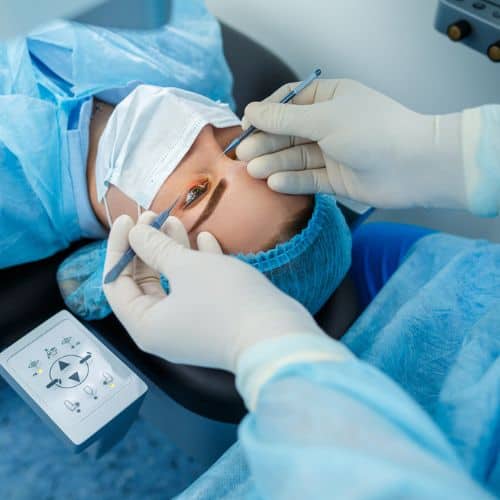
What is punctal occlusion?
Niki Bayat is a thirty-four-year-old individual who was born, raised, and began her education in Iran. At seventeen, she achieved the eighth-best score among 1.5 million students on the Iranian equivalent of the SATs that year.
Using punctal plugs for dry eyes
After her early success, Niki Bayat pursued further education by graduating from Sharif University, then emigrating to the United States to enroll in the University of Southern California, where she earned a Master of Science and a PhD, both in chemical engineering.
Who is Niki Bayat, the heroine of this story?
Niki Bayat is thirty-four years old. She was born, raised, and began her education in Iran. When she was seventeen, she achieved the eighth-best score among the 1.5 million students who took the Iranian equivalent of the SATs that year.
What educational achievements did Niki Bayat pursue after her early success?
After graduation from Sharif University, Bayat sought enhanced opportunities. She emigrated to the United States. She enrolled in the University of Southern California, where she earned a Master of Science and a PhD (both in chemical engineering).
Bayat and Andrew Bartynski (another USC graduate student) founded a startup called AesculaTech
The fledgling company’s first effort involved the development of a unique biocompatible polymer. It functions as a sort of ocular glue or hydrogel, with particular application for eye wounds suffered in locations distant from medical facilities. Like a battlefield.
The material is liquid at room temperature but becomes as sticky as super glue at body temperature. It can be readily applied in the field, sealing an eye wound to prevent further harm. When the patient is transported to a hospital, the treating doctor can easily flush out the sealant with a cold saline solution, and then tend to the wound.
But sealing eye wounds on battlefields is a pretty limited application, so Bayat and Bartynski stayed alert to possibilities with wider potential. Like those 29 million dry eye syndrome patients.
Using innovative engineering to treat dry eye syndrome
It turns out that Niki Bayat has a knack for working with biocompatible materials that alter their characteristics in response to their immediate environment. One of those shape-shifting materials is a liquid at room temperature (just like the battlefield eye-glue) but becomes a durable solid at body temperature.
When injected into a tear duct, the hydrogel forms a punctal plug that conforms exactly to the interior contours of its new surroundings. A punctal plug made from this material fits so well that it will stay in place for at least a year, doing its job of retaining all its new owner’s tears.
AesculaTech’s new punctal plug for dry eyes is undergoing FDA approval
Approval for public use should be granted soon. In the meantime, as you might expect, Bayat is busily developing new shape-shifting materials for new innovative medical applications.
Why Choose Assil Gaur Eye Institute for your eye care
The doctors at Assil Gaur Eye Institute offer world-class eye care and vision correction specializing in LASIK, cataract, cornea, retina and glaucoma treatments. At AGEI, you will experience state-of-the-art medical facilities that bring together revolutionary technologies with the most experienced hands in ophthalmology. Our goal is to help you achieve your personal best vision.
For more information or to schedule a consultant, please call 866-945-2745 or visit us here to make an appointment.