Intraocular Lens (IOLs)
 Larry Waits 50 Years for Perfect Vision. He Finally Gets It in 60 Minutes from Dr. Assil
If there was ever a doubt about Larry Diener’s superior distance vision, it was dispelled almost 50 years ago after the Vietnam War.
At the time, a young Larry, now 64, traveled to Wright-Patterson Air Force Base to explore the idea of becoming a pilot in the Naval Reserve Officer Training Corps.
The quick visit lasted two days as the hosts couldn’t believe Larry’s distance eyesight. But after putting him through numerous exercises, they threw up their hands in disbelief. Fabulous vision. The only problem was that Larry wore super-thick -6 prescription eyeglasses for nearsightedness.
“I could see like a sniper with glasses,” says Larry, adding that despite incredible eye-reading scores, the school would not accept him with glasses. “This was long before LASIK was a thing and before I developed cataracts. I always needed near-vision reading glasses.”
Larry’s journey toward premium IOL lenses
Disappointed but not discouraged, Larry spent the remainder of his adult life searching for a way to have perfect vision without the help of spectacles.
Larry first heard about the intraocular lens (IOL) during the 1980s, when it gained popularity with the advent of silicone-based materials. Nowadays, an IOL lens exchange allows the patient and doctor to customize an artificial lens during or even after cataract surgery rather than deciding on the prescription beforehand.
What is an intraocular lens?
An intraocular lens is a medical device implanted in the eye during cataract surgery to replace the eye’s natural lens that has become cloudy. The lens helps restore clear vision and can correct certain refractive errors such as nearsightedness, farsightedness, and astigmatism.
The IOL, also called an accommodating IOL, is typically made of foldable acrylic or silicone and placed in the same location where the natural lens used to be. It is designed to remain in the eye permanently and does not require any special care or maintenance. IOLs can correct a wider range of vision problems than any other eye surgery.
There are several types of IOLs:
- Monofocal IOLs provide clear vision at one distance. Monofocal lenses magnify either near, intermediate, or far vision.
- Multifocal lenses provide clear vision, and multifocal IOLs excel at multiple distances. Multifocal IOLs can also be trifocal IOLs or extended depth of focus (EDOF) lenses.
- Toric lenses correct astigmatism; toric IOLs provide clear vision at a distance.
Seeing swirls in his vision spells trouble
During his search for IOL, Larry hit a snag when he began seeing swirls and halos in his vision, which became so distracting that he couldn’t focus on words when trying to read.
Larry went to his regular ophthalmologist and was told he required a vitrectomy, a surgical procedure to remove the fluid (vitreous) inside the eyeball. It’s mostly done so your surgeon can access your retina — the layer of tissue at the back of your eye connected to your optic nerve. The retina sends signals that your brain converts into images. Larry had a bilateral vitrectomy (fluid removal in both eyes).
Unfortunately, that surgery only made things worse. Six months later, Larry developed cataracts, needed contact lenses, had quadruple vision in each eye, and could no longer drive.
On to Assil Gaur Eye Institute (AGEI)
Larry had researched intraocular lens surgery for many years before his bilateral vitrectomy, so he knew all the right questions to ask potential optometrists. By this time, however, his case had become more complicated than most doctors wanted to approach.
“I was looking for someone to give me an FDA-approved IOL procedure to give me the very best vision possible,” said Larry, who fruitlessly consulted with numerous eye doctors. “Nobody would talk to me about that. After my cataract surgery, I was looking for a surgeon to do a final perfection tune-up of my vision.”
That was until he consulted with Dr. Kerry Assil at AGEI, known for having the best surgical techniques in Los Angeles. Dr. Assil confidently told Larry that he could perform cataract surgery with an intraocular lens, and it would be a common procedure.
“His attitude was so different from the other doctors I’d seen,” said Larry.
Swayed somewhat by AGEI’s stellar list of patients—including NBA stars Lebron James, Paul George, and Chris Paul—Larry opted to enlist Dr. Assil for his surgery.
“There’s a problem-solving mentality at AGEI to do something unique,” he said. “Dr. Assil wants to give you the best vision possible.”
It’s a beautiful world with clear vision
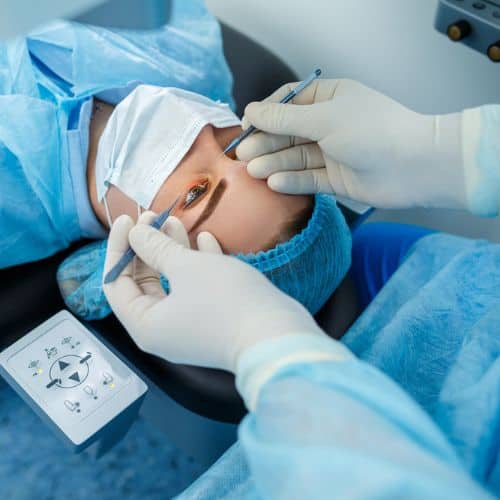
After his years of waiting, the operating room prep time at the AGEI eye clinic was only about 20 minutes, and the procedure was performed on one eye in only 60 minutes total!
The other ophthalmologists Larry consulted with had wanted to wait two weeks between eye surgeries, but AGEI Dr. Assil did eye number two the next day. Larry had a follow-up check two weeks later.
Recovery was a snap. Larry’s only downtime was on the day of the procedure. He resumed his activities the next day and noticed an immediate improvement in his vision. Back behind the driver’s seat, Larry couldn’t be happier.
“I walked out of the surgery, and I could see wonderfully,” he said. “It was like plastic had been removed from my eyes.”
Why trust AGEI with your eye surgery?
AGEI represents the country’s highest standards of the American Academy of Ophthalmology, advancements in eye surgery, and patient care.
The eye care team of top ophthalmology specialists is nationally recognized for compassionate patient-centric care, a commitment to eye health, pioneering advanced technologies, and dedication to supporting the health and well-being of patients and the community.
Request Your Consultation
Call now or book your appointment online.
Los Angeles’s leading laser vision correction, cataract, and retinal surgeons are available to you, all in one practice. State-of-the-art treatments for all eye conditions, including glaucoma, PRK, macular disease, myopia, dry eye, refractive surgery, presbyopia, cataract surgery, astigmatism, farsightedness, and diabetic eye conditions.
We are conveniently located for patients throughout Southern California and the Los Angeles area, including Beverly Hills, Santa Monica, West Los Angeles, West Hollywood, Culver City, Hollywood, Venice, Marina del Rey, Malibu, Manhattan Beach, and Downtown Los Angeles.
More Stories You might be interested in


Intraocular Lens (IOLs) Refractive Lens Exchange (RLE)
Mario’s Second Eye Lens Replacement Surgery, This Time With Dr. Assil, was the Charm

LASIK Nearsightedness
Hollywood Actress Gets ‘Superhero Eyes’ After LASIK Surgery with Dr. Assil

Cataract Surgery Intraocular Lens (IOLs)