LASIK Alternatives for Thin Corneas: Your Options at Assil Gaur Eye Institute
Yes, good LASIK alternatives exist for thin corneas. PRK, SMILE, and the EVO ICL implantable lens each protect corneal strength differently, and the right one depends on your prescription, corneal measurements, and eye health. At Assil Gaur Eye Institute in Los Angeles, a thin cornea is a reason to choose the procedure more carefully – it isn’t a reason to give up on seeing without glasses.
Why Can Thin Corneas Rule Out Standard LASIK?
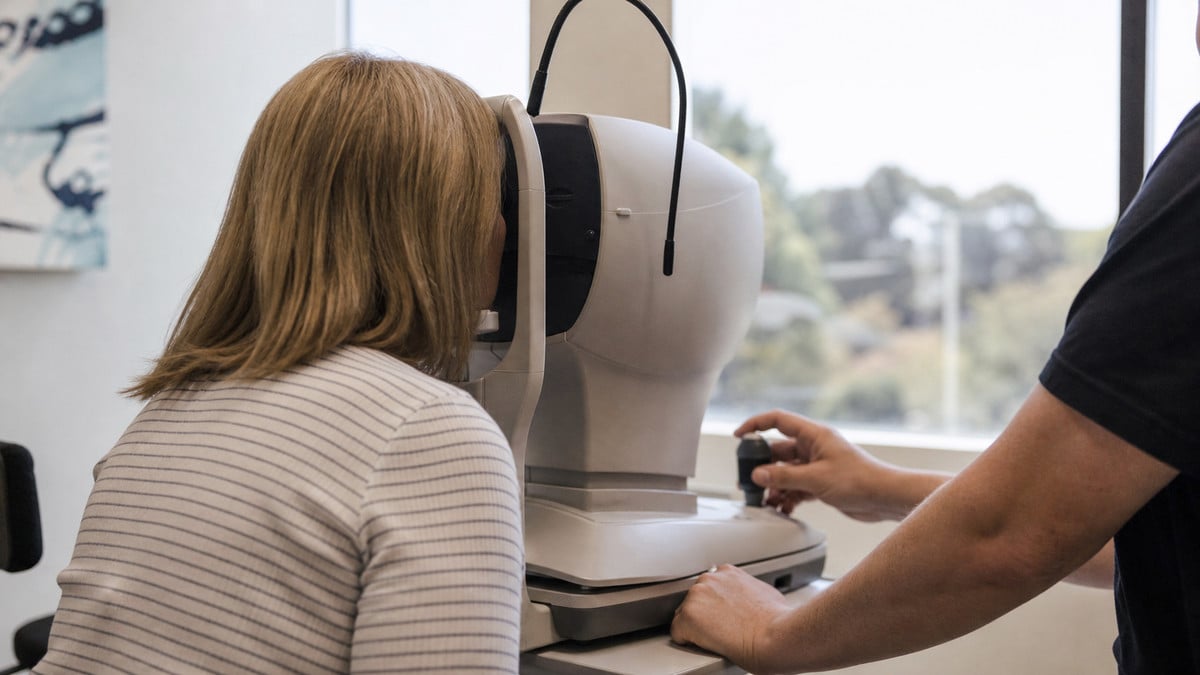
Standard LASIK is often not recommended for a thin cornea because the procedure removes tissue and creates a flap, and enough healthy tissue has to remain afterward to keep the cornea stable. What most people don’t realize is that “thin” is only part of the story. Surgeons also look at the cornea’s shape, how it maps on topography and tomography, and how much tissue your prescription would require removing.
This matters because the main risk is corneal ectasia, a condition in which a weakened cornea gradually bulges and distorts vision. Leaving too little tissue behind is one factor surgeons try to avoid. This is not a reason to panic – it is the reason a full candidacy evaluation comes before any decision. Patient guidance from the American Academy of Ophthalmology covers thin corneas and ectasia in the context of LASIK, PRK, ICL, and SMILE, and it is worth reading before your consultation.
What Are the Main LASIK Alternatives for Thin Corneas?
Three options are used most often: PRK, SMILE, and the EVO ICL. They work differently, so they suit different eyes.
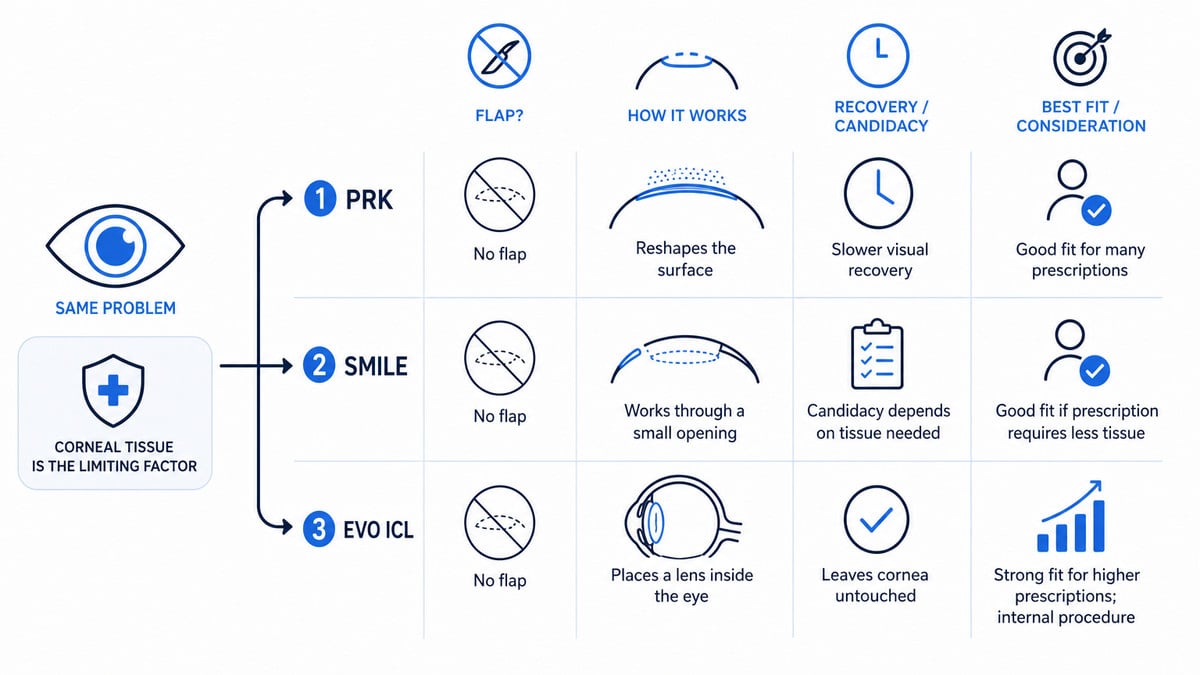
Here is a short version of how each one protects the cornea. PRK reshapes the surface of the cornea and doesn’t create a flap, so no flap needs preserving. SMILE corrects vision through a small opening and does not create a flap either. The EVO ICL does not reshape the cornea at all – a lens is placed inside the eye, so the cornea’s thickness is not what limits the correction.
Is PRK a Good Choice for Thin Corneas?
Usually yes, for the right candidate. PRK, especially our exclusive Epic PRK™, is a surface procedure, so there is no flap and the structural trade-off differs from LASIK. That is why PRK for thin corneas is one of the first options we evaluate when standard LASIK is not suitable.
The trade-off is recovery. The surface layer has to heal after treatment, so vision usually improves more gradually than after LASIK and early discomfort is more common. Our team also offers variations such as LASEK and EPIC PRK. If you are weighing recovery time against corneal safety, ask your surgeon what the first weeks will look like for your work and activities.
Can SMILE Work If You Have a Thin Cornea?
Sometimes. SMILE avoids a flap, so with a thin cornea the question is how much tissue your prescription requires removing and how much remains afterward. A SMILE for a thin cornea is therefore judged case by case, using your measurements rather than a general rule. But overall, we do not believe it is a good option.
If you are comparing the two directly, our article on SMILE versus LASIK covers candidacy, risks, and outcomes in detail.
Is the EVO ICL an Option When the Cornea Is Too Thin?
Often, yes. The EVO ICL is an implantable collamer lens, a thin lens placed inside the eye without removing corneal tissue. Because the correction doesn’t depend on how much cornea is available, ICL is a common option for patients with higher prescriptions or thin corneas who aren’t ideal LASIK candidates.
ICL is still a surgical procedure inside the eye, with its own risks and candidacy requirements, including the eye’s internal anatomy. The FDA publishes patient information on phakic intraocular lenses that is worth reading alongside your surgeon’s advice. For a side-by-side view, see our comparison of EVO ICL and LASIK.
How Do the Options Compare?
The comparison below shows how each procedure approaches the same problem. Corneal tissue is the limiting factor for LASIK, so each alternative either avoids the flap or avoids reshaping the cornea altogether. PRK reshapes the surface and creates no flap, with a slower visual recovery. SMILE creates no flap and works through a small opening, with candidacy that depends on how much tissue your prescription requires removing. The EVO ICL places a lens inside the eye and leaves the cornea untouched, which makes it a strong fit for higher prescriptions, with the added consideration of an internal procedure.
How Does Assil Gaur Eye Institute Decide Which Procedure Fits You?
We decide with measurements, not preference. Your evaluation includes corneal mapping and thickness measurements, a review of your prescription and your dry-eye status, and a conversation about your lifestyle and how quickly you need to return to work, sports, or travel. Our fellowship-trained specialists then explain which procedures are appropriate for you and which are not, and why.
Cost is a legitimate part of that decision, so we address it early. If you are comparing procedures and want to understand payment choices, our LASIK financing page explains what is available for eligible vision-correction costs. Being told you aren’t a standard LASIK candidate usually means a different path, not a closed door.
FAQ
Can I have LASIK if my cornea is only slightly thin?
Possibly. Thickness is one measurement among several, and surgeons also consider corneal shape, prescription and how much tissue the treatment would remove. A slightly thin cornea with otherwise healthy mapping may still qualify, but the decision comes from a full evaluation, not from one number.
What is the safest LASIK alternative for thin corneas?
No single option is safest for everyone. PRK and SMILE avoid a flap, and the ICL avoids reshaping the cornea, so each one addresses corneal strength differently. The safest choice is the one your measurements and eye health support, which is why your surgeon compares them for your eyes specifically.
Will I need a different procedure if I have dry eye as well?
Possibly. Dry eye affects healing and comfort after any vision-correction procedure, so we evaluate and treat it first when needed. Our dry-eye program uses a range of therapies, and your surgeon factors the result into the procedure choice.
Is recovery slower after PRK than after LASIK?
Usually yes. PRK requires the surface layer of the cornea to heal, so vision typically sharpens over days and weeks instead of hours. Many patients accept this trade-off because it avoids a flap in a thin cornea.
Next Step: Get Your Corneas Measured
If you have been told your corneas are too thin, a second opinion based on detailed mapping is a reasonable low-pressure next step. Book a consultation with Assil Gaur Eye Institute at assileye.com, bring any prior measurements you have, and our team will walk you through which options fit your eyes.
Call now or book your appointment online.

Written by The AGEI Educational Team