Best Dry Eye Supplements Before LASIK: An Eye Surgeon’s Guide
The most effective dry eye supplement isn’t the one with the longest ingredient list – it’s the one your ophthalmologist would actually recommend before your LASIK consultation. If you’ve tried every eye drop on the shelf and still wake up with gritty, burning eyes, you’re not alone. Dry eye disease affects tens of millions of Americans, and in a city like Los Angeles, the environmental conditions make it significantly worse than the national average.

This guide delivers the ophthalmologist-vetted dry eye supplements that actually work, explains why the form of omega-3 you take matters more than the dose, and shows you exactly when it’s time to move beyond supplements to advanced dry eye treatment.
You’ll also learn three specific things: which nutrients have the strongest clinical evidence, how the LA environment changes what your eyes need, and when supplements alone won’t protect your vision before surgery.
If you’re already experiencing persistent dry eye symptoms and want a professional evaluation, our team at AGEI’s EagleVision LASIK program includes a full ocular surface assessment as part of every complimentary consultation.
Why Los Angeles Is a Dry Eye Capital And What That Means for Supplements
Los Angeles sits in a semi-arid basin with average relative humidity hovering around 60 to 65 percent – and during Santa Ana wind events, that figure drops below 20 percent. Low ambient humidity accelerates tear film evaporation, which means the ocular surface is under constant stress that residents of more humid cities simply don’t experience at the same intensity.
Add year-round UV exposure, heavy freeway commuting with air conditioning blasting directly at eye level, and one of the highest concentrations of screen-dependent professionals in the country, and you have a perfect storm for tear film instability. Meibomian gland dysfunction, the leading cause of evaporative dry eye, is worsened by all three of these factors.
The meibomian glands line the eyelids and secrete the oily layer of the tear film that prevents evaporation – when they become clogged or inflamed, no amount of artificial tears fully compensates.
This environmental context matters for supplements because it changes the baseline. An omega-3 dose that might be adequate for someone in Seattle – where humidity is naturally higher and UV exposure is lower – may be insufficient for a patient in the San Fernando Valley who spends eight hours a day in air-conditioned offices and drives home into direct afternoon sun.
At AGEI, we factor in these environmental stressors when advising patients on supplement protocols, particularly those preparing for vision correction surgery.
Call now or book your appointment online.
Omega-3 Fatty Acids: The Foundation of Any Dry Eye Supplement Protocol
Does omega-3 help with dry eye syndrome?
Yes, and the evidence is specific. Omega-3 fatty acids, particularly EPA (eicosapentaenoic acid) and DHA (docosahexaenoic acid), reduce the inflammatory signaling that drives meibomian gland dysfunction and tear film instability.
Research published through the National Institutes of Health has documented omega-3’s role in modulating the inflammatory cascade at the ocular surface, reducing cytokine activity that damages the conjunctival epithelium over time.
ALA (alpha-linolenic acid), found in flaxseed oil, is a plant-based omega-3 precursor. The problem is that the human body converts ALA to EPA and DHA at a rate of roughly 5 to 10 percent – meaning flaxseed oil alone is a poor primary source for patients with moderate to severe dry eye. It can supplement a protocol, but it shouldn’t anchor one. Algae oil is a better plant-based alternative because it delivers DHA directly, bypassing the conversion bottleneck entirely.
What is the difference between fish oil and PRN omega-3 for dry eyes?
This is one of the most clinically important questions we hear at AGEI, and the answer comes down to molecular form.
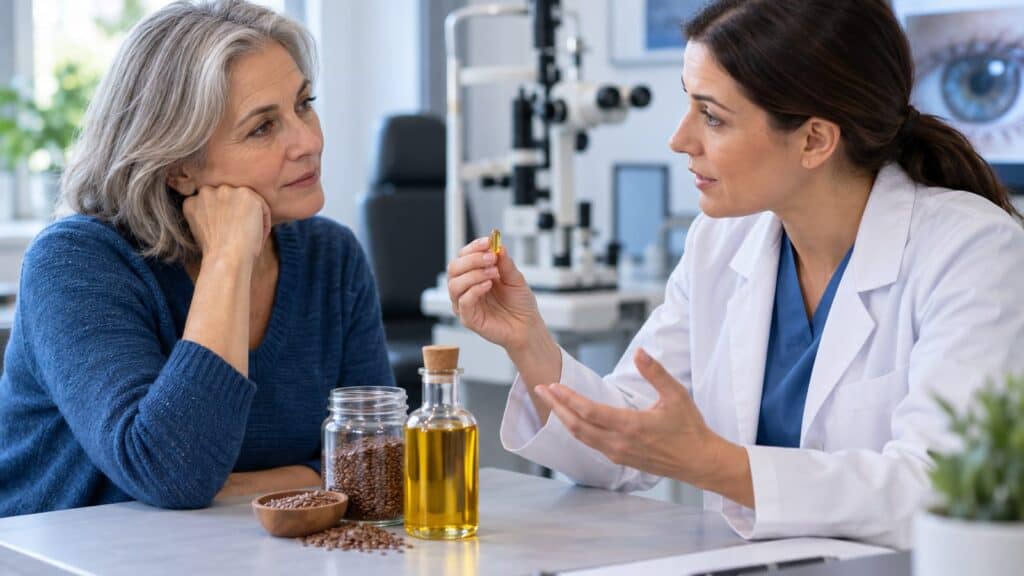
Standard fish oil supplements deliver omega-3 in ethyl ester (EE) form, which has lower bioavailability and requires additional enzymatic processing before the body can use it. PRN Neutraceuticals’ De3 Dry Eye Omega Benefits, one of the most clinically referenced omega-3 products in ophthalmology, delivers EPA and DHA in re-esterified triglyceride (rTg) form – a structure that more closely mirrors how omega-3 occurs naturally in fish tissue and is absorbed significantly more efficiently by the gut.
For LA patients dealing with chronic evaporative dry eye driven by meibomian gland dysfunction, this bioavailability difference is clinically meaningful. A higher-absorption form means more EPA and DHA reach the meibomian glands to reduce inflammation and improve the tear film’s lipid layer.
The De3 product provides a 90-day supply in 270 softgels, which aligns with the typical timeline for measurable improvement – most patients need 8 to 12 weeks of consistent supplementation before noticing a reduction in symptoms.
How long does it take for omega-3 to help dry eyes?
Expect 8 to 12 weeks of consistent daily use before meaningful symptom improvement. Omega-3 works by gradually shifting the inflammatory environment at the ocular surface, not by providing immediate lubrication the way artificial tears do.
Patients who stop after four weeks because they “don’t feel a difference” are abandoning the protocol before the therapeutic window opens. We advise patients to track symptoms weekly using a simple comfort scale so they can see incremental progress that might otherwise go unnoticed.
Vitamin D, Vitamin A, and the Supporting Nutrients That LA Patients Often Miss
Is vitamin D deficiency linked to dry eye disease?
Yes, and the connection is more direct than most patients expect. Vitamin D receptors are present on the corneal epithelium and conjunctival cells, and deficiency has been associated with reduced tear secretion and increased ocular surface inflammation.
Paradoxically, despite living in one of the sunniest cities in the country, many LA residents are vitamin D deficient because they spend most daylight hours indoors, and because sunscreen use (appropriate for UV protection) blocks the skin’s synthesis of vitamin D.
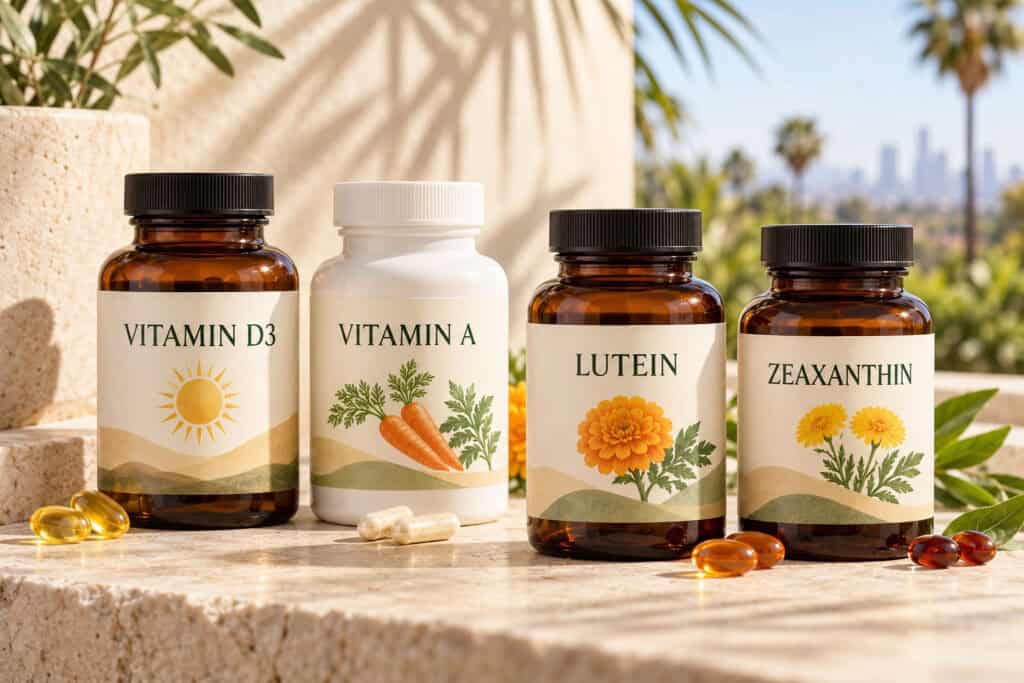
Vitamin A is equally critical. It’s essential for maintaining the goblet cells in the conjunctiva that produce the mucin layer of the tear film. Without adequate mucin, the aqueous layer of tears doesn’t adhere properly to the ocular surface, and even a well-hydrated eye will feel dry.
Vitamin A deficiency is rare in the US, but subclinical insufficiency – particularly in patients on restrictive diets – can meaningfully worsen dry eye symptoms.
Beta-carotene, the plant-based precursor to vitamin A, is found in orange and yellow vegetables, but conversion to active vitamin A varies and is often insufficient for patients with significant ocular surface disease.
Lutein and zeaxanthin, the carotenoids most associated with macular health, also support ocular surface integrity. They concentrate in the macula but are also found in the lens and corneal tissue, where their antioxidant activity helps protect against UV-induced oxidative stress – a particularly relevant benefit for patients spending time outdoors in the LA sun.
Products like PreserVision AREDS 2 from Bausch + Lomb include both lutein and zeaxanthin at clinically studied doses, though that formula is primarily designed to reduce macular degeneration risk rather than dry eye specifically.
Sea Buckthorn Oil, Bilberry, and Emerging Supplement Options
Sea buckthorn oil deserves specific mention because it works through a different mechanism than omega-3. It’s rich in omega-7 fatty acids (palmitoleic acid), which have been shown in clinical studies to reduce tear osmolarity – a key marker of dry eye severity – and improve both the aqueous and lipid layers of the tear film simultaneously. For LA patients whose dry eye is driven by both evaporation and reduced aqueous production, sea buckthorn oil can complement an omega-3 protocol rather than replace it.
Bilberry extract, standardized to anthocyanosides, supports retinal microcirculation and has antioxidant properties relevant to screen-fatigued eyes. It won’t directly treat dry eye disease, but for patients whose symptoms are worsened by prolonged digital device use – a near-universal experience in LA’s entertainment and tech industries – bilberry can reduce the oxidative burden on the ocular surface that compounds dry eye severity.
Consider a patient like Dr. Klaus Ito, an optometrist who wore hard contact lenses and came to AGEI with chronic dry eyes during patient examinations. During his consultation with Dr. Avneet Gaur, a previously undetected retinal tear was discovered and repaired before he underwent Eagle Vision LASIK surgery.
His case illustrates a critical point: supplements can support ocular surface health, but they don’t replace a thorough clinical evaluation. Dr. Ito achieved 20/10 vision in each eye after surgery – better than 20/20 – and his dry eye issues resolved with a combination of surgical correction and targeted post-operative care.
Dry Eye Supplements Before and After LASIK or Cataract Surgery
Should I take dry eye supplements before LASIK surgery?
Yes, and the timing matters. Dry eye disease is both a contraindication risk for LASIK and a predictable post-operative complication. LASIK surgery temporarily reduces corneal nerve density, which impairs the reflex arc that triggers tear production – meaning patients who already have borderline dry eye before surgery are at higher risk of significant post-LASIK dry eye that can affect visual quality and recovery.
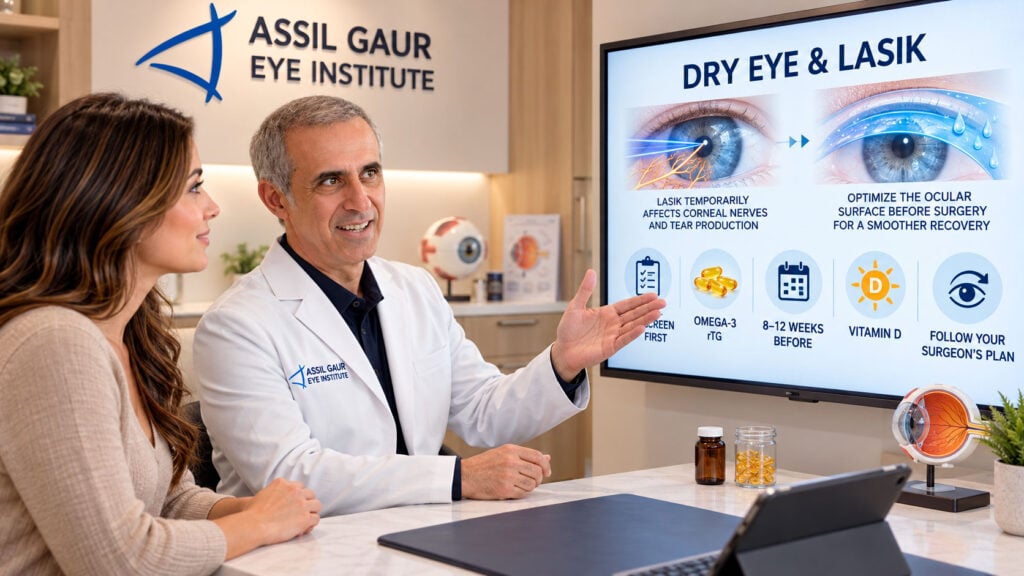
Starting an omega-3 protocol in rTG form at least 8 to 12 weeks before a planned LASIK procedure gives the ocular surface the best possible inflammatory baseline going into surgery.
Post-cataract surgery patients face a similar challenge. The surgical incision disrupts corneal nerves and can temporarily worsen tear film stability. Patients who follow a consistent omega-3 and vitamin D protocol pre-operatively tend to recover more comfortably and report fewer dry eye complaints in the weeks following surgery.
This is why our surgeons at AGEI routinely discuss supplement protocols during pre-surgical consultations for cataract lens implants – not as a replacement for prescription therapy, but as a foundation that makes every other treatment more effective.
When Supplements Aren’t Enough: In-Office Dry Eye Treatments in Los Angeles
Supplements address the inflammatory and nutritional drivers of dry eye, but they can’t physically clear blocked meibomian glands or replace a structurally deficient tear film. When patients present with moderate to severe meibomian gland dysfunction, we typically combine supplement protocols with in-office treatments for meaningful relief.
TearCare is a wearable eyelid-warming device that applies controlled heat directly to the meibomian glands, softening the thickened lipid secretions that block them. BlephEx is a professional lid hygiene treatment that removes the biofilm and debris from the lid margin that contributes to chronic inflammation.
For patients with significant aqueous deficiency, the American Academy of Ophthalmology recognizes prescription options including Restasis (cyclosporine) and Xiidra (lifitegrast) as first-line anti-inflammatory therapies – both of which work synergistically with omega-3 supplementation rather than replacing it.
DELIT Plus (low-level light therapy for dry eye) is another in-office option gaining traction for patients with meibomian gland dysfunction who haven’t responded adequately to heat-based treatments. For patients with anatomical issues that contribute to poor tear drainage, punctal plugs for dry eye treatment in Los Angeles offer a minimally invasive way to conserve the tears being produced.
The key clinical principle is this: supplements build the foundation, and in-office treatments address the structural problems that supplements can’t reach. The most successful dry eye outcomes we see at AGEI combine both approaches, tailored to the specific drivers of each patient’s condition.
Ready to find out whether your dry eye is affecting your candidacy for vision correction? Schedule an evaluation through AGEI’s EagleVision LASIK program – our surgeons will assess your full ocular surface health and build a supplement and treatment protocol tailored to your specific condition and the demands of life in Los Angeles.
Call now or book your appointment online.
Frequently Asked Questions
What supplements are best for dry eyes?
The strongest clinical evidence supports omega-3 fatty acids in re-esterified triglyceride (rTg) form, delivering at least 2,000 mg of combined EPA and DHA daily. Vitamin D (particularly for patients who are deficient), vitamin A, and sea buckthorn oil round out a well-designed dry eye supplement protocol. For patients with macular degeneration risk alongside dry eye, lutein and zeaxanthin at doses consistent with the AREDS 2 formula add meaningful antioxidant protection. The specific combination depends on the underlying cause of your dry eye, which is why a clinical evaluation is always the right starting point.
What vitamins help with dry eye relief?
Vitamin A is essential for maintaining the goblet cells that produce the mucin layer of the tear film – without it, tears don’t adhere properly to the ocular surface. Vitamin D supports corneal epithelial health and reduces ocular surface inflammation, and deficiency is surprisingly common even in sun-drenched cities like Los Angeles. Vitamin C and vitamin E provide antioxidant protection to the ocular surface, reducing oxidative damage from UV exposure and screen use. These vitamins work best as part of a protocol anchored by omega-3 fatty acids, not as standalone treatments.
Can dry eye supplements replace eye drops?
No, and conflating the two is a common mistake that delays effective treatment. Artificial tears provide immediate surface lubrication but do nothing to address the underlying inflammation or meibomian gland dysfunction driving chronic dry eye. Supplements work at the cellular and inflammatory level over weeks to months, improving the quality and stability of the tear film itself. The most effective approach uses both: artificial tears for immediate comfort and supplements for long-term disease modification. Prescription drops like Restasis or Xiidra may also be necessary for patients with significant aqueous deficiency.
What is the difference between fish oil and PRN omega-3 for dry eyes?
Standard fish oil delivers omega-3 in ethyl ester form, which has lower bioavailability and requires additional enzymatic conversion before the body can use it effectively. PRN Neutraceuticals’ De3 Dry Eye Omega Benefits delivers EPA and DHA in re-esterified triglyceride (rTG) form, which more closely mirrors the natural structure of omega-3 in fish tissue and is absorbed significantly more efficiently. For patients with active dry eye disease, this bioavailability difference means more EPA and DHA reach the meibomian glands and ocular surface where it’s needed. Most ophthalmologists recommend using rTG-form omega-3 specifically for dry eye management rather than generic fish oil.

Written by The AGEI Educational Team

Medically Reviewed by Dr. Kerry Assil