Intraocular Lens (IOLs)
 What is selective laser trabeculoplasty (SLT)?
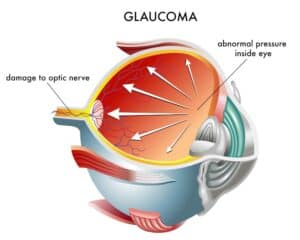
Selective laser trabeculoplasty (SLT) is an FDA-approved laser therapy that lowers eye pressure, also called intraocular pressure (IOP). It works by improving how aqueous fluid (aqueous humor) drains from the eye. SLT is used to treat primary open-angle glaucoma and ocular hypertension.
Unlike older laser techniques such as argon laser trabeculoplasty, SLT targets only the pigmented cells in the eye’s drainage channels, called the trabecular meshwork. The surrounding tissue stays completely intact. This precision allows SLT to gently reduce eye pressure with minimal side effects and no incisions.
At Assil Gaur Eye Institute, our glaucoma specialists and ophthalmologists have performed SLT for patients throughout Beverly Hills and the greater Los Angeles area. They deliver excellent outcomes using advanced technology and the precision our patients trust.
Selective laser trabeculoplasty (SLT) is an FDA-approved laser therapy that lowers eye pressure, also called intraocular pressure (IOP). It works by improving how aqueous fluid (aqueous humor) drains from the eye. SLT is used to treat primary open-angle glaucoma and ocular hypertension.
Unlike older laser techniques such as argon laser trabeculoplasty, SLT targets only the pigmented cells in the eye’s drainage channels, called the trabecular meshwork. The surrounding tissue stays completely intact. This precision allows SLT to gently reduce eye pressure with minimal side effects and no incisions.
At Assil Gaur Eye Institute, our glaucoma specialists and ophthalmologists have performed SLT for patients throughout Beverly Hills and the greater Los Angeles area. They deliver excellent outcomes using advanced technology and the precision our patients trust.
Why selective laser trabeculoplasty is now a first-line treatment
For decades, eye drops were the default starting point for glaucoma management. That changed in 2019, when the landmark LiGHT Trial, a large randomized clinical study, found that SLT was more effective than eye drops as an initial treatment for most patients with open-angle glaucoma.
Patients who received SLT first were more likely to reach their target eye pressure. They were also less likely to need additional eye drop medications, and they had a lower rate of disease progression and vision loss over six years.
Despite this evidence, most newly diagnosed glaucoma patients are still started on daily eye drops. Many are never told that SLT is an option. At AGEI, we believe every patient deserves to know about every treatment available.
How the selective laser trabeculoplasty procedure works
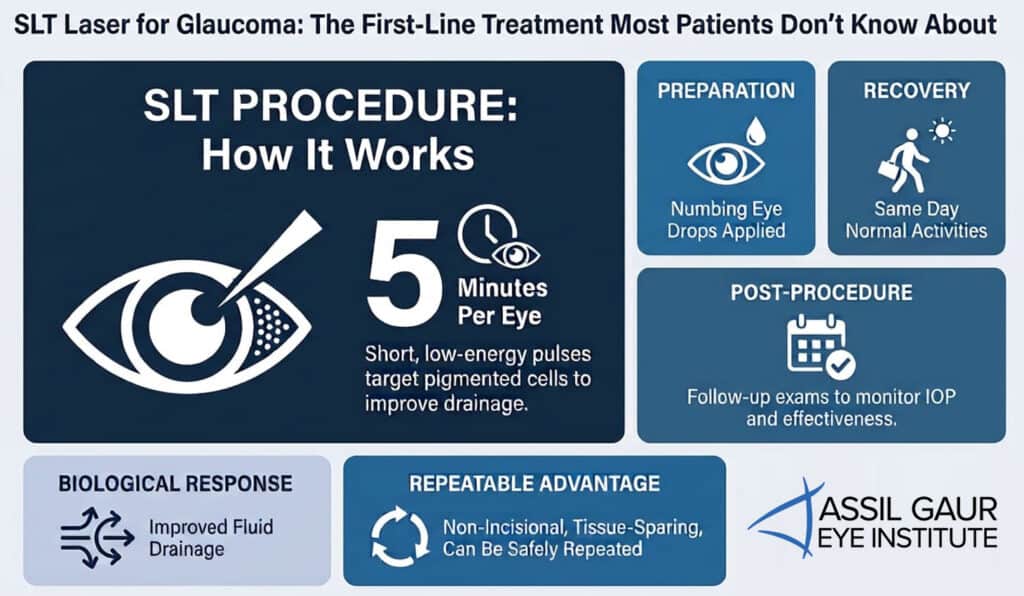
We perform SLT right in our office, and it typically takes less than five minutes per eye. Here is what to expect:
-
Preparation: We apply numbing eye drops, so you feel no discomfort. We may also place a special contact lens on your eye to help the laser focus.
-
Laser application: A specially designed laser delivers short, low-energy pulses of light to the trabecular meshwork, your eye’s natural drainage tissue. The laser targets only pigmented cells, without damaging nearby structures.
-
Biological response: Over the next four to eight weeks, your body’s natural healing response improves fluid drainage from the eye, which lowers eye pressure and prevents a future pressure spike
-
Recovery: Most patients return to normal activities the same day. You may notice mild inflammation, light sensitivity, or temporary blurred vision, but these typically resolve within 24 hours. We may prescribe anti-inflammatory eye drops for a short time.
Because SLT is non-incisional and preserves eye tissue, you can safely repeat it if your eye pressure rises again over time. This is a significant advantage over ALT and many other laser or surgical alternatives.
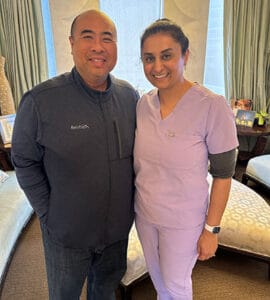
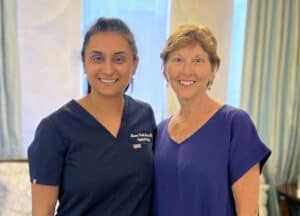
SEE LIFE THROUGH DR. GAUR'S PATIENTS' EYES
READ HER HONEST PATIENT STORIES





Who is a candidate for selective laser trabeculoplasty?
SLT is appropriate for a wide range of glaucoma patients and those with related eye diseases and conditions, including:
- Newly diagnosed patients with open-angle glaucoma or ocular hypertension who want to avoid or delay daily eye drops.
- Patients already on glaucoma medications who are not achieving adequate IOP control.
- Patients who struggle with eye drop compliance due to side effects, cost, or lifestyle.
- Patients seeking a long-term, low-maintenance glaucoma management strategy.
SLT is generally not recommended for patients with angle-closure glaucoma (closed-angle glaucoma), certain secondary glaucomas, or very advanced disease. However, it can often be performed alongside cataract surgery. During your complimentary evaluation at AGEI, our specialists will review your optic nerve health, drainage angle anatomy, and full eye history to determine whether SLT is right for you.
Selective laser trabeculoplasty vs. eye drops: what patients should know
Many patients are surprised to learn how SLT compares to daily glaucoma drops:
| Factor | Selective Laser Trabeculoplasty | Glaucoma Eye Drops |
|---|---|---|
| Daily routine required | No | Yes, one or more times daily |
| Procedure time | Under 5 minutes | Ongoing indefinitely |
| Common side effects | Mild, temporary inflammation | Redness, stinging, systemic effects |
| Long-term cost | Often lower overall | Recurring monthly prescription costs |
|
Repeatability |
Yes, can be repeated | Dosage can be adjusted |
| Insurance coverage | Typically covered | Typically covered |
Freedom from a daily drop regimen is one of the most valued benefits our patients report after SLT. This is especially true for patients with active lifestyles or travel schedules that make consistent medication use difficult.
What results can you expect?
Clinical studies show that SLT successfully lowers eye pressure in approximately 75 to 85 percent of patients. On average, patients experience a 20 to 30 percent reduction in pressure. Results typically appear within four to eight weeks of the procedure. They can last anywhere from one to five years, and many patients maintain pressure control well beyond that window.
At Assil Gaur Eye Institute (AGEI), our approach to SLT is grounded in precision diagnostics. Patient Julie H. described how her AGEI doctor compared high-tech scans taken six months apart to determine her exact needs. Our glaucoma team monitors your response to treatment with that same meticulous, data-driven standard of care.
Request Your Consultation
Call now or book your appointment online.
Why choose Assil Gaur Eye Institute for selective laser trabeculoplasty?
Patients throughout Los Angeles and beyond trust AGEI for world-class glaucoma care. When you choose our institute for SLT, you benefit from:
- Elite glaucoma specialists with advanced fellowship training in laser therapy and surgical procedures for glaucoma management.
- Advanced diagnostic technology, including optical coherence tomography (OCT) and visual field analysis, to precisely stage your glaucoma before and after SLT.
- A patient-first philosophy. As patient Hariyanto J. noted, “Dr. patiently answered my questions with clear, descriptive, and convincing explanations.”
- Comprehensive glaucoma care, from SLT and medical management to advanced minimally invasive glaucoma surgery (MIGS) when needed.
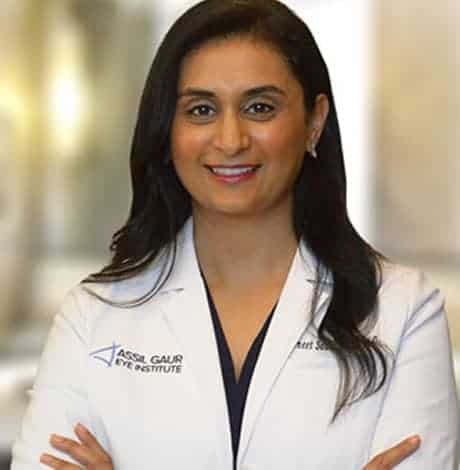
Your SLT procedure will be performed by Dr. Avneet K. Sodhi Gaur, a board-certified, fellowship-trained cataract, refractive, and glaucoma specialist at AGEI. She graduated Magna Cum Laude from The George Washington University, earned her medical degree from The George Washington University School of Medicine and Health Sciences, and has been voted a top Los Angeles ophthalmologist numerous times, including this year by LA Magazine.
Dr. Sodhi Gaur has performed thousands of cataract, glaucoma, and refractive surgeries.
Her glaucoma practice includes selective laser trabeculoplasty, laser peripheral iridotomy, minimally invasive glaucoma surgery (including iStent, iStent inject, Hydrus, ECP, OMNI 360, and iTrack canaloplasty), and traditional surgical procedures such as trabeculectomy and drainage implants.
Our patients consistently say they are receiving the best care available. That's because they are.
If you have been diagnosed with glaucoma or ocular hypertension, or if you simply want to understand your options, we invite you to schedule a complimentary evaluation at Assil Gaur Eye Institute. Our specialists will assess whether SLT is right for you and walk you through every step of the process with the clarity and confidence you deserve.
Selective Laser Trabeculoplasty FAQs
How long do the results of selective laser trabeculoplasty last?
Most patients experience lower eye pressure for one to five years after SLT, and many maintain results even longer. Because the procedure preserves eye tissue, it can be safely repeated if eye pressure increases over time.
Is selective laser trabeculoplasty better than glaucoma eye drops?
For many patients, yes. Studies have shown that SLT can control eye pressure as effectively as, or better than, glaucoma eye drops while reducing the need for daily medication. The best treatment depends on your type of glaucoma, eye pressure, and overall eye health.
How long do the results of SLT last?
Most patients experience meaningful IOP reduction for three to five years following a single SLT treatment, though duration varies by individual. Factors such as glaucoma type, baseline IOP, and the degree of trabecular meshwork pigmentation all influence longevity. Ongoing IOP monitoring at routine follow-up appointments allows your physician to detect any pressure creep early and plan next steps before vision is affected.
Can SLT be repeated if the effect wears off?
Yes. One of SLT’s most significant advantages over older laser techniques is its repeatability. Because the 532nm wavelength selectively targets pigmented cells without thermally scarring the trabecular meshwork, the procedure can generally be performed again once the initial effect diminishes. Repeat SLT has been shown in multiple studies to produce IOP reductions comparable to the initial treatment in many patients.
Is SLT covered by insurance, and what does it cost?
SLT is covered by most major medical insurance plans, including Medicare, when it is medically indicated for the treatment of glaucoma or ocular hypertension. Coverage specifics — including deductibles, co-pays, and prior authorization requirements — vary by plan. We recommend contacting your insurer before your consultation to confirm benefits. Our team can assist with benefit verification as part of the pre-procedure process.
What is the recovery time after SLT?
Recovery is minimal compared to incisional glaucoma surgery. Most patients return to desk work and routine daily activities within 24 hours. Your physician will prescribe a short course of anti-inflammatory eye drops and advise you to avoid rubbing your eyes, swimming, or engaging in heavy exertion for a brief period — typically a few days. A follow-up IOP check is scheduled four to eight weeks after the procedure to assess the pressure-lowering response.
What is the success rate of SLT?
Clinical studies consistently report that SLT achieves a clinically meaningful reduction in IOP (generally defined as 20% or greater reduction from baseline) in approximately 70–80% of appropriate candidates. The landmark LiGHT Trial found that after three years, 74% of participants who received SLT as their initial treatment did not require eye drops to maintain target IOP. Success rates are highest when patients are selected carefully based on glaucoma type and trabecular meshwork characteristics.
Sources
-
Gazzard G, et al. Selective laser trabeculoplasty versus eye drops for first-line treatment of ocular hypertension and glaucoma (LiGHT): a multicentre randomised controlled trial. The Lancet, 2019.
https://pubmed.ncbi.nlm.nih.gov/30862377/ -
Glaucoma Research Foundation. Selective Laser Trabeculoplasty (SLT).
https://glaucoma.org/treatment/laser/slt -
Effectiveness of Selective Laser Trabeculoplasty as Initial or Adjunctive Treatment for Primary Open-Angle Glaucoma. National Library of Medicine, PMC.
https://pmc.ncbi.nlm.nih.gov/articles/PMC8784470/

Written by The AGEI Educational Team

Medically Reviewed by Dr. Avneet Sodhi Gaur