Blepharoplasty & Insurance: Does Your Drooping Eyelid Qualify for Coverage?
Blepharoplasty is often dismissed as a cosmetic luxury, but for thousands of patients, drooping eyelids are a documented medical condition that insurance must cover. If you’ve been told eyelid surgery is purely cosmetic and you’ll have to pay out of pocket, you’re not alone. You may also be wrong.
The distinction between cosmetic and functional blepharoplasty is real, and insurers draw a hard line between the two. This guide gives you a precise, actionable roadmap to determine whether your eyelid surgery qualifies for coverage, and exactly what documentation to build before your first surgical consultation. You’ll learn the three documentation pillars insurers require, how Medicare coverage works for functional blepharoplasty, and what to do if your claim is denied.
If you’re already exploring your options, our team at Assil Gaur Eye Institute can evaluate your candidacy and help you understand what your specific insurer will need to see.
Does Insurance Cover Blepharoplasty? The Answer Depends on One Key Question
Insurance companies classify blepharoplasty into two categories: cosmetic and functional. Cosmetic blepharoplasty is elective, performed to improve the appearance of the eyelids, and is almost never covered. Functional blepharoplasty, also called functional eyelid surgery, corrects a medical condition that impairs vision or causes physical symptoms, and it can be covered.
The single question that determines coverage is this: does the excess skin or drooping eyelid obstruct your visual field in a way that is measurable and documented? If the answer is yes, and you can prove it, you have a case. If the answer is no, or you can’t prove it, you’re paying out of pocket.
This is not a gray area insurers leave open to interpretation. They require specific clinical evidence, submitted in a specific format, before they will authorize the procedure. The rest of this guide walks you through exactly what that evidence looks like.
When Blepharoplasty Is Considered Medically Necessary: The Criteria Insurers Use
What qualifies blepharoplasty as medically necessary?
According to the American Academy of Ophthalmology, medically necessary eyelid surgery typically requires documented evidence of one or more of the following: ptosis (drooping of the upper eyelid caused by a weakened levator muscle), dermatochalasis (excess skin on the upper eyelid that rests on or below the lash line), or a measurable reduction in the superior visual field. The condition must be causing functional impairment, not just aesthetic dissatisfaction.
Ptosis is particularly significant because the eyelid margin drops below the normal position, often blocking the pupil. Dermatochalasis, by contrast, involves skin redundancy that folds over the lid. Both can qualify, but documentation requirements differ slightly, and your oculoplastic surgeon must code the procedure correctly using the appropriate CPT code to match the diagnosis.
Symptoms that support a medical necessity argument include difficulty reading, driving, or performing tasks that require upward gaze; chronic brow aching from constantly raising the eyebrows to compensate for drooping lids; and documented vision impairment confirmed by clinical testing.
Upper Eyelid Surgery and Insurance: What Qualifies – and What Doesn’t
Is upper eyelid surgery covered by insurance?
Upper eyelid blepharoplasty is the most commonly covered form of eyelid surgery, but coverage is not automatic. Insurers require objective proof that the excess skin is obstructing the superior visual field by a clinically significant margin, typically 12 degrees or more of field loss, or that the upper eyelid margin is positioned at or below the pupil.
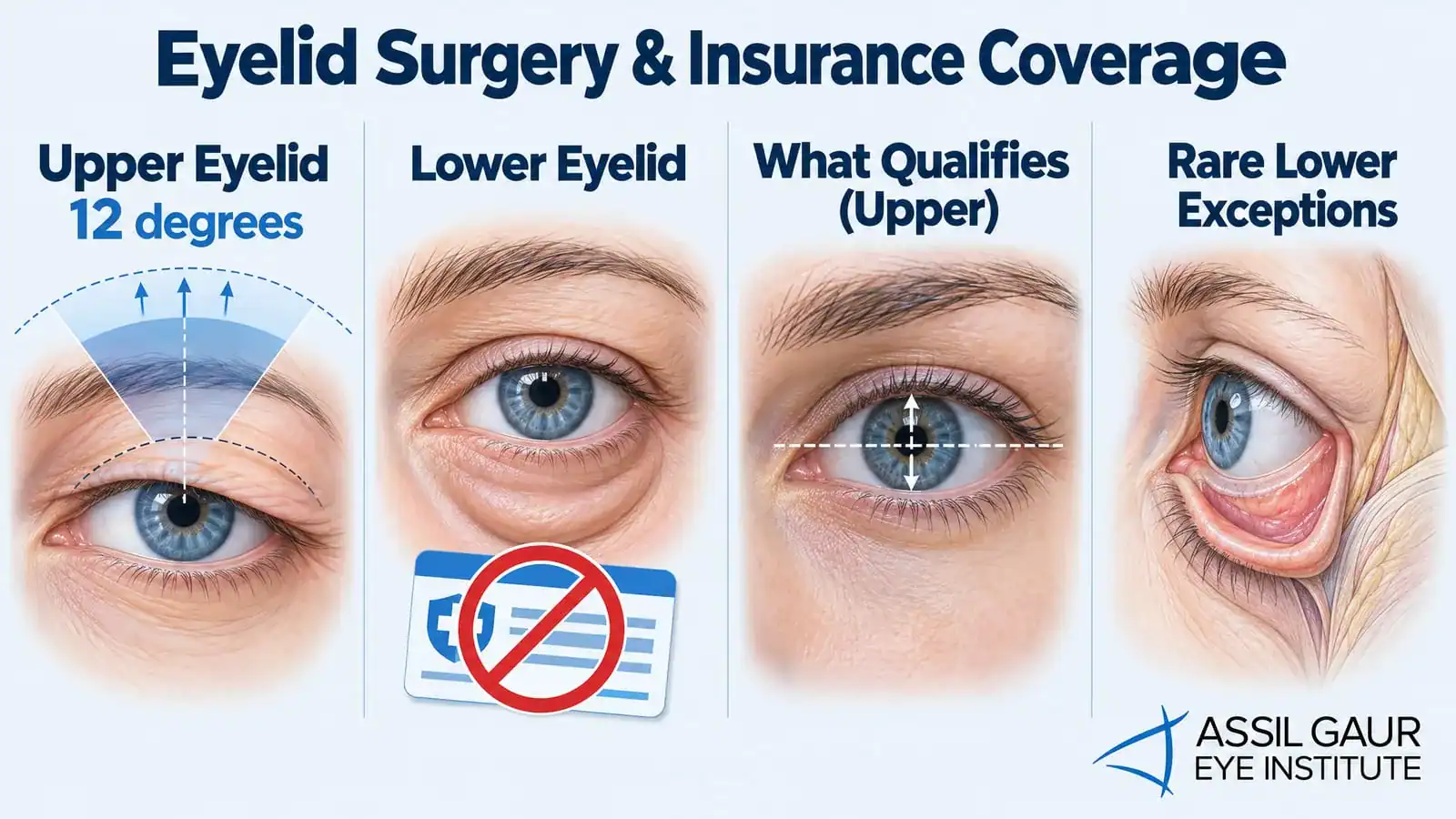
Take standardized clinical photographs at the initial consultation, showing the eyelids in primary gaze without the patient raising their brows. These photographs document the resting position of the lids and the degree of skin overhang. Submit them with the visual field test results as part of the prior authorization package.
What does not qualify: upper eyelid skin that looks heavy or tired but does not obstruct the visual field on testing. Insurers will deny claims when photographs show mild hooding, but the visual field test shows no measurable impairment. The clinical threshold matters, and you must meet it on paper.
Lower Eyelid Surgery: Why Insurance Almost Never Covers It
Lower eyelid blepharoplasty addresses puffiness, bags, and excess skin below the eye. In most cases, these conditions are cosmetic. The lower eyelid does not obstruct the visual field the way the upper eyelid does, which makes the medical-necessity argument extremely difficult.
Rare exceptions include ectropion (outward turning of the lower lid) and entropion (inward turning), which can cause corneal exposure, chronic irritation, and vision disruption, and surgical correction may be covered. But standard lower lid blepharoplasty for cosmetic rejuvenation is not. Patients seeking lower eyelid work should plan for it as an out-of-pocket procedure.
One patient we see frequently at AGEI comes in hoping to address both upper and lower lids under a single insurance claim. The upper lid work may well qualify; the lower lid work almost certainly will not. Understanding this distinction before your consultation saves time and prevents frustration during authorization.
Does Medicare Cover Blepharoplasty? What Los Angeles Patients Need to Know
Does Medicare cover blepharoplasty for drooping eyelids?
Medicare Part B covers functional blepharoplasty when it meets the medical necessity criteria. According to Medicare.gov, Part B covers medically necessary outpatient surgical procedures, including upper eyelid surgery when drooping eyelids impair vision, and the impairment is documented through clinical testing. Cosmetic blepharoplasty is explicitly excluded.
For Medicare patients in Los Angeles, the prior authorization process follows the same documentation requirements as private insurers: standardized photographs, visual field testing with and without lid taping, and a letter of medical necessity from the treating physician. Medicare also requires that the procedure be billed under the correct CPT code, either for blepharoplasty or ptosis repair, depending on the underlying diagnosis. Incorrect coding is one of the most common reasons Medicare denies claims.
Patients under 65 may qualify for Medicare coverage if they have certain qualifying disabilities. For most Los Angeles adults, however, private insurance through an employer or marketplace plan is the primary coverage pathway, and the criteria are broadly similar to Medicare’s.
The Three Documentation Pillars That Determine Insurance Approval
This is the section no competing resource gives you in full. Based on what we see in the prior authorization process at Assil Gaur Eye Institute, insurance approval for functional blepharoplasty rests on three specific documentation pillars. Missing any one can trigger a denial.
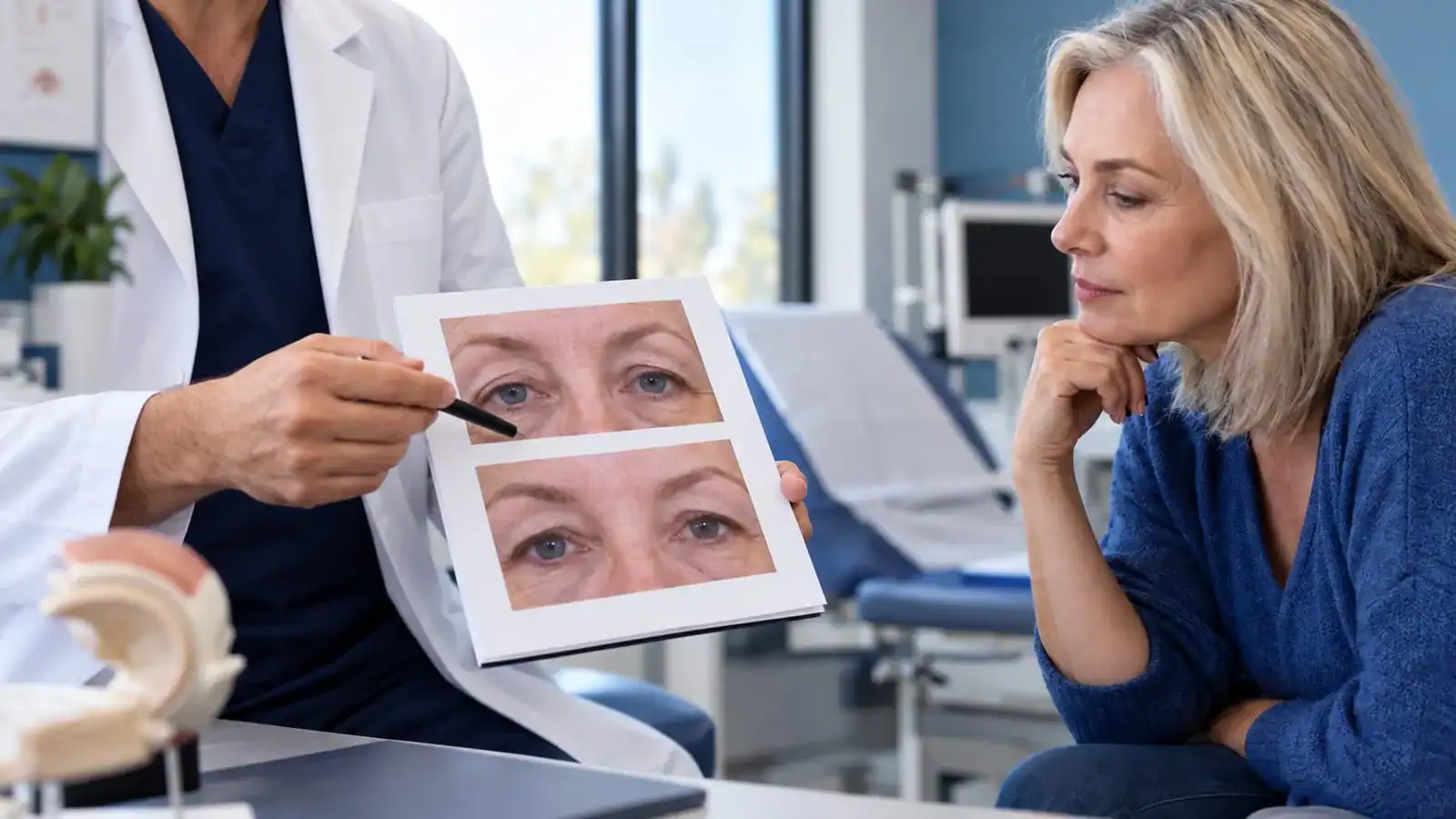
Pillar 1: Standardized Clinical Photographs. These are not casual photos. Take them under consistent lighting, at a standardized distance, with the patient in primary gaze and brows relaxed. The photographs document the resting position of the upper eyelid margin relative to the pupil, and the degree of skin overhang onto or past the lash line. Most insurers require both a frontal view and a lateral view. Your surgeon’s office should take these at your consultation, not at a separate appointment.
Pillar 2: Visual Field Testing. A visual field test measures the full extent of your peripheral and superior vision. For blepharoplasty insurance approval, the test is performed twice: once with the eyelids in their natural resting position, and once with the excess skin taped up to simulate the post-surgical result. The difference between the two tests quantifies how much of the visual field the drooping skin obstructs. Most insurers require at least 12 degrees of superior field loss in the natural position to approve coverage. The American Society of Plastic Surgeons notes that this testing is a standard requirement across major insurers.
Pillar 3: Physician Letter of Medical Necessity. This letter, written by your oculoplastic surgeon, ties the clinical findings together into a coherent medical argument. It must reference the specific diagnosis (ptosis, dermatochalasis, or both), cite the visual field test results, describe the patient’s functional impairment, and explain why surgical correction is appropriate. A generic letter that simply states “patient has droopy eyelids” will not pass insurer review. The letter needs to be specific, clinically grounded, and written by a physician with documented expertise in oculoplastic surgery.
Consider a patient who came to us after her insurer denied coverage following a consultation at a general plastic surgery practice. Her visual field test showed 14 degrees of superior field loss, which met the threshold. But the letter of medical necessity submitted on her behalf was two sentences long and did not reference her functional symptoms. After Dr. Adeleh Yarmohammadi at AGEI drafted a new letter citing the specific field loss, the patient’s difficulty driving at night, and the compensatory brow elevation she had developed, the insurer approved the procedure on appeal. The documentation was always there. It just needed to be presented correctly.
What to Do If Your Blepharoplasty Claim Is Denied: The Appeals Process
How do I appeal an insurance denial for blepharoplasty?
A denial is not final. Most insurance denials for functional blepharoplasty happen because the initial submission was incomplete, not because the patient doesn’t qualify. The appeals process gives you a structured opportunity to correct that.
Step one: request the denial letter in writing and read it carefully. Insurers must state the specific reason for denial. Common reasons include insufficient visual field loss documentation, photographs that don’t meet technical standards, or a missing or inadequate letter of medical necessity. Each of these is correctable.
Step two: work with your oculoplastic surgeon to address the specific deficiency. If the visual field test results were borderline, request a repeat test. If the photographs were taken with the patient raising their brows, have them retaken with brows relaxed. If the letter of medical necessity was inadequate, have a new one drafted that directly addresses the insurer’s stated objection.
Step three: submit the appeal with a cover letter that references the denial reason point by point and explains how each deficiency has been corrected. Include any additional supporting documentation, such as records of prior conservative treatments (lubricating eye drops for corneal exposure, for example) that were tried before surgery was recommended.
Most insurers allow at least one level of internal appeal, and many states require an external independent review option if the internal appeal is also denied. In California, patients can request an Independent Medical Review through the California Department of Managed Health Care if their insurer denies a claim they believe is medically necessary.
Why Choosing an Oculoplastic Specialist Strengthens Your Insurance Case
The surgeon you choose directly affects your insurance approval odds. An oculoplastic surgeon is a physician who first completed ophthalmology training, then completed a fellowship specifically in plastic and reconstructive surgery of the eyelids, orbit, and lacrimal system. This dual training matters to insurers because it establishes that the surgeon is evaluating the procedure from a medical, vision-focused perspective, not purely an aesthetic one.
When Dr. Adeleh Yarmohammadi at Assil Gaur Eye Institute submits a prior authorization for functional blepharoplasty, the documentation carries the weight of her ophthalmology and oculoplastic credentials. Insurers recognize that an oculoplastic specialist is uniquely positioned to distinguish between cosmetic and functional eyelid disease, and that distinction is exactly what they’re paying for when they cover the procedure.
Patient Fay V. described her experience with Dr. Yarmohammadi this way: “I am so glad I went with my gut and trusted something quite sensitive to me to Dr. Adeleh Yarmohammadi. The result is everything I dared to hope for.” Patient Annie Y. added: “Dr. Adele changed my life. Not only did she reconstruct my eyes to help me see better, but also created more symmetry on my face.” These outcomes reflect what happens when the right specialist handles both the clinical documentation and the surgical execution.
For patients in Los Angeles seeking functional blepharoplasty, precise documentation, correct CPT coding, and a credentialed oculoplastic specialist provide the strongest possible foundation for insurance approval. Explore your options with our team through AGEI’s oculoplastics and aesthetics services, or learn more about the full range of advanced eye care procedures we offer. Schedule a consultation with AGEI today and let us build your insurance case from the ground up.
Frequently Asked Questions
What is a visual field test and why do I need one for insurance approval?
A visual field test is a non-invasive diagnostic exam that maps the full extent of your peripheral and central vision. For blepharoplasty insurance approval, it is performed twice: once with your eyelids in their natural drooping position, and once with the excess skin taped up to simulate the post-surgical result. The difference between the two measurements shows how much of your superior visual field the drooping skin blocks. Most insurers require at least 12 degrees of superior field loss in the natural position before they will authorize coverage for functional upper eyelid blepharoplasty.
How much does blepharoplasty cost without insurance?
When blepharoplasty is performed as a cosmetic procedure without insurance coverage, the total cost includes the surgeon’s fee, anesthesia, and facility fees. The American Society of Plastic Surgeons publishes national average surgeon fee benchmarks for eyelid surgery annually. In a premium market like Los Angeles, costs at elite practices reflect oculoplastic specialists’ advanced training and precision. Patients who qualify for functional coverage may have a significant portion of the upper eyelid work covered, with any cosmetic component billed separately as an out-of-pocket expense.
Is lower eyelid surgery ever covered by insurance?
Lower eyelid blepharoplasty for cosmetic reasons, such as removing under-eye bags or tightening loose skin, is almost never covered by insurance. The rare exceptions involve structural conditions like ectropion (outward turning of the lower lid) or entropion (inward turning), which cause corneal exposure and chronic irritation. These conditions have a clear medical necessity argument and may qualify for coverage under both private insurance and Medicare Part B. Standard cosmetic lower lid work does not meet the functional impairment threshold that insurers require.
Assil Gaur Eye Institute of Los Angeles: Los Angeles’ leader in ocularplastic surgery
If you’re ready to find out whether you are a candidate for eyelid surgery, our Occularplastic surgeons can tell you in a single visit whether any surgery makes sense for you.
That level of trust is earned. You can read many eyelid surgery patient stories and learn what other Assil Gaur Eye Institute patients’ journeys were like. These enviable outcomes speak for themselves.
Please call (866) 945-2745 or book your complimentary evaluation online.
We’re conveniently located for patients throughout Southern California and the Los Angeles area, with locations in or near Beverly Hills, Santa Monica, West Los Angeles, West Hollywood, Culver City, Hollywood, Venice, Marina del Rey, Malibu, Manhattan Beach, and Downtown Los Angeles.

Written by The AGEI Educational Team

Medically Reviewed by Dr. Adeleh Yarmohammadi