What Is Goniotomy Surgery? (And Why It’s Gaining Ground in Adult Glaucoma Care)
Has your glaucoma specialist brought up goniotomy surgery? If so, that’s because your eye drops, pills, etc. are probably no longer keeping your eye pressure in check. Surgery is the next step.
We understand that hearing the word ‘surgery’ can feel unsettling, so here is a plain explanation of what the surgical procedure is, who it helps, and what recovery really looks like. We will also cover something many patient pages skip: what happens when goniotomy is done at the same time as cataract surgery.
What is goniotomy surgery?
Goniotomy is a minimally invasive glaucoma surgery (MIGS) procedure that opens your eye’s drainage system to lower intraocular pressure (IOP). For decades, surgeons used it almost only in children born with congenital glaucoma, uveitic glaucoma, or juvenile open-angle glaucoma. That has changed. The American Academy of Ophthalmology reports that goniotomy has made a real comeback in adults. Better tools and a clearer picture of how the eye controls its own pressure are driving that shift.
The big difference is where it works. Older glaucoma operations built a new drain outside the eye. Goniotomy works inside the eye and uses the drainage tissue you already have. This one difference shapes your recovery time, your risk, and whether the surgery can be paired with other procedures.
What type of glaucoma does goniotomy treat?
Goniotomy mainly treats primary open-angle glaucoma, the most common form of the disease. It is meant for patients whose pressure stays high even with drops, pills, or laser treatment such as selective laser trabeculoplasty (SLT). It works best in mild to moderate glaucoma, as long as the drainage tissue still does its job. In the right patient, it can reduce or even eliminate the need for daily drops.
How does goniotomy lower eye pressure?
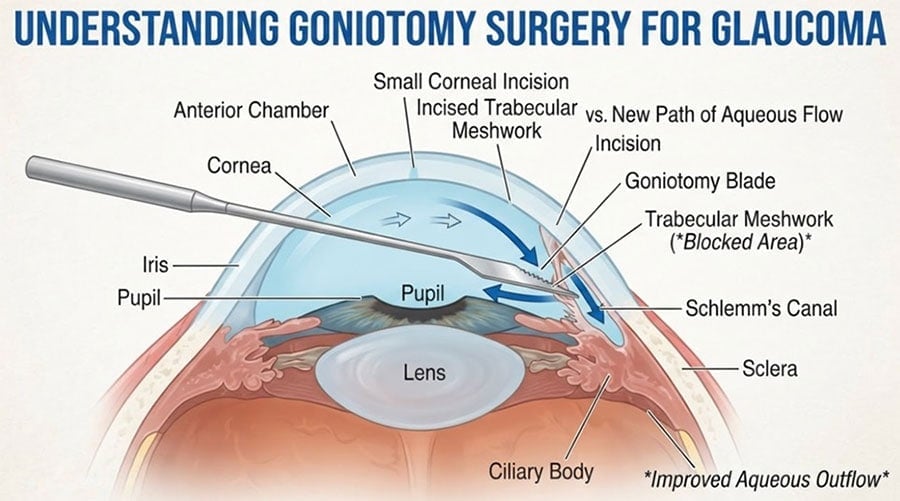
One small structure explains the whole procedure: the trabecular meshwork. This spongy tissue sits at the drainage angle of your eye, where the cornea meets the iris. A clear fluid called aqueous humor flows through the anterior chamber, through the meshwork, and out of the eye. When the meshwork becomes clogged or stiff, fluid backs up, and pressure rises. Over time, that pressure damages the optic nerve, and the resulting damage is how glaucoma damages your vision.
Goniotomy goes straight after that bottleneck. Using a fine blade or cutting tool, your Assil Gaur Eye Institute (AGEI) surgeon will open the inner wall of your eye’s meshwork, so fluid can drain freely into the channels underneath. Pressure comes down, often for years. Nothing new gets built, and your natural anatomy stays intact.
Who is a candidate for goniotomy surgery?
Goniotomy needs an open drainage angle and drainage tissue that still works, which is why it suits open-angle glaucoma rather than angle-closure types. Strong candidates usually have an IOP above target levels despite taking the maximum dosage of medication they can tolerate. It can also help patients who struggle with the side effects or the daily routine of several glaucoma drops. Patients who also have cataracts clouding their vision are especially good candidates because both problems can be addressed in a single operation.
Advanced glaucoma, a very low target pressure, thyroid eye disease, or unusual drainage anatomy may call for something else, such as trabeculectomy, a XEN gel stent, a tube shunt, or a staged plan. What matters is a close look at your own eye by a surgeon who works across the full range of glaucoma treatment.
How do you check that someone is a candidate?
An exam called a gonioscopy confirms the angle is open, and the disease has not yet reached the point of needing stronger surgery.
Call now or book your appointment online.
Is goniotomy safe for adults?
Yes. In carefully chosen adults, goniotomy is considered safe, and it carries less risk than traditional bleb-forming surgery. The most common side effects are a little bleeding inside the eye (called hyphemia), a short-lived pressure spike right after surgery, and mild inflammation. These usually clear up within days to weeks. Serious problems such as infection or major vision loss are rare. Because goniotomy does not create an external drainage pocket, it avoids the infection and low-pressure risks associated with trabeculectomy and tube shunts.
Goniotomy devices our surgeons may use
Patients rarely hear about the device itself, but it matters. Different tools remove tissue in different ways. This changes how much of the drainage angle gets treated and whether the surgery can be combined with cataract surgery.
Traditional goniotomy with a fine surgical knife is still used, mostly in children. For adults with open-angle glaucoma, the newer tools have largely taken over. Here are the two your AGEI surgeon will choose from.
The Kahook Dual Blade
This is the most studied of these tools. Its two-blade design lifts a strip of the trabecular meshwork rather than just slicing it, which more completely clears the main source of drainage resistance. It is a single-use instrument that fits through a tiny corneal incision, so it pairs well with cataract surgery through the same opening.
The OMNI Surgical System
This tool works differently. It gently widens the eye’s main drainage canal and treats a wider arc of the angle in one pass. Some of our surgeons prefer it when they want to reach both the meshwork and the deeper drainage channels, similar to the GATT technique or a canaloplasty. It can also be combined with cataract surgery.
Our surgeons have trained more than 14,000 ophthalmologists worldwide. They will pick the device that best matches your anatomy, how much of the angle needs work, and whether a combined procedure is planned.
Goniotomy with cataract surgery: two conditions, one operation
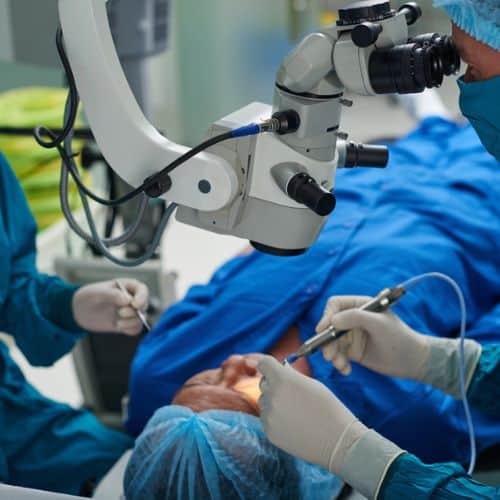
Many adults with open-angle glaucoma are in their 60s and 70s, the same years cataracts tend to cloud vision. When both conditions are present, performing goniotomy and cataract surgery in a single session offers clear advantages over treating them separately. This combined procedure, which utilizes phacoemulsification to remove the cataract, is called a Phacogoniotomy.
Cataract surgery on its own lowers eye pressure a little, usually by two to four mmHg (a unit called millimeters of mercury). Adding goniotomy to the same session pushes that drop much further. A 2024 study indexed in PubMed found that the combined procedure lowers pressure more than either surgery alone, with safety on par with cataract surgery alone.
Besides safety, combining the procedures makes a lot of practical sense:
- You go through one round of anesthesia.
- You only have one recovery.
- Your follow-up visits are halved.
- The cataract incision gives the goniotomy tool direct access, so no extra opening is needed.
- And because the cataract comes out first, our surgeon has a clear view of the drainage angle for the goniotomy step.
At Assil Gaur Eye Institute, patients with both glaucoma and cataracts are evaluated for Phacogoniotomy as part of a coordinated plan. Our premium cataract surgery program includes advanced preoperative imaging. It also includes premium intraocular lens (IOL) options that can sharpen your focus, so a single procedure may lower your pressure, remove the cataract, and reduce your need for glasses. If you want the newest lens technology alongside your glaucoma procedure, we also offer advanced IOL options for combined cataract and glaucoma procedures.
An Assil Gaur Eye Institute Patient Case Study
One of our patients, a retired engineer in his late 60s, had used three separate drops for four years and still had borderline pressure. A cataract was blurring his reading and driving, too. Instead of two surgeries months apart, his care team planned a Phacogoniotomy: cataract removal with a premium lens, then Kahook Dual Blade goniotomy through the same incision. Six months later his pressure had fallen from a medicated average of 19 mmHg to 14 mmHg with no drops at all. His distance vision was sharper than it had been in years.
Goniotomy vs. trabeculectomy and tube shunts
The Cleveland Clinic describes goniotomy as a way to improve fluid flow through the eye’s existing drainage system. That is the key difference from the outside routes trabeculectomy and tube shunts create
So, why is the inside route better for your eyes?
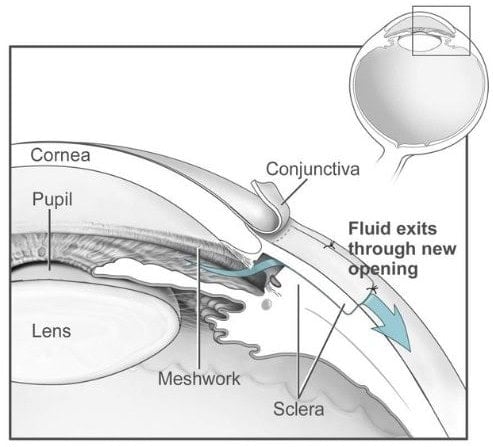
Trabeculectomy has been the standard glaucoma surgery for decades. It creates a new drainage route by removing a small piece of the eyewall, allowing fluid to collect in a pocket beneath the surface. It lowers pressure further than goniotomy, often into the low teens, but it carries more risk: pocket infection, pressure that falls too low, and a longer, harder recovery. It also makes later cataract surgery trickier.
Tube shunts, such as the Ahmed or Baerveldt implants, send fluid through a small silicone tube to a plate stitched to the eye wall. Our surgeons usually save them for patients who have already tried trabeculectomy or who cannot have it. They lower pressure a great deal, but they bring real surgical risk and a long recovery.
Goniotomy sits in a different spot. It is gentler than both, gives a smaller but still meaningful pressure drop, and saves tissue you may need later. For mild to moderate glaucoma that has not reached the point of needing trabeculectomy, goniotomy offers a good trade between benefit and risk, especially when you pair it with cataract surgery.
What to expect: procedure, recovery, and results
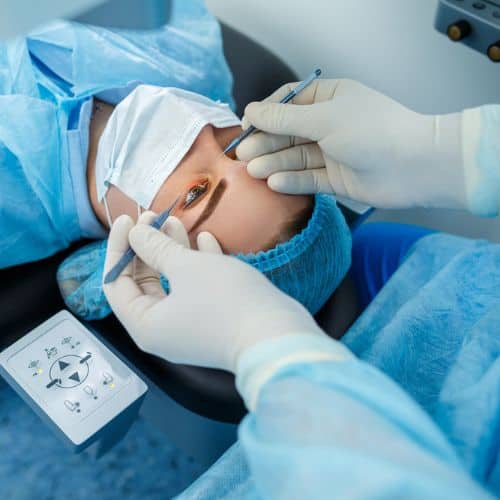
Goniotomy, alone or as part of a Phacogoniotomy, is an outpatient procedure. You arrive at the surgical center and get numbing drops and, in some cases, local anesthesia. Most patients do not need general anesthesia.
A goniotomy on its own usually takes under 30 minutes, and the combined procedure with cataract surgery runs about 45 to 60 minutes.
During surgery, our surgeon places a special lens, known as a goniolens, on your eye to directly visualize the drainage angle. The surgical instrument then passes through a tiny corneal incision to open the trabecular meshwork. The incision seals itself and usually needs no stitches.
Goniotomy Surgery Recovery
For the first few days, expect mild redness, light sensitivity, and blurry vision, and you may wear a protective eye shield at night. A little bleeding inside the eye is common and usually clears on its own within 1 to 2 weeks. You will use antibiotic and anti-inflammatory drops for several weeks. Most patients return to normal activities within a week, though hard exercise and swimming are usually off-limits for two to four weeks. Compared with a trabeculectomy, recovery is much faster.
Goniotomy Surgery Results
Pressure often starts dropping in the first week. In some patients, goniotomy lowers eye pressure by 20% to 35% and cuts the number of glaucoma medications needed. Other patients end up with good control and no drops at all.
Results after a Phacogoniotomy tend to land at the higher end of that range, because removing the cataract adds to the effect.
World-class glaucoma care in Los Angeles

There is a real difference between a general ophthalmologist who does an occasional goniotomy and a glaucoma specialist who does them regularly. Surgical volume, comfort with the instruments, and the ability to adjust mid-procedure when anatomy surprises you all improve with focused experience. During a surgery in which the surgeon views a narrow drainage angle through a lens while guiding a precision blade, that experience counts.
At Assil Gaur Eye Institute (AGEI), glaucoma care is led by Dr. Avneet K. Sodhi Gaur. Gaur’s focus spans the full range of glaucoma treatments, from medications and laser therapy to advanced surgery, including MIGS. Because our glaucoma and cataract surgeons work on the same team, you get the coordinated planning that Phacogoniotomy depends on. As patient Gary W. put it: “Great doctors. World class.”
Ready to find out if goniotomy is right for you?
If you are managing glaucoma in the Los Angeles area, the next step is a full evaluation. Glaucoma specialist Dr. Avneet Gaur can examine your drainage angle, review your pressure history, and walk you through whether goniotomy or Phacogoniotomy fits your situation. Explore world-class glaucoma care at Assil Gaur Eye Institute to learn more and request your consultation online.
Call now or book your appointment online.
-
Two-Year Outcomes of Goniotomy After Failed Surgery for Glaucoma: A Multicenter Study – ScienceDirect
https://doi.org/10.1016/j.xops.2025.100922 -
Goniotomy and Phacogoniotomy in glaucoma surgery – ScienceDirect
https://doi.org/10.1016/j.apjo.2026.100296 -
The Pathophysiology and Treatment of Glaucoma: A Review | Glaucoma | JAMA | JAMA Network
https://jamanetwork.com/journals/jama/fullarticle/1869215 -
The role of steroids in outflow resistance
https://pubmed.ncbi.nlm.nih.gov/18977348/ -
siRNA targeting Schlemm’s canal endothelial tight junctions enhances outflow facility and reduces IOP in a steroid-induced OHT rodent model
https://pubmed.ncbi.nlm.nih.gov/33376757/ -
Glucocorticoid target cells in human outflow pathway: autopsy and surgical specimens
https://pubmed.ncbi.nlm.nih.gov/6654642/

Written by The AGEI Educational Team

Medically Reviewed by Dr. Avneet Sodhi Gaur