LASIK in Beverly Hills with Nationally Recognized Expert Surgeons
When LeBron James needed LASIK, he didn’t search for the nearest provider. He went to Beverly Hills, to the surgeon trusted by elite athletes who cannot afford anything less than perfect vision.
That choice wasn’t random. It reflected something that comparison-stage patients rarely hear discussed openly: not all LASIK is the same, and the gap between standard laser eye surgery and a world-class procedure can be the difference between good vision and extraordinary vision.
If you’re tired of contacts and glasses but want to be certain you’re choosing the safest, most advanced LASIK available in Beverly Hills, this article gives you a clear breakdown of procedure types, the surgeon credentials that actually matter, and the exact questions to ask at your complimentary evaluation.
You’ll learn what separates Eagle Vision LASIK® from commodity procedures, why elite athletes and performers specifically seek out Beverly Hills ophthalmologists Dr. Kerry Assil and Dr. Avneet Sodhi Gaur, and what a genuinely thorough pre-surgical evaluation looks like at a practice that has performed over 100,000 laser vision correction surgeries.
If you’re ready to explore your options now, you can learn more about Eagle Vision LASIK at AGEI and book a complimentary evaluation.

Not all LASIK procedures or experiences are created equal
Most patients researching LASIK in Beverly Hills encounter the same surface-level information: a laser reshapes your cornea, recovery takes a few days, and you may no longer need glasses.
What that framing omits is the enormous variation in surgical precision, pre-operative diagnostics, technology, and surgeon experience that separates one LASIK eye surgery outcome from another.
Standard LASIK, as performed at some high-volume discount centers, can involve a microkeratome blade to create the corneal flap, a single-pass excimer laser treatment, and a brief post-operative check.
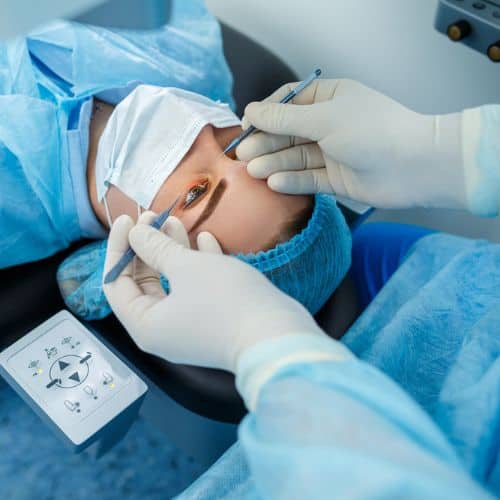
Bladeless LASIK, often referred to as all-laser LASIK, replaces the blade with a femtosecond laser for flap creation, improving precision. SMILE (Small Incision Lenticule Extraction) removes a small lens-shaped piece of corneal tissue without creating a traditional flap, making it suitable for certain patients with thinner corneas. PRK and LASEK are surface-based alternatives that skip flap creation entirely, with a longer recovery but no flap-related risk. Each of these represents a different tier of technology and technique.
But technology alone doesn’t define the tier. The surgeon’s volume, the depth of pre-surgical screening, and the protocol built around the procedure are equally decisive. According to the FDA’s LASIK guidance, patient selection and pre-operative evaluation are among the most critical factors in achieving safe, successful outcomes.
Choosing a LASIK surgeon is about more than cost
The single most common mistake patients make when evaluating LASIK in Beverly Hills is treating it as a commodity purchase. When the decision is driven primarily by price, the implicit assumption is that all LASIK procedures are equivalent. They are not.
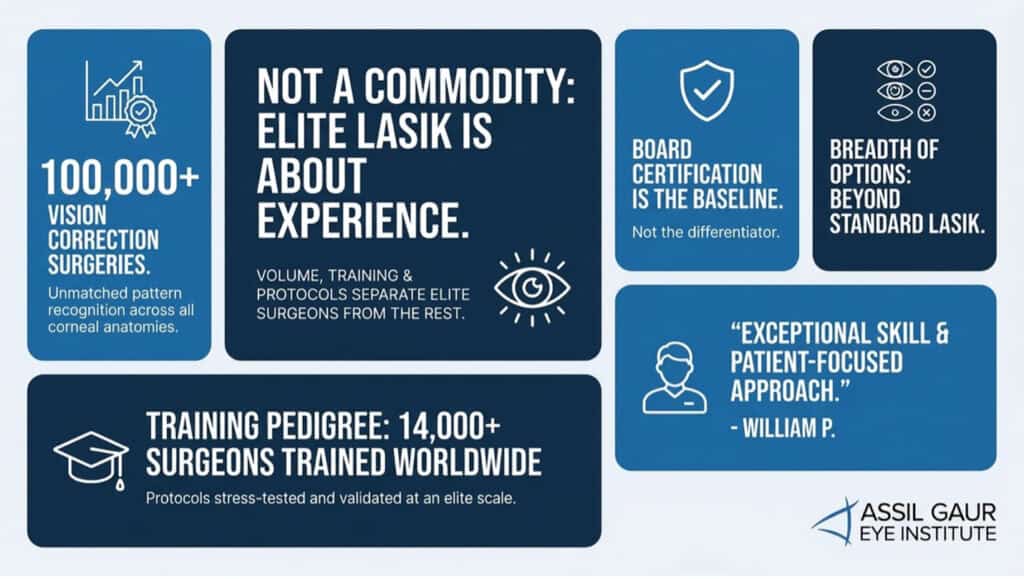
Being a board-certified ophthalmologist is the baseline, not the differentiator. What separates elite surgeons is procedure volume, subspecialty training, and the breadth of refractive options they can offer when standard LASIK isn’t the right fit.
A surgeon who has performed 1,000 procedures operates with a fundamentally different level of pattern recognition than one who has performed 50,000. The more experienced surgeon has encountered and managed the full spectrum of corneal anatomy, healing responses, and edge cases.
At Assil Gaur Eye Institute, that expertise starts at the very top. Dr. Kerry Assil has personally performed over 70,000 eye surgeries and has himself trained more than 14,000 surgeons worldwide. That training pedigree matters because it means the protocols used at AGEI have been stress-tested, refined, and validated at a scale that most practices never approach.
That pedigree doesn’t stop with Dr. Assil; it is carried by the surgeons he has trained. Dr. Avneet K. Sodhi Gaur, who performs LASIK at AGEI’s Beverly Hills location, was trained directly by Dr. Assil in the Eagle Vision LASIK technique, making her one of the only surgeons taught the procedure by the surgeon who developed it.
Board-certified and fellowship-trained at Tufts Medical Center and the New England Eye Center, and named a top Los Angeles ophthalmologist by Los Angeles Magazine, Dr. Gaur has performed thousands of LASIK, cataract, and refractive surgeries. For patients, that connection is the point: the surgeon operating on your eyes doesn’t simply apply Dr. Assil’s protocols; she learned them from him directly.
As patient William P. put it: “I have repeatedly recommended Dr. Assil for his exceptional skill and patient-focused approach. I wouldn’t trust my vision to anyone else for a procedure.” Or as patient Leslie W. wrote, “Dr Guar is amazing. So detailed in her explanation and very careful with the procedure.”
Why athletes and performers trust Beverly Hills LASIK for mission-critical vision
LASIK is safe for athletes and people with active lifestyles. But for elite athletes, the safety bar is actually higher than for the general population. A professional basketball player, for example, needs not just corrected vision but optimized visual acuity under high-speed, high-contrast conditions. Any compromise in contrast sensitivity, night vision, or depth perception is professionally unacceptable. The same goes for boxers and martial artists. This is precisely why LeBron James chose AGEI’s Eagle Vision LASIK: the procedure is engineered for outcomes that exceed the 20/20 standard, not merely meet it.
Dwyane Wade also trusted AGEI with both LASIK and conjunctival nevus removal, a procedure that addresses eye freckles that can affect visual comfort and aesthetics. For performers and athletes whose careers depend on visual precision and personal presentation, the choice of surgeon is not a lifestyle decision. It is a professional one. You can read more about eye freckle removal at AGEI if that’s a concern alongside your vision correction.
Academy Award-winning actress Marlee Matlin underwent vision-saving surgery at AGEI, restoring her sight and allowing her to continue performing on stage and screen.
These are not marketing anecdotes. They are documented outcomes from patients whose livelihoods depend on their eyes functioning at the highest possible level.
What savvy patients look for in a Beverly Hills LASIK surgeon
Patients who have done their research arrive at consultations with a specific set of criteria. They want to know the surgeon’s personal procedure volume, not the practice’s aggregate number. They want to understand what happens if they are not a standard LASIK candidate. And they want to know whether the practice has the diagnostic depth to catch problems before they become surgical complications.
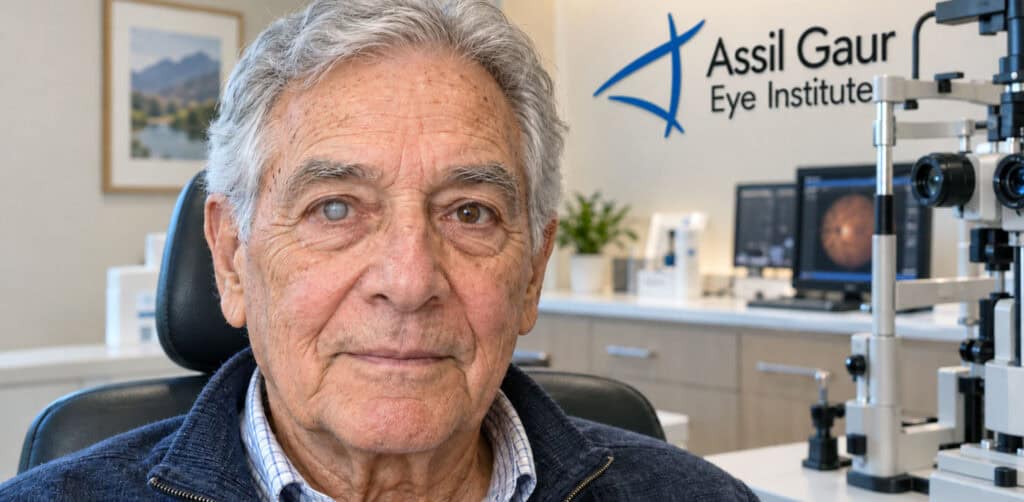
That last point is not hypothetical. Dr. Klaus Ito is an optometrist who wore hard contact lenses and sought Eagle Vision LASIK at AGEI. He had a previously undetected retinal tear discovered during his pre-surgical consultation with Dr. Gaur. The tear was repaired before his LASIK procedure. He went on to achieve 20/10 vision in each eye, better than 20/20, with no dry eye issues post-surgery.
That outcome was only possible because the pre-operative evaluation was thorough enough to find what a previous eye exam had missed.
Patient Steven L. had a similar experience: ” Dr. Pilyugina, also known as Dr. P, detected a retinal issue before having cataract surgery, which was a vision saver. I am so very appreciative of her and everyone at Assil Gaur.”
These stories illustrate a principle that elite patients understand intuitively: the value of a world-class practice isn’t just in the surgery itself. It’s also in everything that happens before the laser fires.
Eagle Vision LASIK vs. standard LASIK: what makes the difference?
Eagle Vision LASIK is a proprietary procedure exclusive to Assil Gaur Eye Institute. It is not a brand name applied to a standard LASIK protocol. It represents a specific combination of advanced diagnostic mapping, customized treatment planning, and surgical execution developed and refined through over 100,000 procedures at AGEI.
Where standard LASIK uses population-average treatment parameters, Eagle Vision LASIK uses wavefront-guided, patient-specific corneal mapping to design a treatment profile unique to each eye. The goal is not 20/20 vision. The goal is the best possible vision that the patient’s anatomy can support, which in many cases exceeds 20/20. Dr. Klaus Ito’s 20/10 outcome in both eyes is a documented example of what that precision delivers.
The procedure is also performed within a surgical environment designed for elite outcomes: twin dedicated LASIK suites at AGEI’s Beverly Hills location, a team trained to the same standards used to train surgeons globally, and a post-operative protocol that monitors healing with the same rigor applied pre-operatively.
Peer-reviewed research indexed at the National Institutes of Health supports the advantages of customized wavefront-guided LASIK over conventional, non-customized treatments in reducing higher-order aberrations and preserving contrast sensitivity; benefits that matter most to patients with demanding visual requirements.
LeBron James said it simply: “I wasn’t nervous at all. I knew I was going to the very best.” That confidence is earned, not marketed.
How do I know if I am a good candidate for LASIK in Beverly Hills?
LASIK candidacy depends on corneal thickness, corneal curvature, pupil size, the degree of astigmatism, the severity of myopia, hyperopia, or other refractive errors, and the absence of conditions like keratoconus or significant dry eye disease. A surface-level screening can confirm the basics. A world-class evaluation goes further.
At AGEI, the complimentary LASIK evaluation includes high-resolution corneal topography, wavefront Aberrometry, and a full assessment of tear film quality. Dry eye is evaluated specifically because it is both a contraindication to LASIK and a condition that can be worsened by surgery if not identified and managed beforehand. The practice offers dedicated dry eye treatment and screening for conditions like glaucoma for patients who need to address these concerns before proceeding.
Patients who are not LASIK candidates are not simply turned away. AGEI offers premium intraocular lens options, including the enVista Envy Trifocal IOL and EVO ICL (an implantable contact lens) for patients outside the LASIK prescription range. PRK and LASEK can be good options for patients with thinner corneas, and Refractive Lens Exchange for patients approaching presbyopia or extreme farsightedness and most other reasons. The Assil Gaur Eye Institute evaluation is designed to find the right procedure for each patient, not to confirm a predetermined recommendation.
What should I expect during a LASIK consultation in Beverly Hills?
Expect the consultation to take 60 to 90 minutes at a thorough practice. Your pupils will be dilated for a full retinal examination. Multiple scans of your corneal surface will be taken and compared. You will have a direct conversation with the surgeon, not just a technician, about your visual goals, lifestyle demands, and any concerns. Patient Hariyanto J. noted that “Dr. Kerry Assil patiently answers patients’ questions with clear, descriptive, and convincing explanations,” which reflects the standard of engagement patients should expect at this level of care.
Why Beverly Hills patients choose Assil Gaur Eye Institute
Beverly Hills attracts some of the most demanding patients in the world, and those patients have options. What draws them to AGEI specifically is a combination no single competitor replicates: a proprietary procedure with a documented roster of celebrity and athlete patients, a surgical team with global training credentials, a full-spectrum practice covering everything from LASIK to retinal surgery, and a setting designed to feel as far from a clinical transaction as possible.
None of that is positioning language. The AAO’s Refractive Surgery Preferred Practice Pattern places ultimate responsibility for the preoperative evaluation and postoperative care on the operating ophthalmologist and identifies thorough pre-surgical screening as central to safe outcomes. That diagnostic depth and post-operative follow-through is exactly what AGEI is built around.
And that high standard has a source. AGEI was chartered in 1949 by Dr. Robert M. Sinskey, the father of modern cataract surgery, who personally chose Dr. Kerry Assil to carry forward his surgical innovations and his commitment to exceptional patient care. For more than seven decades, that lineage still runs through everything that AGEI does. It is why Assil Gaur Eye Institute is now regarded as one of the top LASIK centers in the United States.
Closer to the other side of town? See our Santa Moncia LASIK page.
Why patients travel to Beverly Hills for LASIK
Patients fly to Beverly Hills from across the United States and internationally for LASIK at AGEI. The reason is not geography. It is access to a level of surgical expertise and a proprietary procedure that does not exist elsewhere. Eagle Vision LASIK cannot be performed at another practice because it is exclusive to AGEI. For patients who have already had a standard LASIK consultation elsewhere and want to understand what a higher tier of care looks like, the complimentary evaluation at AGEI provides a direct comparison point.
The Los Angeles market has no shortage of qualified ophthalmologists. What it has in AGEI is a practice that operates at a different standard entirely: one where the surgical team has trained the trainers, where the pre-operative protocol catches what others miss, and where the outcome target is not adequate vision but the best vision that patients’ eyes can achieve.
The difference isn’t what you pay. It’s what you receive.
The conversation about premium LASIK in Beverly Hills often gets reduced to cost. That framing misses the most important point entirely. The meaningful question is not what you pay, as AGEI’s fees are in line with those of other top ophthalmology practices in the country. It is all about what you receive for that investment, and whether the practice you choose has the depth of expertise, the diagnostic rigor, and the surgical precision to deliver the most exceptional outcome, one you will live with for decades.
If you’re ready to find out whether Eagle Vision LASIK is right for you, book your complimentary Eagle Vision LASIK evaluation at Assil Gaur Eye Institute and take the first step toward the clearest vision of your life.
LASIK Beverly Hills FAQs
What is the difference between LASIK, PRK, and SMILE laser eye surgery?
LASIK creates a thin corneal flap using either a blade or femtosecond laser, then reshapes the underlying corneal tissue with an excimer laser before the flap is repositioned. Recovery is typically rapid, with most patients achieving functional vision within 24 to 48 hours.
PRK removes the corneal surface epithelium entirely before laser reshaping, with no flap created. PRK recovery is longer, generally one to two weeks before comfortable functional vision is restored, with full stabilization taking three to six months. SMILE is a flapless procedure that extracts a small disc of corneal tissue through a minimal incision, making it an option for patients with thinner corneas or higher prescriptions of nearsightedness. Each procedure has specific candidacy criteria, which is why a thorough pre-operative evaluation is essential before any recommendation is made.
How long does LASIK recovery take?
Most patients achieve functional vision within 24 to 48 hours of LASIK surgery, with the majority returning to work and normal activities within two to three days. Full stabilization of vision typically occurs over 3 to 6 months as the cornea completes its healing process.
PRK recovery is longer, generally one to two weeks before comfortable functional vision is restored, with full stabilization taking up to three months. AGEI’s proprietary EPIC PRK® is engineered to narrow that gap. Developed by Dr. Kerry Assil, it is an all-laser procedure that uses no chemicals or mechanical abrasion: the laser alone removes the epithelium and sculpts the cornea, so the surface resurfaces faster and with far less irritation than standard PRK or LASEK. From there, post-operative monitoring is built into the protocol rather than treated as optional, ensuring that any healing variations are identified and managed early rather than discovered at a routine follow-up.
Who is the best LASIK surgeon in Beverly Hills?
The answer depends on what criteria you apply. Procedure volume, surgical training pedigree, the breadth of refractive options offered, and the depth of pre-operative diagnostics are all meaningful indicators.
Dr. Kerry Assil at Assil Gaur Eye Institute has personally performed over 70,000 eye surgeries, including laser cataract surgery, trained more than 14,000 surgeons worldwide, and developed the proprietary Eagle Vision LASIK procedure trusted by elite athletes including LeBron James and Dwyane Wade.
He is joined by surgeons he has trained directly, including Dr. Avneet K. Sodhi Gaur, a board-certified, fellowship-trained refractive and cataract surgeon who performs Eagle Vision LASIK at the Beverly Hills location. Board certification as an ophthalmologist is the minimum standard; the differentiator is the combination of volume, innovation, and documented outcomes that a practice like AGEI brings to every procedure and patient.