Intraocular Lens (IOLs) Refractive Lens Exchange (RLE)

How Implantable Collamer Lenses (ICL) from Dr. Gaur Helped Stephanie See Clearly Again
Stephanie had needed glasses since she was five years old. And unfortunately, she didn’t start out with a mild prescription that gradually worsened; her vision concerns were severe right from the start. By adulthood, she was at -15 diopters — a unit of measurement that quantifies the refractive, or focusing power, of a lens, where 0 is ideal (20/20 vision).
Stephanie certainly met the criteria for severe nearsightedness (myopia) as defined by ophthalmologists. She says, “Without glasses or contact lenses, I couldn’t make out a handheld in front of my face or read the largest E on the eye chart.” She explored the various techniques available for vision correction, but most were out of reach as they were considered unsuitable for someone with such a high prescription.
So, as she got older, she learned to live with the fact that she would likely always need to wear glasses or occasionally contact lenses.
Why a -15 diopter prescription puts LASIK out of reach
When Stephanie arrived at Assil Gaur Eye Institute (AGEI) for an appointment with Dr. Avneet Gaur to discuss her options, she already knew that LASIK was off the table. The procedure uses a laser to reshape the cornea by removing corneal tissue to correct how the eye bends light. For patients with mild to moderate refractive errors, it’s a proven, highly effective procedure.
But the math only works up to a point. The higher the prescription, the more tissue must be removed. And for patients with severe nearsightedness or thin corneas to begin with, LASIK is not an option because there isn’t enough corneal tissue to safely remove.
The lasers and technique matter enormously, but no amount of technology or surgical skill can change the underlying biology of the eye. Photorefractive keratectomy (PRK), another form of laser vision correction, runs into the same issue. And at -15 diopters, Stephanie wasn’t just borderline; she was well beyond what any corneal surgery could safely address.
Fortunately, as Stephanie was to discover, all hope was not lost. What she needed was a procedure that didn’t touch the cornea at all, and she was cautiously optimistic that something could be done to help.
“I knew that AGEI had a reputation for being at the forefront of modern techniques and new technology,” Stephanie said. “I already knew that I wasn’t a LASIK candidate, but I was confident there was something else Dr. Gaur could do,” she continues.
What Dr. Gaur offered that others hadn’t
Stephanie wasn’t only familiar with the Assil Gaur Eye Institute’s reputation for being on the cutting edge of treatments, but also specifically Dr. Gaur’s reputation. “People praised her bedside manner and accessibility,” Stephanie says. “I heard lots of wonderful things about her.”
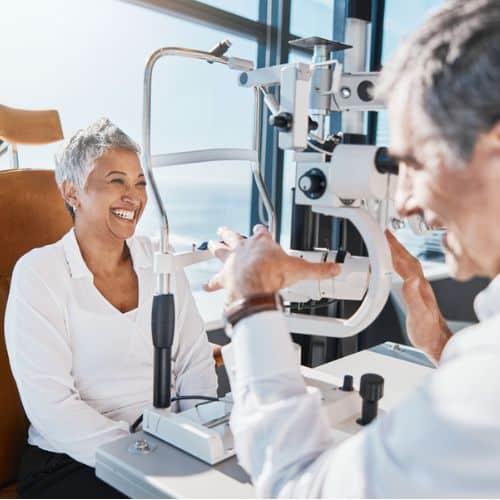
So, when she attended the clinic, Stephanie was hopeful. “At the appointment, Dr. Gaur walked me through the EVO Visian ICL procedure,” Stephanie says.
Also called an implantable collamer lens (ICL), this procedure works differently from LASIK or other laser vision correction methods. Instead of reshaping the front of the eye, a thin, safe lens is gently placed inside the eye through a small incision. It sits in front of the eye’s natural lens but behind the colored part of the eye (the iris), keeping the eye’s existing structures intact. This is how it can safely correct many prescriptions that are too high for laser surgery, such as strong nearsightedness or astigmatism. Learn more about how the ICL procedure works and who it’s right for.
“Dr. Gaur explained how the ICL procedure was different than LASIK, and why this would be a great option for me,” Stephanie notes. “She went through all of the benefits and positive outcomes as well as the potential downsides.”
The EVO ICL is FDA-approved, leaves the cornea untouched, and, unlike laser vision correction, the lens is removable if vision needs change in the future, such as when cataract surgery on the natural lens becomes necessary later in life. It also provides built-in UV protection and has a strong track record on night vision and halos.
“By the end of our conversation, I felt really confident moving forward with the ICL procedure,” Stephanie admits.
What surprised Stephanie about the EVO ICL procedure
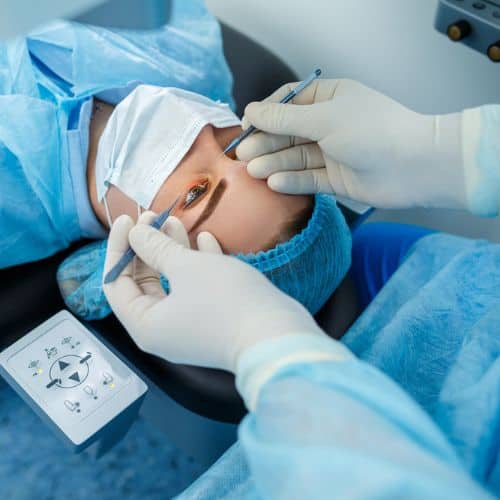
Stephanie’s EVO ICL surgery performed by Dr. Gaur was an outpatient procedure and “straightforward and relatively quick,” Stephanie says. The lens implantation itself took no more than 15 minutes, involving a small incision and precise placement of the implant.
Stephanie was surprised by how smoothly everything went. “The process was really easy,” she says. “The team at Assil Gaur Eye Institute was great at checking in with me afterward and really responsive whenever I had a question, and the facility was wonderful — it was everything I could have hoped for.”
Then came the moment Stephanie had longed for but had given up hope on. The morning after surgery, she woke up, opened her eyes, and could see clearly for the first time in decades. She didn’t need to reach for her glasses or insert contact lenses — her eyesight was just fine.
And the ICL procedure doesn’t require general anesthesia or a hospital stay, allowing patients to quickly return to their normal routine. “Recovery was quick and painless. I had no dry eye or other symptoms,” Stephanie says. “I think I was back at work the next day.”
One thing that wasn’t normal for Stephanie, though, was her vision without glasses. “Post-op, I tested at 15/20. Better than 20/20 vision!” she says with clear delight. The person who once couldn’t read the big E on the chart had come out the other side with sharper vision than most people with perfect natural eyesight.
Stephanie is really pleased with the results that have persisted
More than a year after her EVO ICL surgery, Stephanie’s results have endured: no glasses for distance, no contact lenses, no compromises.
“I’m still seeing really well, so no complaints,” she says simply. “I’m really pleased with the outcome.”
For anyone who has spent decades believing their prescription was simply too strong for vision correction to be an option, Stephanie’s story is worth noting. The right eye surgeon, the right technology, and the right match between patient and procedure can lead to new possibilities — even for a prescription unsuitable for most standard options.
Why choose Assil Gaur Eye Institute for EVO ICL surgery and vision correction?
At Assil Gaur Eye Institute, board-certified ophthalmologists and refractive surgery specialists like Dr. Avneet Gaur combine clinical precision with deeply personalized care, helping patients achieve clear vision even when other procedures aren’t an option. Whether you’re exploring the EVO Visian ICL, evaluating your LASIK candidacy, or starting with a comprehensive eye exam to understand and explore your options, exceptional vision care is available at AGEI.
Request Your Consultation
Call now or book your appointment online.
AGEI serves patients throughout Southern California, including Beverly Hills, Santa Monica, West Los Angeles, and surrounding communities.
Frequently Asked Questions About the EVO ICL Procedure
Can the EVO ICL correct prescriptions that are too strong for LASIK?
Yes, and that’s one of its key advantages. The EVO Visian ICL is designed for patients with moderate to severe myopia, including prescriptions well outside the safe range for corneal-based procedures like LASIK or PRK.
Because EVO ICL surgery doesn’t remove corneal tissue, it’s a strong option for patients with high diopter counts who have been told that laser vision correction simply isn’t right for them.
What is the recovery time after EVO ICL surgery?
A quick recovery is common with EVO ICL surgery. Most patients notice dramatically improved vision within 24 hours and return to work and normal activities the next day. Post-op care usually involves prescription eye drops and follow-up appointments to monitor intraocular pressure (eye pressure) and confirm the implant has settled correctly. The procedure has a low risk of complications, and serious side effects are rare.
Is the EVO ICL permanent?
The biocompatible lens is designed to remain in place long-term, but it is removable, which sets it apart from procedures that permanently alter corneal tissue. If your prescription changes significantly, or if cataract surgery on the natural lens becomes necessary down the road, the ICL lenses can be removed or exchanged.
This flexibility is one reason many eye doctors consider it among the most versatile vision correction procedures available.
Does the EVO ICL affect night vision or cause halos?
Some patients experience mild halos or glare in the early weeks after lens implantation as their eyes adjust, but this typically resolves. The EVO ICL’s design allows natural fluid flow within the eye, helping to maintain healthy intraocular pressure, and was specifically developed to minimize the visual disturbances associated with older intraocular lens designs.
Sources
-
Evaluating the Rate and Causes of Non-candidacy After Laser-Assisted in Situ Keratomileusis (LASIK) Screening
https://pubmed.ncbi.nlm.nih.gov/40704251/ -
Upgrade your vision and change your life with EVO ICL
https://us.discovericl.com/ -
A Comprehensive Retrospective Analysis of EVO/EVO+ Implantable Collamer Lens: Evaluating Refractive Outcomes in the Largest Single Center Study of ICL Patients in the United States
https://pmc.ncbi.nlm.nih.gov/articles/PMC10787571/
More Stories You might be interested in


Cataract Surgery Intraocular Lens (IOLs)
Sylvia, 75, Goes Glasses-Free for First Time in a Decade After Premium Cataract Surgery with Dr. Assil

Cataract Surgery Intraocular Lens (IOLs)
Light Sensitivity Made Steve’s Life Unbearable—Until Dr. Assil’s State-of-the-Art IOL Surgery

Intraocular Lens (IOLs) Nearsightedness